
Back
The Future of Ecommerce Outsourcing: Strategic Trends and Predictions for 2026 and Beyond

By Ralf Ellspermann / 9 February 2026

The 30-Second Executive Briefing
- The State of Play: In 2026, the era of “Transactional Outsourcing” is over. Cost-arbitrage alone is no longer a competitive advantage; the new battlefield is Intelligence Arbitrage.
- The Core Shift: Outsourcing has evolved from a back-office utility into a Strategic Growth Engine. Brands are no longer hiring “agents”; they are integrating “AI Pilots” who manage autonomous workflows.
- The Prediction: By 2028, the “Digital Twin” of every major e-commerce brand will be managed by a global command center in the Philippines, blending Agentic AI with high-EQ human oversight to achieve 99.9% operational accuracy.
Executive Summary: The Rise of BPO 2.0
The next three years will witness the most radical transformation in retail history. Ecommerce outsourcing through forward-thinking partners is transitioning from a reactive support model to a proactive “Value Orchestration” framework. As we look toward 2027 and 2028, the successful brands will be those that view their Philippine teams not as an external vendor, but as the “Engine Room” of their global expansion, capable of navigating a world of 51% higher supply chain volatility and AI-driven consumer behavior.
Trend #1: From Chatbots to “Agentic” Orchestration
The most significant shift in 2026 is the transition from Robotic Process Automation (RPA) to Agentic AI.
- The 2026 Reality: AI agents no longer just “suggest” replies; they execute multi-step business logic. They re-route stalled containers, negotiate B2B wholesale quotes within guardrails, and autonomously resolve logistics exceptions.
- The Philippine Role: Manila has become the global hub for Human-in-the-Loop (HITL). Filipino specialists now act as “AI Supervisors,” auditing autonomous decisions to ensure they align with brand-specific ethics and localized market nuances.
Trend #2: The “Global Command Center” Model
Mid-market brands are now adopting the “Command Center” structure previously reserved for Fortune 500 giants.
- 24/7 Synchronization: Philippine teams are now managing the entire “Digital Twin” of a brand—inventory levels, ad-spend efficiency, and fraud signals—in real-time across 10+ global marketplaces.
- The Impact: This shift has moved the ROI focus from “Cost per Ticket” to “Lifetime Value (LTV) Velocity.” By centralizing all data-intensive tasks in Manila, brands can launch into new territories (like the EU or LATAM) in weeks, not years.
Trend #3: Predictive Commerce & Reverse Logistics
In 2027, “Returns” will no longer be seen as a loss, but as a Resale Recovery strategy.
- Predictive Triage: AI hubs in the Philippines will predict return risks before a purchase is even made, prompting a Manila-based specialist to reach out via video-chat to ensure the customer has the right size/fit.
- Smart Circularity: Outsourced teams will manage the entire circular economy for brands—overseeing refurbished sales, recycling programs, and secondary marketplace listings, effectively turning the “Reverse Logistics” department into a profit center.
The Expert Perspective: The Strategic Horizon
John Maczynski, CEO of PITON-Global. notes: “We are entering the age of ‘Outcome-Based Partnerships.’ By 2028, you won’t pay your BPO partner for ‘hours worked’; you’ll pay for ‘Orders Perfected’ or ‘Churn Reduced.’ The Philippines has spent the last 20 years mastering the front office; they are spending the next five years mastering the entire e-commerce ecosystem. As a former CEO of an ecommerce company, my advice is simple: stop looking for a ‘service provider’ and start looking for a ‘Growth Architect.’ The brands that win will be those that empower their Manila teams to take a seat at the strategic table.”
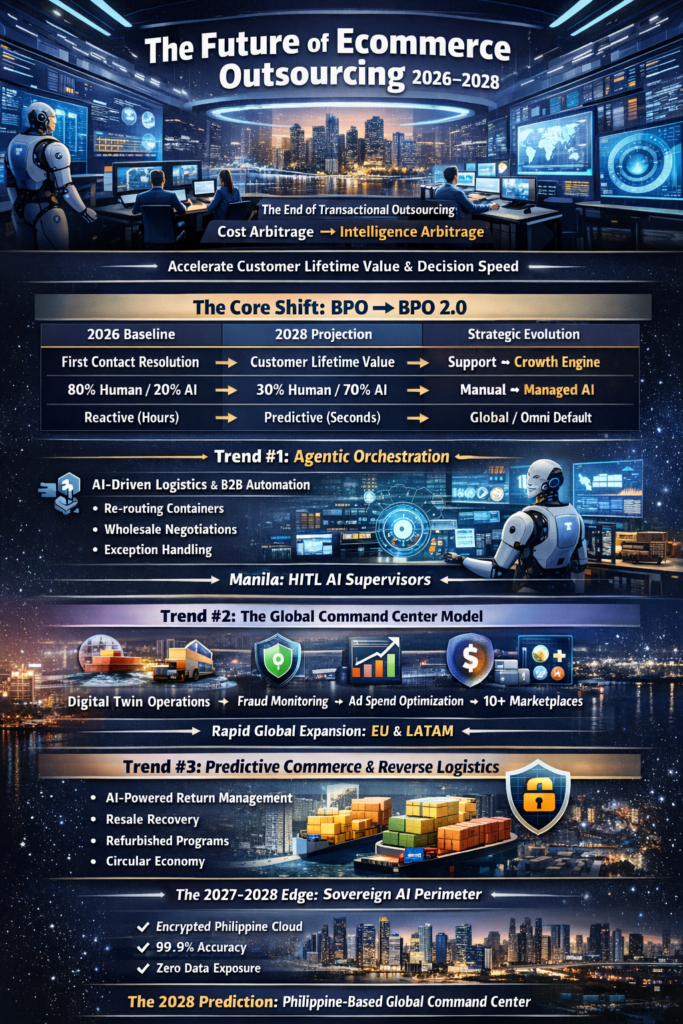
Benchmarking the Future: 2026 vs. 2028
Table 1: The Evolution of Ecommerce Outsourcing Metrics
| Metric | 2026 Baseline | 2028 Projection | Strategic Shift |
| Primary Metric | First Contact Resolution | Customer Lifetime Value | From Support to Growth |
| Labor Mix | 80% Human / 20% AI | 30% Human / 70% AI | From Manual to Managed |
| Market Access | Single-Market Focus | Global/OMNI-Default | From Local to Borderless |
| Decision Speed | Reactive (Hours) | Predictive (Seconds) | From Lagging to Leading |
The “Zero-Latency” Retailer
A unique insight for the next era: “The Sovereign Data Perimeter.” In 2027, as global data privacy laws tighten (EU AI Act, etc.), the most valuable BPO partners will be those offering “Sovereign AI” environments in the Philippines. This allows brands to leverage massive AI efficiency without their sensitive proprietary data ever leaving a secure, encrypted, and legally compliant Philippine-based cloud.
Final Expert FAQ: Looking Ahead
Q: Will AI replace the Philippine BPO industry?
No. It is augmenting it. The roles are shifting from “Data Entry” to “Data Strategy.” The demand for high-skill Filipino “AI Pilots” is actually outstripping the supply.
Q: What is the biggest risk in 2027?
“Capability Dilution.” As generalist BPOs scramble to add “AI” to their websites, the risk of hiring a partner with no real technical depth increases. Niche expertise is the only true safeguard.
Q: Should we still focus on the Philippines?
Yes. With its massive university-educated, English-proficient, and now “AI-Fluent” workforce, it remains the undisputed leader for e-commerce orchestration.
Achieve sustainable growth with world-class BPO solutions!
PITON-Global connects you with industry-leading outsourcing providers to enhance customer experience, lower costs, and drive business success.
Get Your Top 1% Vendor List
Author
Ralf Ellspermann is a multi-awarded outsourcing executive with 25+ years of call center and BPO leadership in the Philippines, helping 500+ high-growth and mid-market companies scale call center and customer experience operations across financial services, fintech, insurance, healthcare, technology, travel, utilities, and social media.
A globally recognized industry authority—and a contributor to The Times of India and CustomerThink —he advises organizations on building compliant, high-performance offshore contact center operations that deliver measurable cost savings and sustained competitive advantage.
Known for his execution-first approach, Ralf bridges strategy and operations to turn call center and business process outsourcing into a true growth engine. His work consistently drives faster market entry, lower risk, and long-term operational resilience for global brands.