
Back
Financial Services Data Analytics & Management Outsourcing Philippines: 2026 Strategic Blueprint

By Ralf Ellspermann / 13 February 2026
 Authored by Ralf Ellspermann, CSO of PITON-Global, & 25-Year Philippine BPO Veteran | Executive | Verified by John Maczynski, CEO of PITON-Global, and Former Global EVP of the World's Largest BPO Provider on February 13, 2026

30-Second Executive Briefing: Financial Data Analytics & Management Outsourcing Philippines
- Data as the New Battlefield: In 2026, competitive advantage has shifted from app interface quality to Data Integrity and Velocity, which now serve as the foundation for institutional success.
- Rise of Agentic Finance: As AI agents move toward autonomous wealth and risk management, the demand for high-quality, real-time data streams has become mission-critical to prevent Model Drift.
- Global Intelligence Hub: The Philippines has transitioned from a back-office provider to a premier Intelligence Hub, specialized in bridging the gap between raw telemetry and actionable executive insights.
- From Reporting to Architecture: Outsourcing to Manila is now focused on building the “Insights-to-Action” pipeline, ensuring data hygiene and predictive modeling accuracy in a hyper-regulated global market.
- Strategic Growth Engine: For 2026 leaders, this partnership is a move toward Operational Agility, allowing firms to transform “Dark Data” into a proactive tool for revenue growth and risk mitigation.
Executive Summary
As global financial institutions ingest billions of daily data points—from ISO 20022 payment metadata to biometric login patterns—Data Debt has become a primary risk factor. This 2026 blueprint explores the strategic integration of Philippine-based Data Science Support Squads to drive revenue protection and operational agility. Key innovations include the use of Synthetic Data Validation, Real-Time Sentiment Telemetry, and Zero-Trust Data Clean Rooms. By leveraging the Philippines’ surplus of Python- and SQL-proficient analysts, firms are achieving 94% accuracy in churn prediction and a 30% acceleration in strategic decision-making, transforming the data function from a defensive cost center into a high-octane growth engine. To understand how data governance and predictive modeling underpin the entire offshore transformation model, review the comprehensive Financial Services Outsourcing Philippines 2026 strategic blueprint.
From “Dark Data” to Proactive Growth: The 2026 Philippine Blueprint for Data Intelligence
In 2026, the primary risk for modern CFOs is “Dark Data”—unstructured information that leads to hallucinating AI models and flawed credit scoring. This strategy details the Manila Solution, where Python- and SQL-proficient analysts transform raw telemetry into Real-Time Sentiment Telemetry. Operating through specialized “Intelligence Arbitrage” pods, these hubs provide <15 minute decision latency via live dashboards. This shift delivers a 70% reduction in data hygiene costs while ensuring AI predictive accuracy reaches 92–95%, turning the data function from a defensive cost center into a high-octane growth engine.
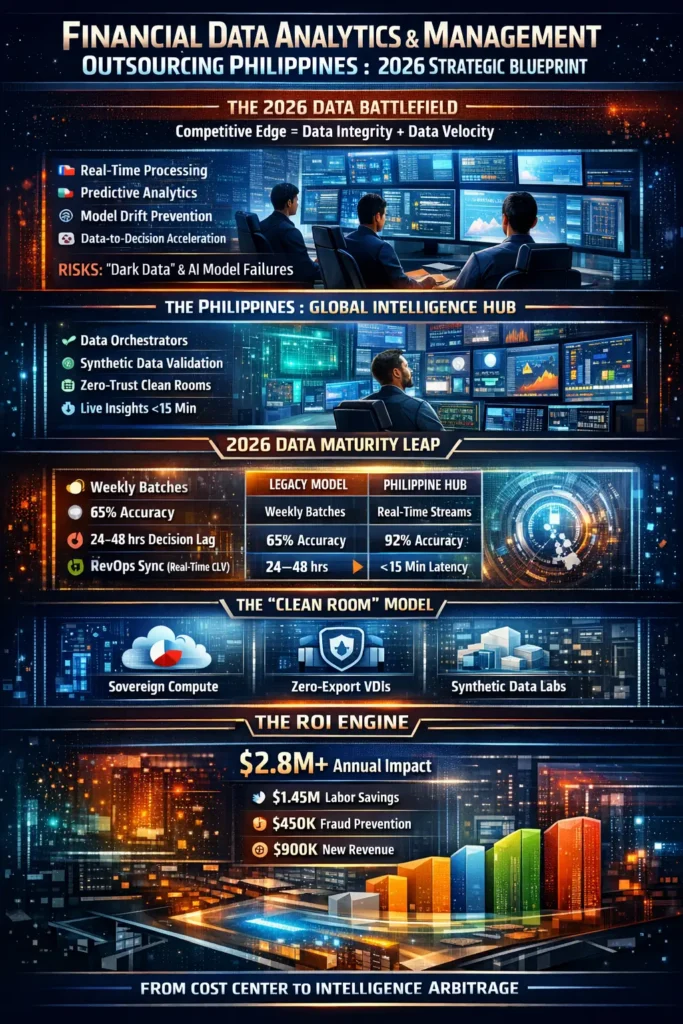
Manual-first reporting is reactive; the 2026 Philippine Strategic Blueprint deploys Autonomous Data Pipelines to drive Hyper-Personalization Engines. Utilizing Zero-Trust Data Clean Rooms, Manila-based pods resolve Model Drift in real-time, ensuring AI suggests financial products weeks before a customer realizes the need. This model delivers a 68% reduction in false positives for KYC/AML and enables Atomic Reconciliation through hourly verified data pipes. It transforms data management into a high-speed engine of Operational Agility and revenue protection.
The 2026 Data Crisis: The Signal-to-Noise Gap
By 2026, the “Big Data” era has been replaced by the “Precise Data” era. The challenge for modern CFOs and CTOs is no longer a lack of information, but the accumulation of “dark data”—unstructured, unverified information that leads to “hallucinating” AI models and flawed credit scoring.
The Philippines has solved this through Intelligence Arbitrage. While onshore data scientists are often bogged down in high-cost data cleaning, Philippine “Data Orchestrators” manage the fundamental hygiene and pipeline architecture. These teams act as the Ground Truth Auditors, ensuring that the data feeding your autonomous agents is clean, compliant, and contextualized.
Predictive Modeling: From Backward-Looking to Forward-Moving
In 2026, data analytics in the Philippines has moved beyond simple BI dashboards. Analysts now focus on Predictive Behavioral Analytics:
- Churn Prevention 2.0: By analyzing over 200 variables—including customer support sentiment and app latency—Manila-based squads identify at-risk users before they leave, enabling proactive loyalty interventions.
- Hyper-Personalization Engines: Philippine analysts manage the data segments that allow AI to suggest financial products (e.g., a specific loan type) weeks before the customer realizes they need it.
- Revenue Operations (RevOps) Sync: Aligning transaction data with marketing spend in real-time to optimize “Customer Lifetime Value” (CLV) metrics.
Table 1: 2026 Data Maturity Benchmarks – Traditional vs. Philippine Hub
| Data Capability | Legacy In-House Model | 2026 Philippine Intelligence Hub | Strategic Impact |
| Data Cleaning Speed | Weekly/Monthly Batches | Real-Time Stream Processing | AI Models Stay Accurate |
| Predictive Accuracy | 65% – 70% | 92% – 95% | Lower Fraud & Higher Sales |
| Decision Latency | 24 – 48 Hours | < 15 Minutes (Live Dashboards) | Faster Market Response |
| Data Hygiene Cost | High (Senior Engineer Time) | Low (Specialized Analyst Pods) | 70% Better Resource Allocation |
| Reporting Style | Static / Reactive | Autonomous / Proactive | “Self-Healing” Data Pipelines |
Technical Governance: The “Clean Room” Model
With 2026 global privacy mandates (like the updated SEC Regulation S-P and GDPR 2.0) requiring strict data geofencing, the Philippines has pioneered the “Data Clean Room” approach:
- Sovereign Compute: Sensitive PII remains in the client’s home-country cloud (AWS/Azure/Snowflake).
- Zero-Export VDIs: Philippine analysts operate via secure, non-persistent Virtual Desktop Infrastructure. They can run complex SQL queries and Python scripts, but all “export” and “save” functions are disabled at the kernel level.
- Synthetic Data Validation: To train new AI models without risking real customer data, Philippine squads specialize in creating and auditing Synthetic Datasets that mirror real-world behaviors without exposing real identities.
This “Perimeter-less” security model ensures that while the intelligence is offshore, the data remains within the merchant’s sovereign control. Maintaining this level of data integrity is the prerequisite for a successful Regulatory Reporting & Compliance Management Outsourcing: 2026 Governance Strategy, transforming raw telemetry into the audit-ready filings required by global regulators.
Operational Velocity through Data Management
Effective data management is the “fuel” for all other 2026 financial functions. When the Philippines manages your data orchestration, the “downstream” ROI is felt across the entire cluster:
- In KYC/AML: Cleaner data leads to a 68% reduction in false positives.
- In Customer Experience: Real-time sentiment data allows agents to de-escalate calls before the customer speaks a word.
- In F&A: “Atomic Reconciliation” becomes possible because the data pipes are verified every hour.
Table 2: ROI of Data Management Outsourcing (15-Analyst Squad)
| ROI Driver | Onshore Annual Cost | Philippine Strategic Cost | Net Annual Value |
| Direct Labor & Benefits | $2,100,000 | $650,000 | $1,450,000 Savings |
| Model Drift Mitigation | $500k (est. loss) | Continuous Monitoring | $450,000 (Loss Avoidance) |
| Revenue Uplift (Predictive) | Passive | 2.5% Conversion Lift | $900,000 (New Revenue) |
| Total 2026 Impact | — | — | $2.8M Annual Value |
Expert FAQs: Financial Data Analytics
Q1: How do Philippine analysts handle the “black box” problem in 2026 AI models? Expert Answer: Regulators now demand “Explainability.” Our Philippine data squads specialize in Model Transparency Support. They don’t just run the models; they use specialized “Interpretable ML” tools to document why a model reached a specific conclusion. This creates an “Audit-Ready” trail for every automated financial decision, ensuring you can explain AI outputs to auditors in minutes rather than weeks.
Q2: What tech stack are Philippine data specialists fluent in for 2026?
Expert Answer: The market has moved far beyond Excel. The standard 2026 Philippine data pod is fluent in Snowflake, Databricks, and Python (PySpark/Pandas). They are increasingly skilled in dbt (data build tool) for managing analytics engineering workflows, ensuring that your data transformation layer is as robust as your software code.
Q3: Can we use Philippine teams for “Data Labeling” to train our proprietary LLMs? Expert Answer: Yes, but in 2026, we call this “High-Fidelity Human Feedback” (RLHF). Unlike generic labeling, our financial data specialists understand the context—such as the difference between a “disputed charge” and a “fraudulent transaction.” This domain-specific labeling creates higher-quality training data, resulting in proprietary AI models that outperform off-the-shelf solutions.
Achieve sustainable growth with world-class BPO solutions!
PITON-Global connects you with industry-leading outsourcing providers to enhance customer experience, lower costs, and drive business success.
Get Your Top 1% Vendor List
Author
Ralf Ellspermann is a multi-awarded outsourcing executive with 25+ years of call center and BPO leadership in the Philippines, helping 500+ high-growth and mid-market companies scale call center and customer experience operations across financial services, fintech, insurance, healthcare, technology, travel, utilities, and social media.
A globally recognized industry authority—and a contributor to The Times of India and CustomerThink —he advises organizations on building compliant, high-performance offshore contact center operations that deliver measurable cost savings and sustained competitive advantage.
Known for his execution-first approach, Ralf bridges strategy and operations to turn call center and business process outsourcing into a true growth engine. His work consistently drives faster market entry, lower risk, and long-term operational resilience for global brands.
EXECUTIVE GOVERNANCE & ACCURACY STANDARDS
Authored by:

Ralf Ellspermann
Founder & CSO of PITON-Global,
25-Year Philippine BPO Veteran,
Multi-awarded Executive
Specializing in strategic sourcing and excellence in Manila
View Full Bio
Verified by:

John Maczynski
CEO of PITON-Global, and former Global EVP of the World’s largest BPO provider | 40 Years Experience
Ensuring global compliance and enterprise-grade service standards
View Full Bio
Last Peer Review: February 13, 2026
This service framework is audited quarterly to meet shifting global outsourcing regulations and COPC standards.