The 30-Second Executive Briefing
- The Problem: In 2026, e-commerce has moved beyond simple “buying and selling” into a complex ecosystem of IoT-connected products, SaaS subscriptions, and augmented reality (AR) shopping tools. When the tech fails, the customer blames the brand, not the software.
- The Shift: Technical support is no longer a “Help Desk” utility; it is an Innovation Lab.
- The Solution: Specialized ecommerce technical support outsourcing Philippines providing Tier 1–3 assistance that integrates human troubleshooting with Agentic Diagnostics.
- The Bottom Line: Elite Manila-based tech teams (US$15–$22/hr) deliver an 84% First-Contact Resolution (FCR) rate on complex issues, outperforming domestic teams while reducing operational overhead by 60%.
Executive Summary: Resolving Friction in a High-Tech Landscape
As retailers deploy more sophisticated digital tools—from smart-home integrations to complex B2B procurement platforms—the demand for high-level technical fluency has skyrocketed. Ecommerce technical support outsourcing Philippines through vetted partners allows brands to scale technical expertise without the massive “Onshore Tax.” By tapping into the Philippines’ 1.3 million IT professionals, brands can offer 24/7 troubleshooting for everything from API glitches to hardware configuration, ensuring that technology remains an enabler of sales rather than a barrier. Technical oversight is the backbone of the integrated CX frameworks we’ve outlined for 2026.
High-Velocity Tech Support: The Philippine Technical Outsourcing Model
In 2026, technical friction is the primary driver of customer churn. This infographic explores how specialized ecommerce technical support in the Philippines bridges the gap between complex tech stacks and seamless CX. By utilizing Agentic Diagnostics and Autonomous Log Analysis, Manila-based teams provide Tier 1–3 support that achieves an 84% First-Contact Resolution (FCR) rate. This “Staff Augmentation” model allows brands to scale high-level troubleshooting—from API conflicts to AR shopping glitches—without the massive “Onshore Tax.” By operating in a Zero-Trust security environment, these specialists not only resolve bugs but provide critical Product Intelligence that cuts development cycles by 30% and significantly boosts long-term customer LTV.
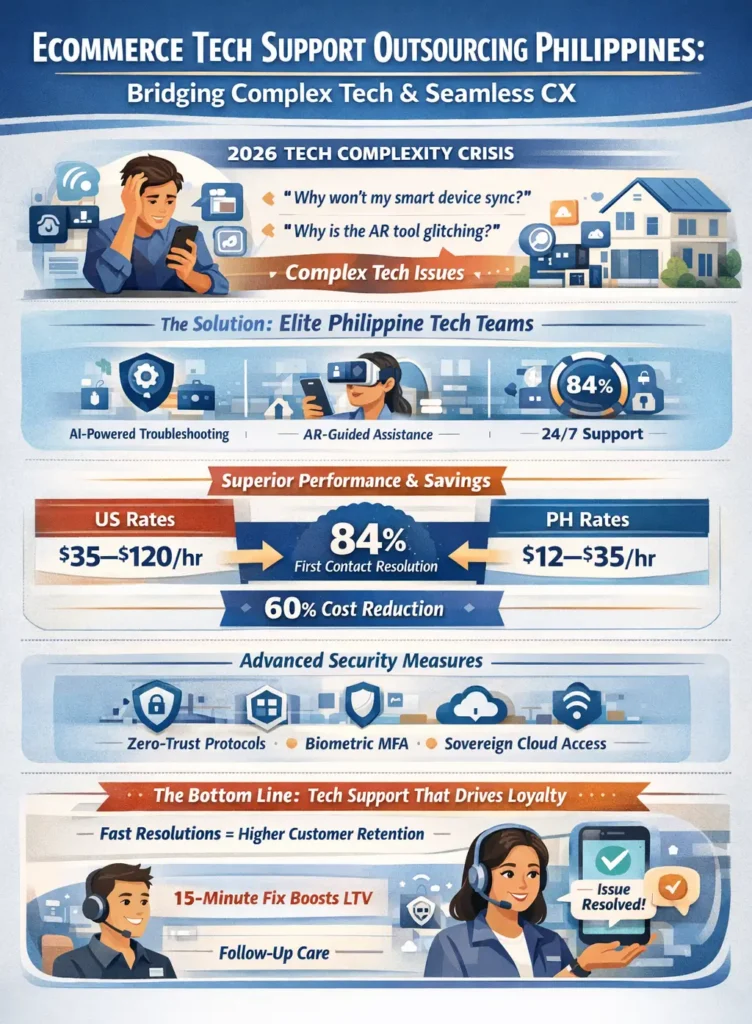
This visual breakdown highlights the Tiered ROI of Philippine technical support. While Tier 1 handles high-volume FAQs, Tier 2 and 3 specialists focus on complex code debugging and server operations, saving onshore engineers for core development. The infographic showcases the 84% FCR rate and the impact of 24/7 Site-Down Monitoring. By integrating human “Systems Thinking” with AI-driven log scanning, elite Philippine hubs ensure that technical issues are intercepted before they escalate. With 60-70% net savings across all tiers, this model transforms support from a reactive cost center into a proactive retention engine that safeguards your brand’s digital ecosystem.
The 2026 Technical Complexity Crisis
Today’s shopper isn’t just asking “Where is my order?”; they are asking, “Why won’t my smart-kettle sync with your app?” or “Why is the AR try-on tool flickering on my device?”
Why “Generalist” Support Fails for Tech:
- The Knowledge Gap: Basic customer service agents lack the “Systems Thinking” required to troubleshoot across fragmented tech stacks (Shopify, ERPs, and Third-Party Apps).
- High Escalation Costs: Without skilled Tier 2/3 specialists in Manila, every minor glitch is escalated to your expensive domestic engineering team, pulling them away from core product development.
- Linguistic Precision: Technical troubleshooting requires absolute clarity. Small misunderstandings in language can lead to incorrect fixes that cause further system downtime.
Unit Economics: The “Tiered” ROI
Technical support in the Philippines offers a unique “Skill-to-Cost” ratio that allows for deep specialization.
Table 1: 2026 Tech Support Performance Matrix
| Support Level | US/UK Rate (Burdened) | Philippine Rate (Elite) | Function |
| Tier 1 (Basic) | $35–$45/hr | $12–$15/hr | Logins, FAQs, Basic Setup |
| Tier 2 (Advanced) | $55–$75/hr | $18–$24/hr | API Issues, App Conflicts |
| Tier 3 (Expert) | $90–$120/hr | $28–$35/hr | Code Debugging, Server Ops |
| Net Savings | – | 60–70% | High-Skill Retention |
Agentic Diagnostics: The 2026 Edge
Elite Philippine tech teams utilize Agentic AI Orchestrators to accelerate the resolution of complex cases:
- Autonomous Log Analysis: Before the agent joins the chat, the AI scans user error logs, identifies the conflict, and surfaces the exact documentation needed for a fix.
- Predictive Debugging: The system monitors “Cluster Errors”—if five users report the same checkout glitch in 10 minutes, the Manila team is alerted to a “Site-Wide Event” before the first ticket is even triaged.
- Visual Troubleshooting: Specialists use AR-guided tools to see what the customer sees on their device, providing real-time “Over-the-Shoulder” support for hardware issues.
The Expert Perspective: The Strategic Nerve Center
John Maczynski, CEO of PITON-Global, notes: “In 2026, your tech support team is your best source of ‘Product Intelligence. We found that Manila-based tech support agents were identifying UX friction points months before our data scientists. By outsourcing tech support to a premium Philippine hub, you aren’t just ‘fixing bugs’; you are gaining an extension of your R&D team that works while your onshore engineers sleep, cutting development cycles by 30%.”
Security and Data Sovereignty
Technical support often requires high-level “Admin” access. Premium Philippine hubs lead with “Zero-Trust” Security:
- Hardware-Level Security: Using Yubikeys and biometric MFA to ensure only authorized specialists access your backend.
- Ephemeral Workspaces: Agents work in “Stateless” environments where data is never cached locally, maintaining total GDPR and CCPA compliance.
- Sovereign Cloud Tunnels: Your data stays in your domestic cloud (AWS/Azure); only the “Pixel Stream” is sent to the specialist in Manila.
Tech Support as a “Retention Engine”
A unique 2026 insight: The faster the tech fix, the higher the LTV. Data shows that if a technical issue is resolved within 15 minutes, customer loyalty actually increases (the “Service Recovery Paradox”). Philippine specialists are trained to follow up 24 hours later to ensure the fix is holding—a level of proactive care that is cost-prohibitive with onshore teams.
Expert FAQ: The Tech Support Briefing
Q: Can they handle 24/7 “Site-Down” emergencies?
Yes. Elite partners offer NOC (Network Operations Center) services, monitoring site health 24/7 and initiating “War Room” protocols if downtime occurs.
Q: Is the English proficiency high enough for documentation?
The Philippines ranks in the top 25 globally for English proficiency, specifically excelling in “Technical English” for documentation and structured troubleshooting.
Q: Can they work directly with our developers?
Absolutely. Most premium Manila tech teams operate as an integrated “Staff Augmentation” model, attending daily stand-ups and using the same Jira/GitHub workflows.