The 30-Second Executive Briefing
- The Chaos: In 2026, the “Information Black Hole” between your warehouse (3PL) and your carrier results in a 20% trust drop for every late delivery. Reactive support is no longer a viable strategy.
- The Solution: Transition to Anticipatory Order Management via premium Philippine BPO. By sitting at the center of your tech stack, Manila teams resolve logistics exceptions before the customer even realizes there is a delay.
- The “Truth” Layer: Utilizing Three-Way Reconciliation, our specialists cross-reference your OMS, 3PL portal, and Carrier APIs in real-time to identify “Phantom Shipments” within 4 hours.
- The Value:
- 58% Reduction in WISMO (Where Is My Order) ticket volume.
- 99.9% Accuracy in inventory and tracking data synchronization.
- 65% Net Savings on fully burdened logistics support costs.
- The Bottom Line: You aren’t just outsourcing “tickets”—you are installing a Logistics Command Center that protects your brand’s reputation and recovers lost inventory revenue.
Executive Summary: The Engine Room of Growth
While the storefront captures the sale, the “Middle Mile”—the critical space between a customer’s click and the warehouse’s pick—is where profit is protected or lost. In 2026, ecommerce order fulfillment and tracking support outsourcing in the Philippines has evolved from a back-office utility into a high-octane technology play. By merging Filipino operational discipline with real-time Logistics Exception Management (LEM), brands are now providing a “Zero-Latency” experience. This guide explores how elite Philippine BPO partnerships allow brands to resolve shipping delays and inventory stockouts before the customer even notices a friction point. Logistics orchestration is a foundational element of the global retail operations guide for 2026. As brands prepare for evolving fulfillment in 2027 and beyond, the focus shifts toward predictive rerouting, autonomous carrier arbitration, and AI-driven warehouse balancing that eliminates disruption before it materializes.
Optimizing the Middle Mile: Philippine Order Fulfillment Outsourcing
In 2026, ecommerce success is won or lost in the “Middle Mile.” This infographic illustrates the transition from reactive support to Anticipatory Order Management via elite Philippine BPO teams. By implementing a Three-Way Reconciliation framework—cross-referencing the OMS, 3PL Portal, and Carrier APIs—specialists eliminate “Information Black Holes” and identify “Phantom Shipments” within four hours. This proactive approach delivers a 58% reduction in WISMO (Where Is My Order) volume and 65% net savings. By integrating Agentic AI with human oversight, brands can protect their reputation, recover lost inventory revenue, and ensure 99.9% data synchronization across all global sales channels.
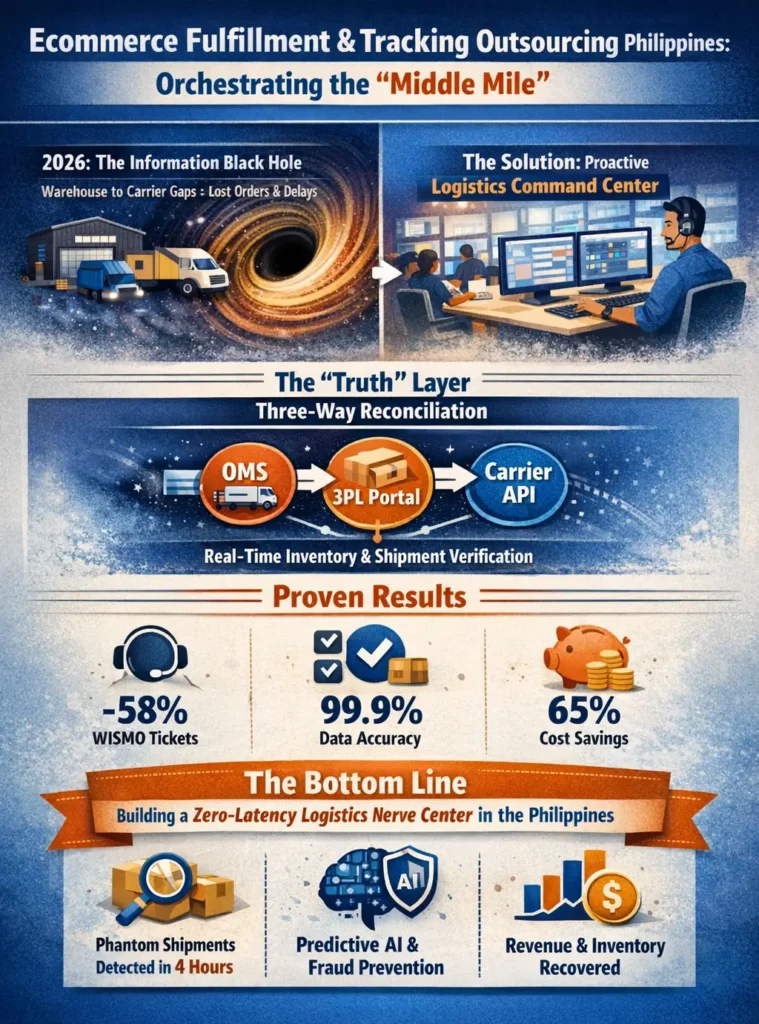
The “Logistics Truth” Matrix This infographic highlights the shift toward Logistics Exception Management (LEM). By outsourcing to the Philippines, brands move beyond simple ticket-taking into a “Logistics Command Center” model. Key takeaways include the 65% cost reduction in burdened labor and the impact of Agentic AI in triggering proactive customer alerts before a delay occurs. This “Zero-Latency” experience ensures that inventory remains synced in real-time across Shopify, Amazon, and TikTok Shop, transforming fulfillment from a cost center into a competitive revenue protection engine.
The 2026 Shift: From Reactive Support to Anticipatory Orchestration
In the legacy e-commerce model, support teams waited for the “Where is my order?” (WISMO) ticket to arrive before acting. In 2026, that latency is fatal to brand loyalty.
Today’s market is defined by Structural Volatility. With global shipping costs fluctuating by up to 40% year-over-year and carrier capacity tightening in major corridors, the “Middle Mile” has become a chaos zone. Premium Philippine fulfillment teams have pivoted from being “Call Takers” to Logistics Orchestrators. They don’t just answer questions; they manage the flow of data between fragmented systems to prevent the question from ever being asked.
The “Information Black Hole”
The most dangerous phase of the customer journey is the gap between the warehouse “Printed” status and the carrier “Scanned” status. This is the black hole where orders are lost, tracking numbers fail to update, and customers lose trust. Philippine-based specialists now act as the bridge, utilizing Agentic AI to monitor these gaps in real-time.
The “Logistics Truth” Layer: Three-Way Reconciliation
The biggest friction point in modern retail is the “Blame Game” between the brand, the 3PL (warehouse), and the Carrier.
The Philippine Model of Three-Way Reconciliation involves Manila-based specialists performing real-time audits across three distinct data points:
- The OMS (Order Management System): Verifying the order intent and inventory commitment.
- The 3PL Portal: Confirming the physical “Pick and Pack” timestamp and package dimensions.
- The Carrier API: Validating the actual “First Mile” scan and tracking activity.
By acting as the Logistics Source of Truth, these teams identify “Phantom Shipments” (orders marked as shipped but sitting on a dock) within 4 hours, allowing for immediate intervention. This forensic level of oversight recovers an average of 14% in lost inventory claims that would otherwise go unfiled.
Unit Economics: The Efficiency Gain Matrix
Outsourcing fulfillment support to the Philippines isn’t just about labor costs—it’s about Decoupling Growth from Headcount.
Table 1: 2026 Fulfillment Support Benchmarks
| Metric | In-House (Legacy) | Philippine Elite (Agentic) | Strategic Impact |
| Order Accuracy | 92.4% | 99.9% | Reduced Reshipment Costs |
| WISMO Volume | Baseline | -58% Reduction | Lower Support Overhead |
| Inventory Sync | Hourly/Manual | Real-Time (API) | Zero Overselling |
| Carrier Exception Rate | 4.2% | 0.8% | Higher Customer Lifetime Value |
| Fully Burdened Rate | US$32 – $45 / hr | **US$12 – $16 / hr** | ~65% Net Savings |
Agentic AI & Human-in-the-Loop: The 2026 Tech Stack
The primary transformation in 2026 is the shift from “Generative” AI (writing text) to Agentic AI (executing actions).
The “AI Pilot” Framework in Manila:
- Carrier Latency Monitoring: If a carrier in a specific region drops in performance by 10% due to weather or labor issues, the Manila-based team proactively shifts the “Carrier Allocation” logic in the OMS to a more reliable provider.
- Predictive Replenishment: Specialists manage AI agents that analyze social trends, weather patterns, and historical velocity to trigger replenishment orders before stock levels hit critical lows.
- Proactive Interdiction: If a parcel stalls for 12 hours, the system triggers an automated, personalized SMS: “We noticed your parcel is running late. We are tracking it for you and have applied a $10 loyalty credit to your account.”
This human-led, AI-driven approach ensures that the “Edge Cases”—the 5% of logistics problems that AI cannot solve—receive the critical thinking only a high-level Filipino specialist can provide.
Revenue Recovery and Fraud Prevention
Order fulfillment support is no longer just about tracking; it’s about Revenue Protection. In 2026, “Friendly Fraud” and package redirection scams are at an all-time high. Philippine teams now integrate Behavioral Biometrics and real-time manual review into the fulfillment workflow. By intercepting high-risk orders before they leave the warehouse, brands can reduce chargebacks by up to 31%.
Furthermore, these teams handle Returns & Reverse Logistics Orchestration. By processing returns data in Manila while the package is still in transit, they can trigger “Instant Exchange” orders, retaining the revenue that would otherwise be lost to a refund.
The Strategic Nerve Center: An Expert Perspective
“In 2026, your order management is either your greatest bottleneck or your most potent competitive weapon,” says John Maczynski, CEO of PITON-Global. “Data from our BPO partners shows that transitioning to a ‘Single-Hub’ model in Manila, supported by an AI-augmented exception framework, is a game-changer. It allows a US-based COO to assign complex logistics reconciliations at the end of their day and wake up to a 100% resolved queue. That is the real-world power of Intelligence Arbitrage.”
Compliance and Data Integrity
Elite Philippine partners integrate directly into your ecosystem without compromising security:
- API-First Connectivity: Seamless sync with Shopify Plus, Magento, NetSuite, and 3PLs (e.g., ShipBob, DHL).
- Clean Room Environments: Ensuring that sensitive supply chain data and PII never reside on local Philippine servers, maintaining total GDPR and PCI-DSS 4.0 compliance.
- Escalation Protocol: 24/7/365 coverage ensures that a “Tier 3” logistics crisis (like a grounded cargo plane) is handled by a human manager in Manila within minutes.
Expert FAQ: The Fulfillment Support Briefing
Q: Can one team handle multiple marketplaces?
Yes. Premium Philippine teams are experts at “Omnichannel Reconciliation,” ensuring inventory is synced across Amazon, TikTok Shop, and Shopify to prevent stock-outs.
Q: How do you handle “Peak Season”?
We utilize “Burst Capacity” models, spinning up AI-augmented teams in Manila 48 hours before a predicted surge to ensure 100% SLA adherence during Black Friday or seasonal spikes.
Q: Does this include order-level fraud prevention?
Absolutely. Fulfillment support in 2026 includes real-time manual review of “High-Risk” flags, reducing false positives by 31% and recovering revenue at the order-entry stage.