
Back
Ecommerce Customer Support Outsourcing Philippines: The 2026 Shift to Zero-Latency Predictive CX

By Ralf Ellspermann / 9 February 2026

The 30-Second Executive Briefing
- The Problem: In 2026, “reactive” support is a brand killer. If a customer has to ask “Where is my order?”, you have already lost the opportunity to protect their Lifetime Value (LTV).
- The Shift: Ecommerce customer support outsourcing in the Philippines has evolved from a tactical cost-save into a Revenue Recovery Unit.
- The Solution: Merging Filipino Malasakit (genuine care) with Agentic AI—autonomous systems that don’t just “suggest” replies but execute complex, multi-step business logic via API.
- The Bottom Line: Elite Philippine partners achieve 65–75% operational savings while converting 34% of return requests into exchanges, effectively making the support department self-funding.
Executive Summary: Beyond Labor Arbitrage
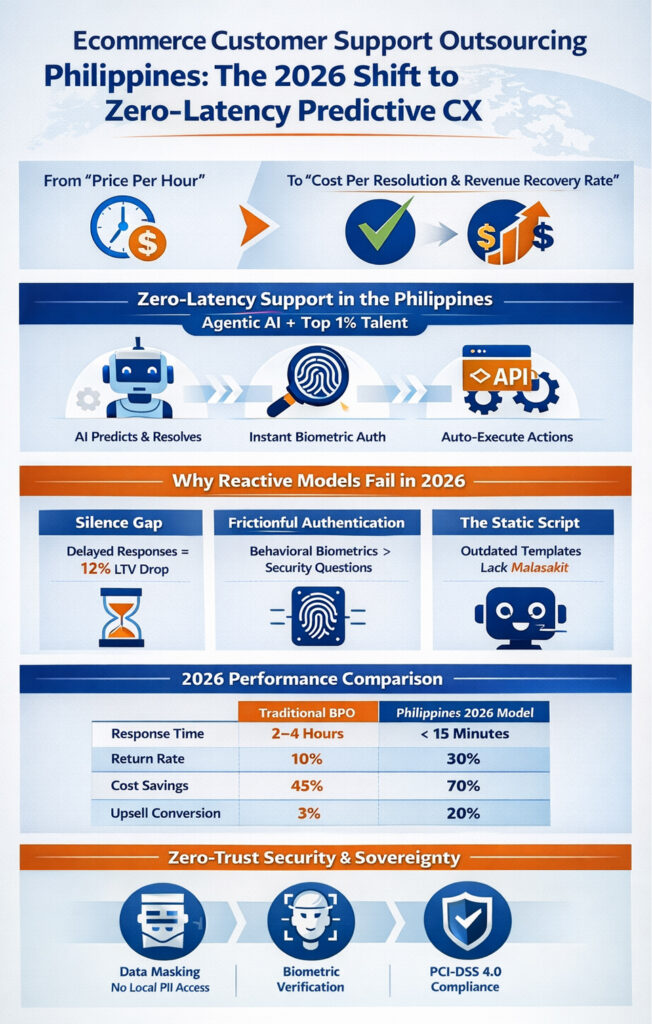
For decades, outsourcing was measured by “price per hour.” In 2026, leading retailers have abandoned that legacy metric in favor of Cost Per Resolution and Revenue Recovery Rate.
Ecommerce customer support outsourcing in the Philippines now leverages Intelligence Arbitrage. By utilizing the top 1% of the Philippine workforce, brands can provide a “Zero-Latency” experience—resolving logistics and fraud issues via Agentic AI before the customer ever hits “Send.”
The Death of the “Ticket”: Moving to Event-Driven Orchestration
Legacy BPOs wait for a “Where is my order?” (WISMO) ticket. In 2026, this is considered an operational failure. Modern commerce requires a move to Anticipatory Service Loops.
Why “Reactive” Models Fail in 2026:
- The Silence Gap: Customers expect real-time transparency. A 2-hour delay in responding to a shipping query results in a 12% drop in LTV.
- Frictionful Authentication: Traditional “Security Questions” frustrate modern shoppers. Elite Manila hubs now use Behavioral Biometrics to authenticate users instantly based on typing patterns and device signatures.
- The Static Script: AI-literate customers can spot a template immediately. Without the Filipino value of Malasakit, your automated support feels like a digital wall.
2026 Performance Comparison: The ROI Benchmark
Outsourcing to the Philippines is no longer just a budget play; it’s an Efficiency Engine. By reducing the Total Cost of Ownership (TCO) of a customer interaction, brands can reinvest that capital into aggressive acquisition.
| Metric | Traditional BPO (Legacy) | PITON-Vetted 2026 Standard | Strategic Advantage |
| Response Time | 2–4 Hours | <15 Minutes (Predictive) | Churn Prevention |
| Return-to-Exchange Rate | 9–11% | 28–35% | Revenue Recovery |
| Cost Savings | 40–50% | 65–75% (AI-Hybrid) | Margin Protection |
| Upsell Conversion | 2–5% | 18–24% | Increased AOV |
Agentic AI: The “Engine Room” of the Philippines
The most significant change for 2026 is the Agentic Workflow. Unlike Generative AI, which simply drafts text, Agentic AI acts as a digital employee within the Philippine hub:
- Authenticates: Verifies the user without human intervention via biometric signals.
- Analyzes: Scans the CRM/ERP for LTV to determine if a “No-Return Refund” is more profitable than a physical return.
- Executes: Autonomously triggers the retailer’s API to process the refund, update Shopify, and notify the warehouse instantly.
Scaling the “Human Element”: The Malasakit Edge
While AI handles 80% of routine queries, the remaining 20%—high-emotion, high-complexity cases—require a level of emotional intelligence technology cannot replicate.
The Filipino concept of Malasakit—taking deep, personal ownership of a customer’s problem—is the antidote to the “automated fatigue” of 2026. When a delivery for a child’s birthday is lost, an agent in Manila doesn’t just read a policy; they orchestrate a solution, coordinating with logistics to ensure a replacement arrives on time. This High-Touch interaction is what converts a frustrated shopper into a brand advocate.
“In 2026, if you’re still treating the Philippines as a place for ‘cheap labor,’ you’ve already lost. The most successful brands treat their Manila operations as an ‘Innovation Lab.’ They aren’t just offloading tickets; they are building ‘Self-Healing’ systems.” — John Maczynski, CEO of PITON-Global
Security & Sovereignty: The “Zero-Trust” Edge
As cyber threats evolve, the Philippines has hardened its infrastructure to meet global banking standards (PCI-DSS 4.0).
- Data Masking: Philippine agents handle transactions without ever “possessing” sensitive PII on their local machines.
- Biometric Security: Facilities are protected by continuous facial recognition and “clean room” environments to ensure total compliance with GDPR and CCPA.
Expert FAQ: The 2026 Support Briefing
Q: Can Philippine teams handle UK/AU cultural nuances?
Yes. The Philippines is the world leader in “Cultural Fluency” training, specifically tailored for 2026 UK and Australian retail standards, ensuring that colloquialisms and sentiment are handled with precision.
Q: What is the typical launch timeline?
Most premium programs can be live in 4–8 weeks, including full AI-workflow integration and brand immersion.
Q: Is there a minimum volume requirement?
While many global BPOs require 50+ agents, PITON-Global specializes in connecting mid-market leaders with flexible partners starting at 5–10 dedicated specialists.
Achieve sustainable growth with world-class BPO solutions!
PITON-Global connects you with industry-leading outsourcing providers to enhance customer experience, lower costs, and drive business success.
Get Your Top 1% Vendor List
Author
Ralf Ellspermann is a multi-awarded outsourcing executive with 25+ years of call center and BPO leadership in the Philippines, helping 500+ high-growth and mid-market companies scale call center and customer experience operations across financial services, fintech, insurance, healthcare, technology, travel, utilities, and social media.
A globally recognized industry authority—and a contributor to The Times of India and CustomerThink —he advises organizations on building compliant, high-performance offshore contact center operations that deliver measurable cost savings and sustained competitive advantage.
Known for his execution-first approach, Ralf bridges strategy and operations to turn call center and business process outsourcing into a true growth engine. His work consistently drives faster market entry, lower risk, and long-term operational resilience for global brands.