
Back
Depth Estimation Labeling Outsourcing Philippines: Adding the Third Dimension to Machine Vision

By Ralf Ellspermann / 23 March 2026
 Authored by Ralf Ellspermann, CSO of PITON-Global, & 25-Year Philippine BPO Veteran | Executive | Verified by John Maczynski, CEO of PITON-Global, and Former Global EVP of the World's Largest BPO Provider on March 23, 2026

TL;DR: The Key Takeaway
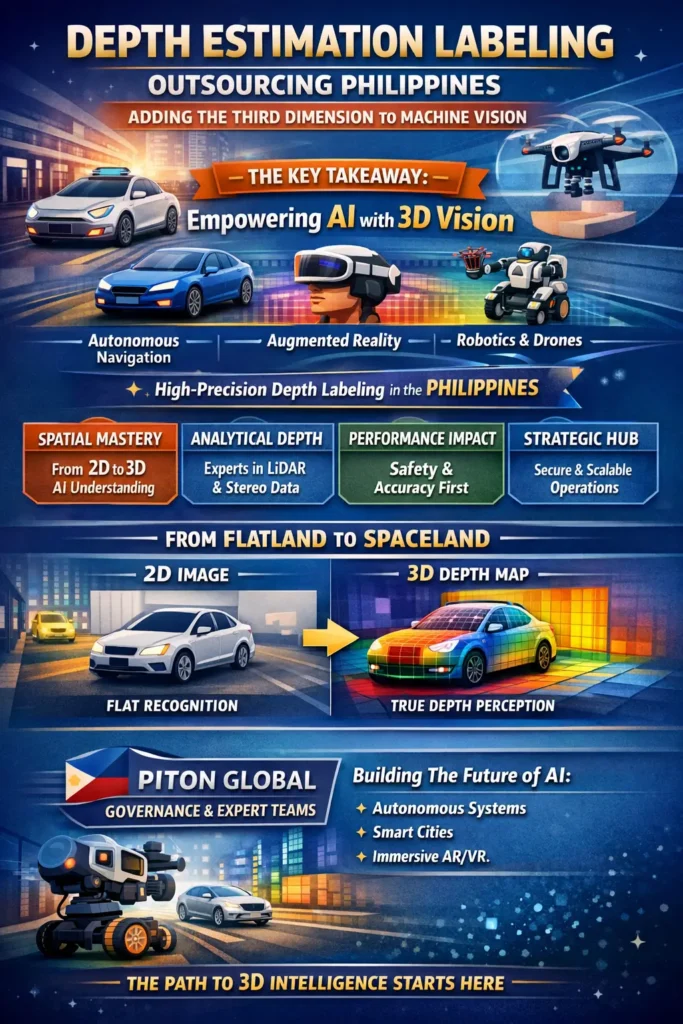
Depth estimation labeling in the Philippines has become the cornerstone of advanced machine vision, providing the essential 3D context that allows AI models to perceive and interact with the world accurately. This strategic capability is fueling innovation across industries, from autonomous navigation to immersive augmented reality.
The transition from flat image recognition to spatial awareness represents a critical milestone in artificial intelligence. Depth estimation labeling in the Philippines serves as the architectural foundation for this shift, providing AI models with the per-pixel distance data necessary to calculate volume, scale, and proximity. By utilizing a workforce that excels in spatial reasoning and sensor fusion, global tech leaders are securing the high-fidelity training data required for 2026-era robotics, autonomous flight, and augmented reality.
- Spatial Mastery: Industry leaders have pivoted from basic 2D identification to 3D scene understanding as the benchmark for AI performance.
- Analytical Depth: The Philippines offers a talent pool uniquely capable of interpreting complex LiDAR point clouds and stereo-image disparities.
- Performance Impact: Success is no longer defined by the quantity of labels, but by the model’s precision in navigating physical environments safely.
- Strategic Hub: The archipelago’s mature BPO infrastructure ensures a secure, scalable, and data-sovereign environment for sensitive 3D datasets.
- PITON-Global’s Governance: As a strategic link, the firm ensures that AI innovators are matched with elite teams capable of delivering certifiably accurate ground truth.
From Flatland to Spaceland: The Imperative of 3D Perception
Early computer vision was largely confined to a two-dimensional world. While identifying a face or a vehicle on a flat plane is impressive, these capabilities lack the “visual common sense” required for physical interaction. To function in our world, a machine must do more than identify an object; it must understand where that object exists in a three-dimensional coordinate system. Knowing a car is present is useful; knowing it is precisely 12.5 meters away and moving at a specific velocity is revolutionary.
Depth estimation labeling bridges this gap. This meticulous process involves annotating data from stereo cameras or LiDAR sensors to assign a specific distance value to every pixel. The resulting “depth map” allows an AI to perceive the world with human-like depth perception. This technological leap is the primary enabler for a new generation of applications, including surgical robots that require sub-millimeter precision and AR headsets that must anchor virtual objects realistically within a physical room.
The Philippine Advantage in 3D Data Annotation
Assigning depth to complex visual data is a cognitively exhausting task that resists simple automation. It requires human annotators to interpret subtle lighting cues, account for occlusion (where one object blocks another), and resolve discrepancies in sensor data. The Philippines has solidified its role as the global center for this work by cultivating a workforce that balances technical tool proficiency with high-level analytical skills.
| Feature | Traditional 2D Annotation | Advanced 3D Depth Labeling |
| Primary Input | Single 2D images. | Stereo imagery, LiDAR, sensor fusion. |
| Core Task | Bounding boxes and polygons. | Per-pixel depth mapping and 3D cuboids. |
| Cognitive Load | Low to moderate. | Very high; requires spatial deduction. |
| Required Skills | Basic computer literacy. | Spatial reasoning and sensor physics. |
| AI Impact | Recognition and classification. | Navigation and physical interaction. |
The Filipino workforce’s high educational attainment and English fluency facilitate the deep understanding of technical guidelines necessary for these high-stakes projects. This ecosystem allows AI companies to scale their 3D training pipelines without sacrificing the accuracy required for safety-critical applications.
The Strategic Value of Outsourcing Depth Estimation
For organizations pushing the boundaries of machine vision, partnering with a specialized Philippine provider is a strategic move to access elite expertise. Managing an in-house team of 3D specialists involves prohibitive costs in recruitment, specialized software training, and quality control. By leveraging the established framework in the Philippines, AI firms can transform their labeling needs into a variable, scalable resource.
This collaboration allows R&D teams to focus on model architecture rather than data management. The Philippine partner functions as a high-fidelity “truth engine,” providing the constant stream of verified data needed for iterative model training. In this context, value is measured by the reduction in model errors and the acceleration of the product’s time-to-market.
Maturity Model for Machine Perception Data
- Level 1: Foundational: Simple 2D boxes focused on cost and volume.
- Level 2: Advanced 2D: Pixel-level semantic segmentation for detailed outlines.
- Level 3: Basic 3D: Initial introduction of spatial awareness through 3D cuboids.
- Level 4: Advanced 3D: High-fidelity sensor fusion and comprehensive depth maps.
- Level 5: Expert-in-the-Loop: Human-led validation of AI-generated 3D environments.
The Future is Three-Dimensional
As we move through 2026, the demand for 3D perception data is accelerating. From the development of smart city infrastructure to immersive gaming in the metaverse, the ability of machines to understand volume and distance is no longer optional. The depth estimation industry in the Philippines is at the center of this transformation, providing the “spatial intelligence” that makes these innovations possible.
The ongoing evolution of sensor technology will only increase the complexity of this work. The Philippines is uniquely positioned to meet this challenge, offering the human judgment required to refine raw sensor data into actionable intelligence. For any enterprise building the next wave of AI, the road to 3D accuracy begins with the expertise found in this Southeast Asian BPO powerhouse.
“Our clients are no longer satisfied with machines that just ‘see’; they want machines that ‘understand’ space. This is the power of high-quality depth labeling. It provides the foundation for everything from autonomous delivery to realistic virtual experiences. We are proud to connect innovators with the Filipino talent that makes this 3D future possible.” — John Maczynski, CEO, PITON-Global
Expert FAQs
What are the primary difficulties in labeling for depth?
The biggest challenges involve transparency and reflective surfaces, which can confuse both sensors and algorithms. Human annotators must use their intuition to correctly estimate depth in these scenarios, ensuring the AI learns to navigate tricky environments like glass buildings or rain-slicked roads.
How does sensor fusion change the labeling process?
Sensor fusion involves merging data from cameras (visual) and LiDAR (geometric). Annotators must be skilled enough to cross-reference these disparate data streams, identifying and resolving any conflicts between what the camera sees and what the LiDAR measures to create a single, unified “ground truth.”
Can synthetic data replace human-annotated depth maps?
Synthetic data is a powerful tool for generating volume, but it often lacks the “real-world noise” found in physical environments. Human-labeled real-world data remains essential for fine-tuning models to ensure they can handle the unpredictability of the real world, such as unexpected lighting changes or sensor malfunctions.
How will AI tools assist human annotators in the future?
We are seeing a move toward “AI-assisted labeling,” where models suggest depth maps and human experts provide the final validation and correction. This “Human-in-the-Loop” model increases speed while maintaining the high quality required for safety-critical systems, a methodology perfected by top-tier providers in the Philippines.
Achieve sustainable growth with world-class BPO solutions!
PITON-Global connects you with industry-leading outsourcing providers to enhance customer experience, lower costs, and drive business success.
Get Your Top 1% Vendor List
Author
Ralf Ellspermann is a multi-awarded outsourcing executive with 25+ years of call center and BPO leadership in the Philippines, helping 500+ high-growth and mid-market companies scale call center and customer experience operations across financial services, fintech, insurance, healthcare, technology, travel, utilities, and social media.
A globally recognized industry authority—and a contributor to The Times of India and CustomerThink —he advises organizations on building compliant, high-performance offshore contact center operations that deliver measurable cost savings and sustained competitive advantage.
Known for his execution-first approach, Ralf bridges strategy and operations to turn call center and business process outsourcing into a true growth engine. His work consistently drives faster market entry, lower risk, and long-term operational resilience for global brands.
EXECUTIVE GOVERNANCE & ACCURACY STANDARDS
Authored by:

Ralf Ellspermann
Founder & CSO of PITON-Global,
25-Year Philippine BPO Veteran,
Multi-awarded Executive
Specializing in strategic sourcing and excellence in Manila
View Full Bio
Verified by:

John Maczynski
CEO of PITON-Global, and former Global EVP of the World’s largest BPO provider | 40 Years Experience
Ensuring global compliance and enterprise-grade service standards
View Full Bio
Last Peer Review: March 23, 2026
This service framework is audited quarterly to meet shifting global outsourcing regulations and COPC standards.