
Back
Conversational AI Training Outsourcing Philippines: Designing Dialogues That Feel Authentically Human

By Ralf Ellspermann / 19 March 2026
 Authored by Ralf Ellspermann, CSO of PITON-Global, & 25-Year Philippine BPO Veteran | Executive | Verified by John Maczynski, CEO of PITON-Global, and Former Global EVP of the World's Largest BPO Provider on March 19, 2026

TL;DR: The Key Takeaway
Conversational AI training outsourcing in the Philippines has pivoted from basic response generation to the sophisticated art of Dialogue Design. This new discipline focuses on crafting nuanced, context-aware, and emotionally intelligent interactions, transforming chatbots and voice assistants from functional tools into engaging, human-like conversational partners. The archipelago is now the premier hub for sourcing the elite human talent required to teach AI the subtleties of authentic communication.
Modern users no longer tolerate rigid, robotic interactions; they demand digital experiences that reflect human empathy and contextual intelligence. The Philippines has positioned itself as the global epicenter for this evolution, transitioning from basic script management to sophisticated Dialogue Design. By leveraging a unique workforce skilled in linguistics and psychology, the archipelago helps developers move beyond simple accuracy toward “Interaction Arbitrage”—where the value is found in the AI’s ability to de-escalate tension, build brand rapport, and navigate the messy unpredictability of natural conversation.
Executive Briefing
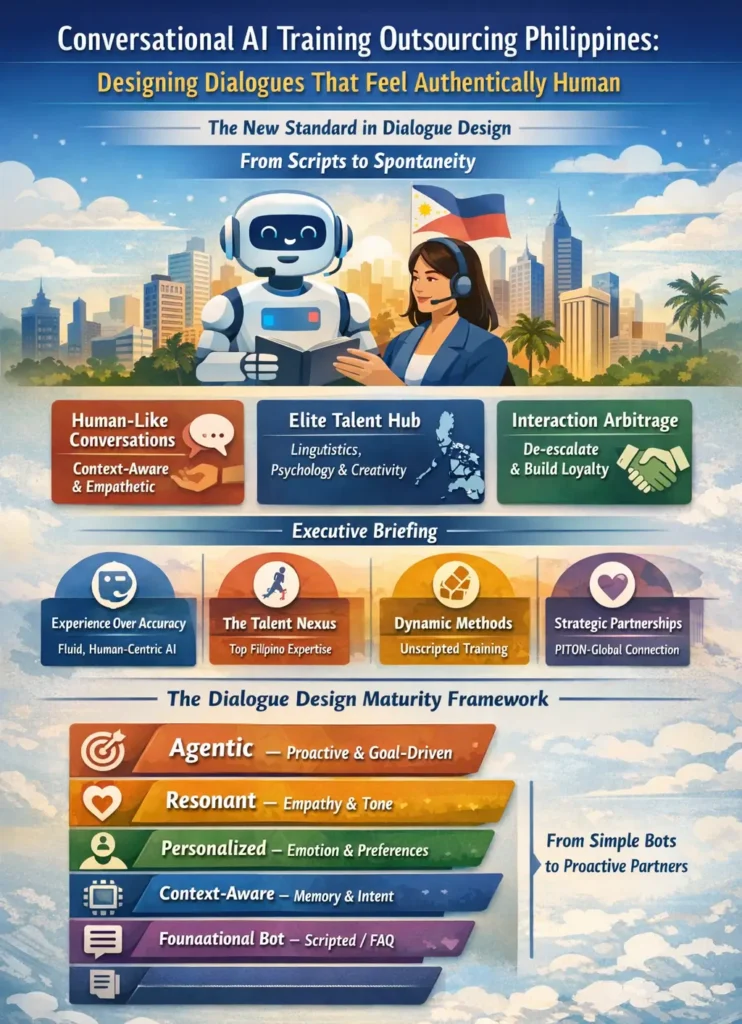
- Experience Over Accuracy: Success in 2026 is defined by the fluid quality of the user journey rather than just the binary correctness of a bot’s response.
- The Talent Nexus: The Philippines offers a rare concentration of experts in creative writing, linguistics, and psychology—the essential pillars of modern AI training.
- Interaction Arbitrage: This new ROI metric focuses on an AI’s capacity to handle complex emotional flows and foster brand loyalty through authentic speech.
- Dynamic Methodology: Leading BPO firms in the region are replacing static datasets with unscripted, “wild” conversational models to create more adaptable systems.
- Strategic Architecture: PITON-Global bridges the gap, connecting tech innovators with elite Philippine teams capable of teaching machines the subtle art of empathy.
Executive Summary
The framework for conversational AI training outsourcing Philippines is currently undergoing a radical transformation. We are witnessing a decisive departure from the era of “if-then” decision trees toward a future where digital interactions are indistinguishable from a conversation with a premier human consultant. This shift is anchored in Dialogue Design—a discipline that treats conversation as an art form requiring deep psychological insight and narrative flair. The objective is no longer a mere transaction; it is an engaging, empathetic partnership. With its vast reservoir of culturally attuned and emotionally intelligent talent, the Philippines has become the undisputed headquarters for this high-level cognitive work. PITON-Global facilitates these elite partnerships, ensuring that AI doesn’t just process information, but communicates with a human soul.
From Scripts to Spontaneity: The New Mandate for Conversational AI
The initial wave of automated support relied on fragile keyword matching and rigid trees. While these systems handled basic tasks, they crumbled the moment a user veered off-script, leading to “bot rage” and immediate human escalation. In today’s hyper-competitive landscape, that friction is a brand killer. Consumers now expect AI to possess memory, understand sarcasm or frustration, and provide personalized coaching rather than just FAQ links.
Meeting this demand requires a total overhaul of training philosophy. Feeding an AI a static library of answers is no longer enough. Instead, models must be immersed in dynamic, evolving datasets that capture the nuance of real-world human speech. This is the primary challenge addressed by Dialogue Design: moving from a programmed machine to a spontaneous conversationalist.
The Dialogue Design Maturity Framework
Advancing from a basic bot to a proactive agent is a journey through five distinct stages of sophistication. Outsourcing to specialized Philippine hubs accelerates this progression.
| Maturity Level | Core Characteristic | Primary Training Activity | Business Outcome |
| Level 1: Foundational | Scripted/FAQ-based | Simple Knowledge Base Ingestion | Cost reduction; basic resolution. |
| Level 2: Context-Aware | Session Memory | Intent & Entity Tuning | Higher first-contact resolution. |
| Level 3: Personalized | History Integration | Preference Modeling | Increased user loyalty & CSAT. |
| Level 4: Resonant | Sentiment/Tone | Empathy & De-escalation Training | Reduced churn; brand affinity. |
| Level 5: Agentic | Goal-Oriented | Persuasion & Narrative Modeling | Revenue generation; proactive help. |
“The Turing Test is a relic. The new benchmark isn’t about fooling a user into thinking the AI is a human; it’s about making the interaction so helpful and fluid that the user simply stops caring about the distinction,” states John Maczynski, CEO of PITON-Global. “Our clients come to the archipelago because they recognize that training an AI in the art of dialogue requires a level of cognitive agility and empathy that is uniquely concentrated here.”
Interaction Arbitrage: The New ROI of AI Training
“Interaction Arbitrage” represents a fundamental shift in how we value AI. It moves the needle from “how many calls did we avoid?” to “how much value did this conversation create?” This arbitrage is the tangible profit generated when a robotic, frustrating encounter is replaced by one that is smooth, persuasive, and effective.
This is measured through enhanced Customer Lifetime Value (CLV), improved Net Promoter Scores (NPS), and the AI’s ability to successfully suggest upgrades based on a deep understanding of user needs. Cultivating this requires “Dialogue Designers”—a specialized workforce that the Southeast Asian BPO sector has spent years developing.
Core Competencies for Modern Dialogue Designers
Training a modern AI requires a hybrid professional—part data scientist, part novelist, and part therapist. PITON-Global identifies partners who excel in these specific areas:
- Linguistic Acumen: The ability to parse slang, regional dialects, and implied meanings to ensure the AI understands what isn’t being said.
- Psychological Insight: Modeling user motivations and biases to create responses that are persuasive yet ethical.
- Creative Narrative: Crafting a consistent “brand voice” so the AI has a personality that aligns with corporate identity.
- UX Strategy: Designing frictionless flows that minimize user effort and maximize task completion.
- Data Synthesis: Analyzing thousands of logs to find the “friction points” where the AI’s conversational logic breaks down.
Agentic Dialogue: The Pinnacle of Human-AI Collaboration
The ultimate frontier is “Agentic Dialogue,” where the AI stops waiting for a prompt and begins to act as a proactive partner. An agentic system anticipates a user’s next hurdle, offers a solution before it’s requested, and guides the conversation toward a goal—like solving a billing dispute or planning a trip.
This requires training the AI on multi-turn scenarios involving negotiation and collaborative problem-solving. This is the most cognitively taxing form of training, demanding human trainers in the Philippines who can think strategically. The local talent pool, famous for its service-oriented mindset and complex problem-solving skills, is uniquely suited to lead this global charge.
Expert FAQs
Why is the Philippines the top choice for this specific AI niche?
Beyond the English fluency, there is a “cultural empathy” factor. The Philippine workforce has a natural aptitude for Western consumer nuances and emotional intelligence. This allows them to train AI in ways that feel authentically human rather than just technically correct.
What distinguishes Dialogue Design from traditional bot training?
Traditional training is “lexicon-centric” (matching words to answers). Dialogue Design is “human-centric”—it focuses on the emotional arc, the tone of voice, and the flow of the conversation to ensure it feels like a partnership.
How do we measure the financial return on this training?
ROI is found in the “soft” metrics that lead to “hard” dollars: higher conversion rates, lower churn, and a massive reduction in escalations to expensive human tiers for emotional issues.
What is PITON-Global’s role in this process?
We act as the strategic architect. We vet and connect AI developers with the top 1% of Dialogue Design teams in the Philippines, ensuring that our clients receive the technical depth and creative talent necessary to dominate their market.
Achieve sustainable growth with world-class BPO solutions!
PITON-Global connects you with industry-leading outsourcing providers to enhance customer experience, lower costs, and drive business success.
Get Your Top 1% Vendor List
Author
Ralf Ellspermann is a multi-awarded outsourcing executive with 25+ years of call center and BPO leadership in the Philippines, helping 500+ high-growth and mid-market companies scale call center and customer experience operations across financial services, fintech, insurance, healthcare, technology, travel, utilities, and social media.
A globally recognized industry authority—and a contributor to The Times of India and CustomerThink —he advises organizations on building compliant, high-performance offshore contact center operations that deliver measurable cost savings and sustained competitive advantage.
Known for his execution-first approach, Ralf bridges strategy and operations to turn call center and business process outsourcing into a true growth engine. His work consistently drives faster market entry, lower risk, and long-term operational resilience for global brands.
EXECUTIVE GOVERNANCE & ACCURACY STANDARDS
Authored by:

Ralf Ellspermann
Founder & CSO of PITON-Global,
25-Year Philippine BPO Veteran,
Multi-awarded Executive
Specializing in strategic sourcing and excellence in Manila
View Full Bio
Verified by:

John Maczynski
CEO of PITON-Global, and former Global EVP of the World’s largest BPO provider | 40 Years Experience
Ensuring global compliance and enterprise-grade service standards
View Full Bio
Last Peer Review: March 19, 2026
This service framework is audited quarterly to meet shifting global outsourcing regulations and COPC standards.