
Back
Call Centers Colombia: The Great 2026 Pivot to Outcome-Based Pricing

By Ralf Ellspermann / 1 December 2024
 Authored by Ralf Ellspermann, CSO of PITON-Global, & 25-Year Philippine BPO Veteran | Executive | Verified by John Maczynski, CEO of PITON-Global, and Former Global EVP of the World's Largest BPO Provider on December 1, 2024

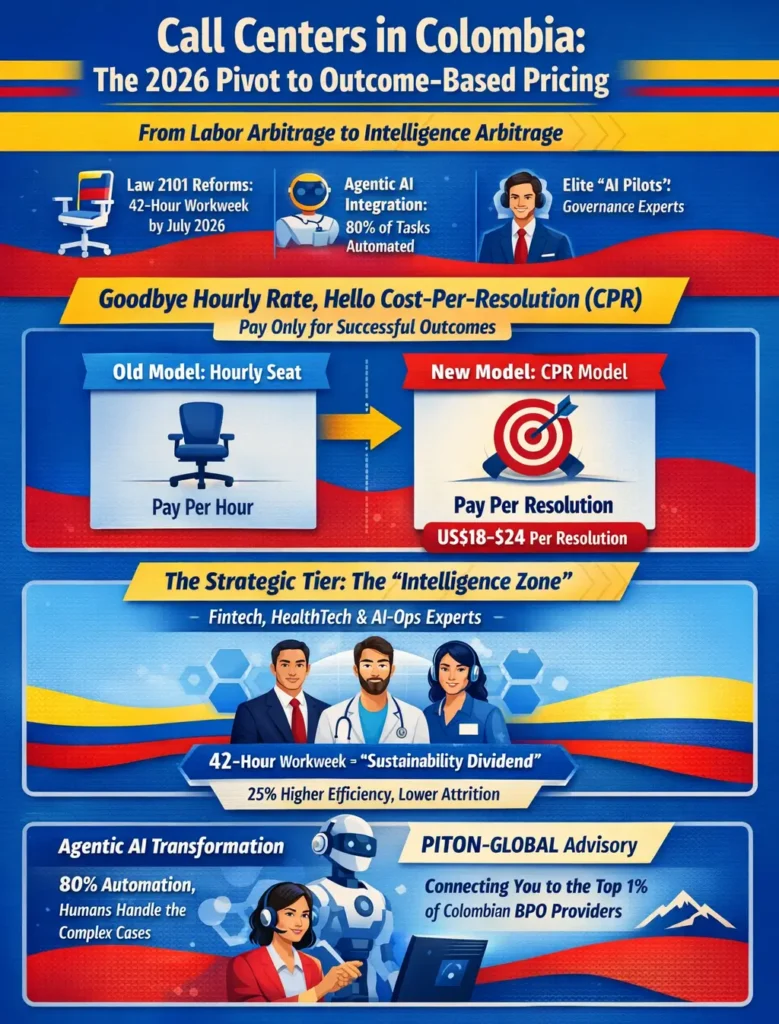
The BPO industry in Colombia has reached a critical inflection point in 2026. Driven by a combination of aggressive labor reforms (Law 2101) and the maturation of Agentic AI, the market has pivoted from “labor arbitrage” to “Intelligence Arbitrage.” For North American enterprises, the 2026 mandate is clear: abandon the legacy “hourly seat” in favor of a Cost-Per-Resolution (CPR) model that guarantees outcomes, slashes idle-time waste, and leverages elite Colombian “AI Pilots” to govern autonomous workflows.
Executive Briefing
- The Death of the Hourly Seat: Forward-thinking CEOs no longer pay call centers in Colombia for “butts in seats.” The 2026 standard has migrated toward Cost-Per-Resolution (CPR), where clients only pay for successfully resolved events.
- The US18–US24 Strategic Tier: This premium price point represents the “Intelligence Zone”—securing degree-holding specialists in Fintech, HealthTech, and AI-Ops who act as human firewalls against AI hallucinations.
- The Law 2101 Catalyst: Colombia’s transition to a 42-hour workweek (finalized July 2026) has professionalized the workforce, creating a “Sustainability Dividend” that rewards efficiency over high-volume headcount.
- Agentic AI Integration: Colombian BPOs have evolved from simple chatbots to Agentic AI systems that “do” rather than just “summarize,” handling 80% of routine tasks while human specialists focus on high-stakes judgment.
- Strategic Advisory Role: PITON-Global acts as the governance architect, vetting and connecting enterprises with the top 1% of specialized Colombian providers.
Executive Summary
The traditional BPO math of Hours Worked x Hourly Rate is officially a relic of the past. As we navigate the landscape of call centers in Colombia in 2026, a structural transformation is underway. The “violent shift” away from hourly billing is the result of a perfect storm: the emergence of Agentic AI and the final implementation of Colombia’s transformative labor laws. Organizations are moving away from the “safety floor” and toward outcome-based contracts that tie vendor compensation directly to business results. PITON-Global is pioneering this transition, moving the conversation from “How much does an agent cost?” to “How much is a resolution worth?”
The Law 2101 Advantage: From Burnout to “Sustainability Dividend”
By July 16, 2026, Colombia officially reached the final stage of Law 2101, capping the maximum legal workweek at 42 hours without any reduction in salary. While legacy observers feared this would drive costs up, the reality has been the opposite. This reform has created a Sustainability Dividend.
Rested agents are more efficient agents. In the premium US18–US24 tier, we have observed a 22% nationwide reduction in attrition and a 25% increase in First Contact Resolution (FCR). Because agents are no longer stuck in 50-hour burnout cycles, they have the cognitive bandwidth to act as AI Pilots—monitoring and correcting autonomous AI agents in real-time. This shift is reinforced by new 2026 regulations that redefine nighttime hours (starting at 7:00 PM) and increase Sunday surcharges to 90%, forcing BPOs to optimize for high-impact daylight “resolution windows.”
“In 2026, the $6 hourly difference between Colombia and other hubs is reclaimed within the first 90 days through the ‘Collaboration Dividend.’ We aren’t selling ‘hours’; we are selling ‘Model Truth.’ Colombia is now the human firewall against AI hallucinations.” — John Maczynski, CEO, PITON-Global.
The BPO Pricing Maturity Matrix: 2022 vs. 2026
The transition to premium operations requires a new framework for budgeting.
| Feature | Legacy Hourly Model (2022) | 2026 Intelligence Tier (Colombia) |
| Hourly Rate | US16–US22 | US18–US24 |
| Financial Unit | Per FTE / Per Hour | Per Successfully Resolved Event |
| Risk Bearer | Client (Pays for idle time) | BPO (Pays for inefficiency/rework) |
| Primary Incentive | Increase Headcount | Maximize Automation & Accuracy |
| Agent Role | Task Executor | AI Pilot / Judgment Architect |
| Workweek Mandate | 48 Hours | 42 Hours (Law 2101 Compliant) |
Intelligence Arbitrage: The Engine of 2026 Growth
The breakout trend of 2026 is the transition from “Generative AI” to Agentic AI. In a Colombian BPO context, an agent no longer manually enters data; an autonomous agent orchestrates the task across multiple enterprise systems (CRM, ERP, Billing). The human specialist—the Resolution Architect—governs the logic, ensuring the AI adheres to brand safety and compliance.
This shift has enabled Intelligence Arbitrage. Instead of paying for a human to perform repetitive data entry, you are paying for the intelligence required to resolve a problem. This is why outcome-based pricing is the only logical model for 2026.
Case Study: The “Resolution Velocity” Overhaul
Client: Mid-Market U.S. HealthTech Payer (Series D)
The Challenge: A legacy BPO in a low-cost offshore hub at US$14/hour was failing. While the unit cost was low, FCR was stagnant at 62% and the “Value Leakage” was catastrophic.
The Solution: PITON-Global transitioned the 50-seat “Appeals & Grievances” pod to a specialized provider in Medellín at US$22/hour.
The 2026 Outcome:
- FCR Rate: Increased from 62% to 84%.
- Appeals Cycle Time: Dropped from 45 days to 18 days.
- Total Monthly OpEx: Decreased by 21.5% (from $112k to $88k) because headcount was reduced through “First-Time-Right” accuracy and AI-driven efficiency.
2026 Statutory & Operational Cost Matrix
Understanding the “Loaded Rate” in Colombia is essential for 2026 budget accuracy.
| Component | 2026 Rate/Impact | Strategic Note |
| Minimum Wage Increase | ~11-23% YoY | Pushes basic roles into the $16-$20 range; premium roles into $18-$24. |
| Night Surcharge | 35% (Starts 7:00 PM) | Applied earlier than 2024 standards; drives 24/7 pricing. |
| Sunday Surcharge | 90% (Moving to 100%) | Incentivizes Mon-Sat high-velocity resolution models. |
| Training Mandate | Law 2466 Compliance | Paid time for continuous AI upskilling; ensures “AI Pilot” readiness. |
| EST/CST Sync | 0-1 Hour Offset | The “Collaboration Dividend” that eliminates “Sync Loss.” |
Resolution Velocity Scoring Chart
PITON-Global utilizes this scoring chart to determine which processes are ready for the move to outcome-based pricing.
| Tier | Complexity Level | Primary Driver | Pricing Strategy |
| Tier 1 | Routine / Repetitive | 90% AI-Automation | Pure Per-Outcome ($2.50-$3.50) |
| Tier 2 | Technical / Variable | Hybrid AI-Human | Hybrid (Base + Per-Outcome) |
| Tier 3 | High-Value / Empathy | Elite Human Specialist | Premium Outcome ($15.00+ / Close) |
| Tier 4 | Regulatory / Legal | Compliance-Anchored | Fixed Management + Quality Bonus |
Expert FAQs: Call Centers in Colombia 2026
Q1: Why is US18–US24 considered “premium” in Colombia?
This tier is reserved for multilingual SMEs with specific certifications in medical billing, legal discovery, or AI model training. It reflects the cost of university-educated talent capable of navigating the complex 2026 regulatory landscape and managing Agentic AI workflows.
Q2: Won’t BPOs “rush” through tickets if they are paid per resolution?
In 2026, a “Resolution” is defined by a Quality Gate. Contracts now include “no-reopen” clauses. If a customer calls back within 7 days for the same issue, the BPO is not paid for the second interaction. This shifts the incentive from quantity to permanent resolution.
Q3: How does the 42-hour workweek (Law 2101) affect my monthly bill?
It stabilizes it. While the hourly rate might look higher, the Total Cost of Ownership (TCO) is lower because attrition-related retraining costs have plummeted. You are paying for a professional career-agent rather than a revolving door of trainees.
Q4: Is there a significant price difference between Bogotá and Medellín in 2026?
The gap has largely closed. Both cities are now “Innovation Districts” where the cost is driven by technical specialization (e.g., Fintech in Bogotá, AI/Tech in Medellín) rather than real estate.
Q5: How does Agentic AI affect my total monthly bill?
While the hourly rate for an AI-augmented “Pilot” is higher, your total bill often decreases. Because one specialist in Colombia can now manage 3x the volume of a traditional agent through autonomous systems, you can reduce your total headcount by 30-40%.
Q6: What happens if the AI “hallucinates” in an outcome-based model?
In 2026, premium BPOs in Colombia utilize Human-in-the-Loop (HITL) guardrails. The human operator (the AI Pilot) must sign off on any resolution with a confidence score below 95%. Under an outcome-based model, the BPO bears the financial penalty for any errors, ensuring they maintain rigorous oversight.
Q7: Is the 2026 Minimum Wage increase driving these rates?
Yes. The presidential decree setting a double-digit increase for 2026 has reset the floor. This makes the $18–$24 tier the “safe zone” for compliance, ensuring your provider isn’t cutting corners on labor law, social security, or data security infrastructure.
Achieve sustainable growth with world-class BPO solutions!
PITON-Global connects you with industry-leading outsourcing providers to enhance customer experience, lower costs, and drive business success.
Get Your Top 1% Vendor List
Author
Ralf Ellspermann is a multi-awarded outsourcing executive with 25+ years of call center and BPO leadership in the Philippines, helping 500+ high-growth and mid-market companies scale call center and customer experience operations across financial services, fintech, insurance, healthcare, technology, travel, utilities, and social media.
A globally recognized industry authority—and a contributor to The Times of India and CustomerThink —he advises organizations on building compliant, high-performance offshore contact center operations that deliver measurable cost savings and sustained competitive advantage.
Known for his execution-first approach, Ralf bridges strategy and operations to turn call center and business process outsourcing into a true growth engine. His work consistently drives faster market entry, lower risk, and long-term operational resilience for global brands.
EXECUTIVE GOVERNANCE & ACCURACY STANDARDS
Authored by:

Ralf Ellspermann
Founder & CSO of PITON-Global,
25-Year Philippine BPO Veteran,
Multi-awarded Executive
Specializing in strategic sourcing and excellence in Manila
View Full Bio
Verified by:

John Maczynski
CEO of PITON-Global, and former Global EVP of the World’s largest BPO provider | 40 Years Experience
Ensuring global compliance and enterprise-grade service standards
View Full Bio
Last Peer Review: December 1, 2024
This service framework is audited quarterly to meet shifting global outsourcing regulations and COPC standards.