
Back
Call Center Philippines: Why 60% of Inbound Migrations Fail (And The 2026 Framework How to Avoid it)

By Ralf Ellspermann / 6 February 2026

The “Friction” Diagnostic
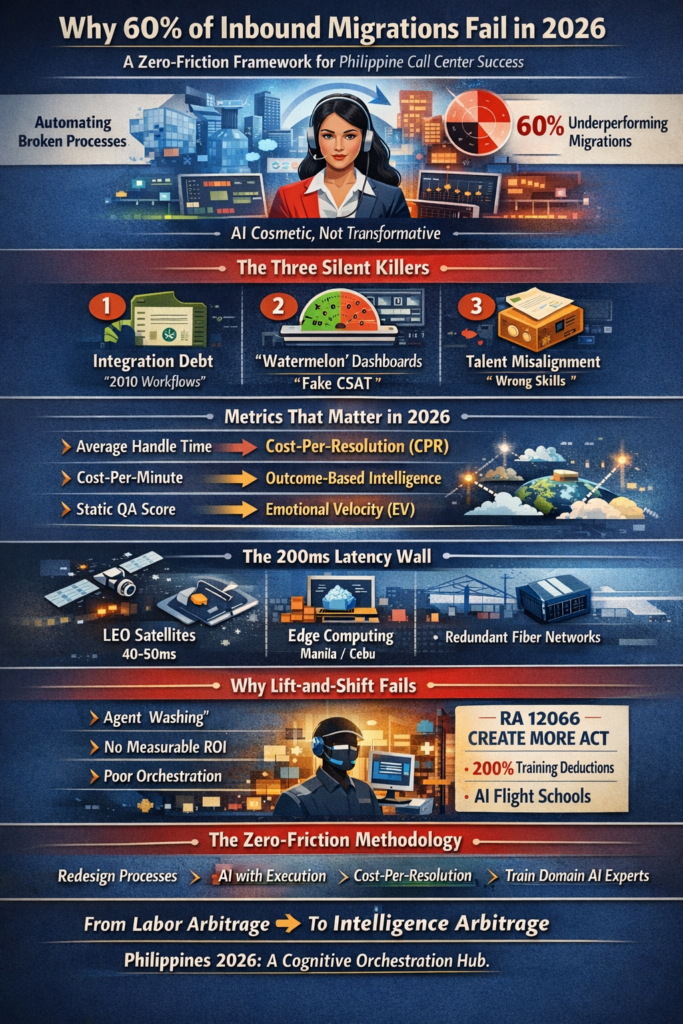
Executive Summary: By 2026, 60% of “call center Philippines” migrations underperform because organizations automate “broken processes” rather than redesigning for Agentic AI. Success now requires the Zero-Friction Methodology—a shift from labor arbitrage to Intelligence Arbitrage. This aligns with Deloitte’s 2026 Global Outsourcing findings that 83% of executives now prioritize AI-powered models over simple headcount. Learn how we are Applying the Fortune 500 Supplier Sourcing Process.
The 2026 “Relevance” Reckoning
The Philippines is undergoing a massive strategic pivot. As noted in McKinsey’s 2026 “Resilience to Relevance” Report, the nation is evolving from a cost-center capital into a “regional digital talent hub.” However, this evolution has created a “Great Divide”: 40% of companies are thriving in this high-value ecosystem, while 60% remain trapped in a Legacy Friction Loop.
The 2026 “Friction Scorecard”: A Pre-Migration Diagnostic
Before committing to a Manila-based partner, executives must calculate their Friction Quotient. The 60% of migrations that fail typically ignore these three “Silent Killers”:
- The Integration Debt: Are you layering AI on top of a 2010 “scripted” workflow? If your AI doesn’t have “Agency”—the ability to execute refunds and cross-reference inventory via API—you are simply adding a digital layer of friction.
- The “Watermelon” Dashboard: Are your vendors reporting 95%+ CSAT while your churn rate increases? In 2026, high CSAT often hides “resolution fatigue,” where customers give high marks just to end a circular interaction.
- The Talent Misalignment: Hiring for “English Fluency” in 2026 is like hiring a pilot based on their ability to read a manual. You must hire for Systemic Oversight—the ability to manage a “Multi-Agent System” (MAS).
Metrics of the Future: Beyond the “Watermelon” KPI
In 2026, traditional metrics like Average Handle Time (AHT) are often “Watermelon KPIs”—green on the outside (meeting targets), but red on the inside (failing customers). To succeed, leaders must pivot to Outcome-Based Intelligence:
- Cost-Per-Resolution (CPR): The definitive 2026 metric. Unlike “Cost-per-Minute,” CPR tracks the total loaded cost (labor + AI tokens + overhead) required to fully resolve a ticket.
- Strategic Win: A 10/10 migration often has a higher hourly rate but a 40% lower CPR due to superior AI-human synergy.
- Emotional Velocity (EV): Measures the speed at which an agent moves a customer from a high-frustration state to resolution-neutral using real-time sentiment analysis.
- Agent-AI Synergy Rate: Measures the “lift” AI provides. Success in 2026 is defined by a 40%+ reduction in manual documentation time through Agentic Copilots.
Infrastructure Deep-Dive: Solving the “200ms Latency Wall”
In an Agentic AI environment, latency is a business liability. Gartner’s 2026 predictions warn that human-AI conversations collapse if the “Intelligence Lag” exceeds 200 milliseconds.
- The LEO Advantage: Successful 2026 hubs in the Philippines utilize Low Earth Orbit (LEO) satellites (like Starlink) as a mission-critical backup. LEO offers 40-50ms latency, far superior to legacy geostationary systems.
- Edge Inference Stacks: Successful providers host AI models in local data halls in Manila or Cebu, rather than “round-tripping” queries to the US. This reduces response times by up to 150ms.
Why the “Lift-and-Shift” Model Fails in 2026
The 2010-era strategy of moving a messy process from London to Manila to save 70% is now a liability. Gartner warns that over 40% of agentic AI projects will be canceled by 2027 due to “agent washing” (rebranding basic chatbots as agents) and unclear ROI.
Expert Perspective: The CEO’s View
“The 60% failure rate we see in 2026 isn’t a talent issue; it’s a structural one. You cannot solve a 2026 problem with a 2010 outsourcing contract. Our Zero-Friction methodology is about bridging the gap between the ‘Wingman’ (AI) and the ‘Pilot’ (The Filipino Expert). We are moving away from ‘managing people’ to ‘orchestrating intelligent systems’.” — John Maczynski, CEO of PITON-Global
The Zero-Friction Methodology: A 2026 Strategic Blueprint
The 40% of migrations that succeed utilize the Zero-Friction Framework, which aligns with PwC’s 2026 AI Predictions of moving from “crowdsourced pilots” to enterprise-wide, top-down strategy.
The Legal Edge: RA 12066 (CREATE MORE Act)
Ignoring regulatory friction is a major cause of failure. The CREATE MORE Act allows providers to claim a 200% deduction on training expenses. Leading providers use this to fund “AI Flight Schools,” reskilling agents into Domain-Specific Language Model (DSLM) orchestrators.
Achieve sustainable growth with world-class BPO solutions!
PITON-Global connects you with industry-leading outsourcing providers to enhance customer experience, lower costs, and drive business success.
Get Your Top 1% Vendor List
Author
Ralf Ellspermann is a multi-awarded outsourcing executive with 25+ years of call center and BPO leadership in the Philippines, helping 500+ high-growth and mid-market companies scale call center and customer experience operations across financial services, fintech, insurance, healthcare, technology, travel, utilities, and social media.
A globally recognized industry authority—and a contributor to The Times of India and CustomerThink —he advises organizations on building compliant, high-performance offshore contact center operations that deliver measurable cost savings and sustained competitive advantage.
Known for his execution-first approach, Ralf bridges strategy and operations to turn call center and business process outsourcing into a true growth engine. His work consistently drives faster market entry, lower risk, and long-term operational resilience for global brands.