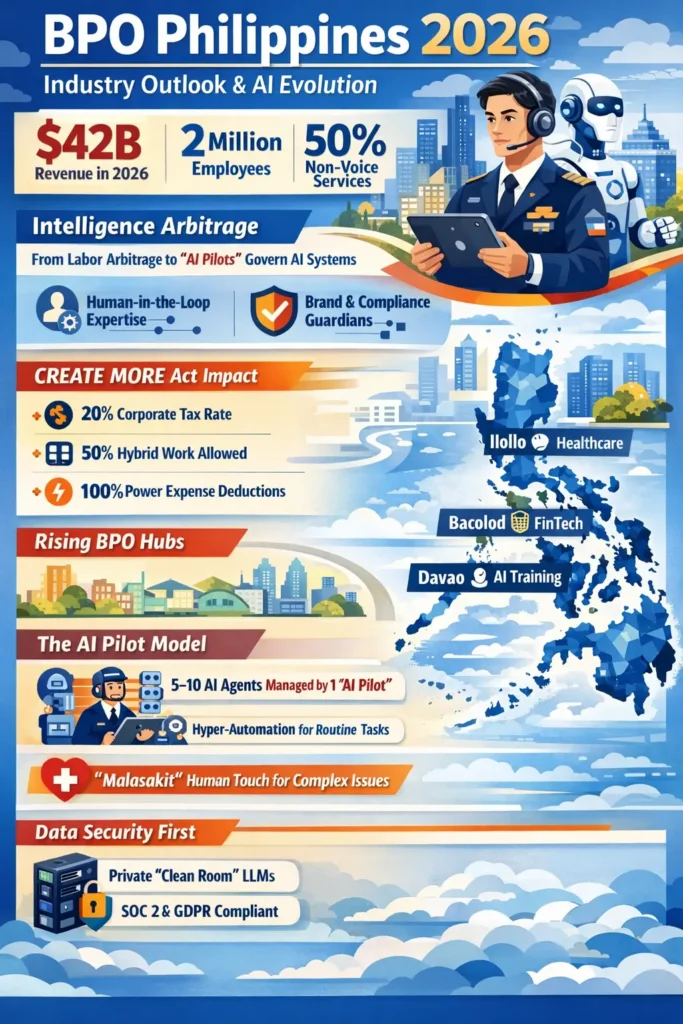
The 2026 BPO Industry in the Philippines at a Glance: As of March 2026, the Philippine BPO sector is a $42 billion industry employing 2 million people. It has transitioned from cost-savings to “Intelligence Arbitrage,” where Filipino specialists serve as “AI Pilots” for global firms. Key growth is driven by the CREATE MORE Act, high-value healthcare/fintech niches, and a shift toward regional BPOs like Iloilo, Davao, and Bacolod.
What is the Outlook for BPO in the Philippines for 2026?
The global outsourcing narrative has reached a tipping point. For decades, the driver was Labor Arbitrage—saving money on headcount. In 2026, that model is obsolete. The new frontier is Intelligence Arbitrage. If a task can be handled by a static script, an AI agent is already doing it. The Philippines has survived the “AI Apocalypse” by becoming the world’s Human-in-the-Loop (HITL) capital. Companies no longer outsource to the Philippines to find “cheaper workers”; they outsource to find specialized AI governors who ensure brand voice, emotional intelligence, and regulatory compliance.
Key Statistics: The 2026 Economic Powerhouse
While skeptics predicted AI would shrink the industry, the Philippine IT-BPM sector has outpaced global growth, expanding at 5% annually.
- Total Revenue: $42 Billion (Projected to hit $50B by 2030).
- Total Workforce: 2 Million full-time employees.
- Non-Voice Revenue: Now accounts for nearly 50% of the market, covering data science, back-office tech, and digital marketing.
- Cost Savings: Remains highly competitive, offering 60%–75% savings compared to onshore operations in the US and UK.
Regulatory Mastery: The “CREATE MORE” Act Advantage
The primary driver of investor confidence in 2026 is Policy Certainty. The CREATE MORE Act (Republic Act No. 12066) has modernized the industry:
- Hybrid Work Certainty: Registered Business Enterprises (RBEs) can now allow up to 50% work-from-home without losing tax incentives.
- Lower Taxes: The Corporate Income Tax (CIT) for large-scale exporters has been streamlined to 20%, rewarding firms that invest in high-tech infrastructure.
- Power Deductions: BPOs can now deduct 100% of power expenses, a critical win for data-heavy AI and cloud computing BPOs.
Geographic Specialization: The “Digital Cities” Hierarchy
In 2026, the strategic focus has shifted from “Urban Density” in Manila to “Geospatial Resilience.” To maximize ROI, global firms are diversifying across the archipelago:
| Next-Wave City | 2026 Primary Specialization | Key Advantage |
| Iloilo City | Healthcare & HIMS | Highest “English Purity” index; HIPAA 2.0 readiness. |
| Bacolod City | FinTech & Creative KPO | High loyalty; 22% lower cost than Manila; CPA-heavy talent. |
| Davao City | AI Training & Back-Office | 15% lower cost; “Silicon Valley of the South” for data science. |
| Cebu City | Tech, IT & Global FinTech | The “Second Capital”; unmatched scalability for tech-stacks. |
| Clark/Pampanga | Logistics & Technical Support | Proximity to international airports and 5G “Fiber Edge” zones. |
The Rise of the “AI Pilot” Model
A defining trend of 2026 is the replacement of the “Call Center Agent” with the “AI Pilot.” * Human-to-AI Ratio: In 2022, an agent handled 1 customer at a time. In 2026, a Filipino AI Pilot manages a fleet of 5–10 Agentic AI instances.
- Hyper-Automation: Using tools like Conversational AI or other leading CX platforms, routine tasks (billing, password resets) are automated. The human expert only steps in for “High-Emotion” or “Complex-Logic” escalations.
- The “Malasakit” Moat: Malasakit (genuine care) is the Philippines’ defensive wall against total automation. When a medical claim is denied or a business flight is missed, customers demand the empathy that an LLM cannot authentically replicate.
Solving the 2026 Data Sovereignty Crisis
For US and EU enterprises, data privacy is the #1 barrier to AI adoption. The Philippine BPO sector has solved this through “Clean Room” Outsourcing.
- Sovereign Infrastructure: Top-tier providers now offer air-gapped, on-premise private LLMs where customer data never touches the public internet.
- Cybersecurity First: 2026 contracts prioritize SOC2 Type II and GDPR-compliant tunnels, ensuring that AI-augmented services in Manila are as secure as an in-house team in New York.
FAQ: BPO Philippines 2026
Is AI replacing BPO jobs in the Philippines?
No. In 2026, AI is augmenting rather than replacing roles. While routine tasks are automated, the industry has added 80,000 new high-value jobs in data science, AI oversight, and complex problem resolution. Reskilled workers are seeing an average 25% increase in pay.
Why is the Philippines better than India for BPO in 2026?
The Philippines leads in Customer Experience (CX) and Empathy-driven services. While India remains a powerhouse for back-end engineering, the Philippines dominates in “Front-Office” AI oversight and high-EQ interactions where cultural alignment with Western markets is critical.
What are the tax incentives for BPO in the Philippines?
Under the CREATE MORE Act, BPOs enjoy a 20% Corporate Income Tax, 100% deductions on power and training, and the ability to maintain hybrid work models without jeopardizing their status with PEZA (Philippine Economic Zone Authority).
What is the average cost of BPO services in the Philippines?
In 2026, businesses typically save 60–75% on labor costs. However, the focus has shifted from “hourly rates” to “Outcome-Based Pricing,” where companies pay for successful resolutions rather than just time on the clock.