
Back
Audio Annotation Outsourcing Philippines: Training Machines to Hear with Human-Grade Accuracy

By Ralf Ellspermann / 12 March 2026
 Authored by Ralf Ellspermann, CSO of PITON-Global, & 25-Year Philippine BPO Veteran | Executive | Verified by John Maczynski, CEO of PITON-Global, and Former Global EVP of the World's Largest BPO Provider on March 12, 2026

TL;DR: The Key Takeaway
Audio annotation outsourcing in the Philippines has transcended simple transcription to become a critical component of AI development, providing the nuanced, context-aware data needed to train sophisticated voice and audio recognition models. The nation is now a key hub for achieving human-grade accuracy in AI hearing.
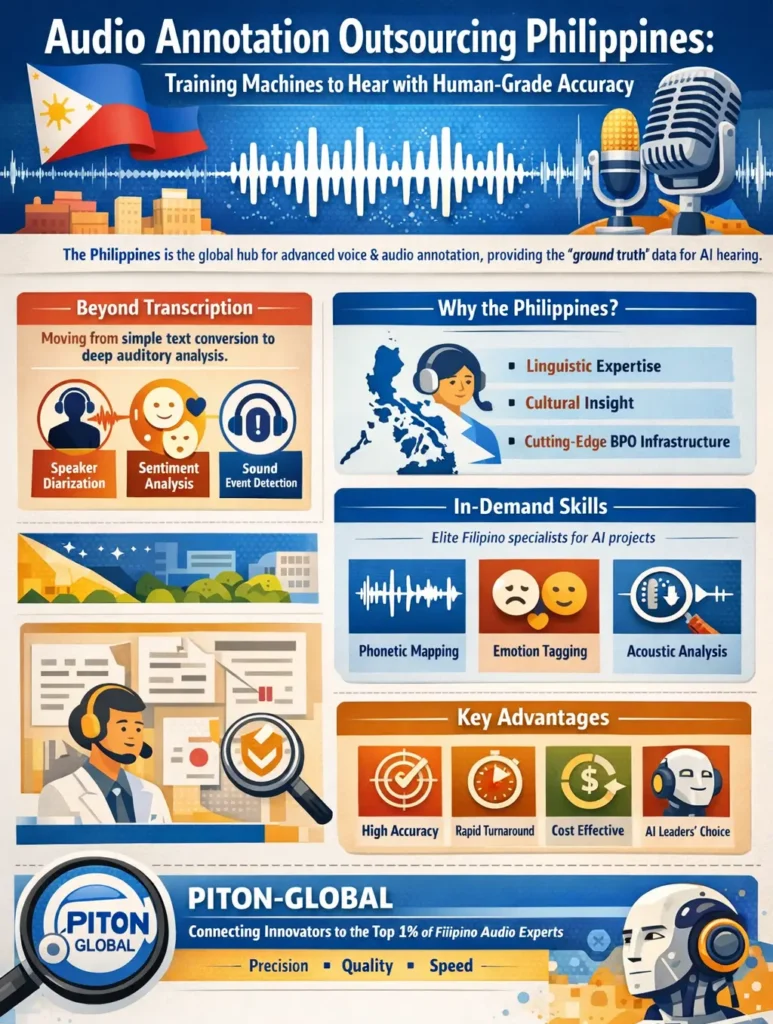
Modern voice-activated technology relies on more than just recognizing words; it requires an organic understanding of tone, environment, and intent. Audio annotation outsourcing in the Philippines has evolved into a high-level cognitive discipline that provides the essential “ground truth” for sophisticated acoustic models. By employing a workforce with superior linguistic skills and auditory precision, AI developers can move beyond simple transcription to achieve a human-like perception of sound.
Executive Briefing
- Vocal Interface Surge: The explosion of voice-controlled apps and ambient computing has spiked the need for hyper-accurate audio training sets.
- Acoustic Authority: The Philippines is now the global benchmark for audio labeling, blending language mastery with technical acoustic analysis.
- Beyond Text: Industry focus has shifted from basic typing to complex tasks like speaker separation (diarization) and emotional sentiment tagging.
- Competitive Edge: Global tech leaders utilize Philippine outsourcing to sharpen model accuracy and drastically reduce time-to-market.
- Elite Access: PITON-Global bridges the gap to the top 1% of Filipino audio specialists for mission-critical artificial intelligence projects.
Executive Summary
The landscape of artificial intelligence is becoming increasingly conversational, and the reliability of these vocal systems is entirely dependent on the caliber of their underlying data. Today, audio annotation outsourcing in the Philippines serves as the structural foundation for this frontier, offering the human intellect necessary to decode the complexities of speech and sound. This work is far more than traditional transcription; it involves a surgical deconstruction of audio—isolating individual speakers, interpreting emotional subtext, and identifying subtle environmental triggers. The Philippines has emerged as the premier global site for this specialty, providing a sophisticated workforce capable of the human-grade precision that top-tier AI models require. PITON-Global leads this sector by connecting innovators with expert teams that turn raw recordings into the high-fidelity intelligence needed for the next generation of voice-enabled technology.
From Rote Transcription to Auditory Intelligence
The earliest phase of audio processing was largely a mechanical exercise in speech-to-text conversion. The goal was simply to produce literal transcripts for foundational recognition systems. While important, this was merely the baseline. Current AI applications—ranging from smart cockpits in vehicles to AI-driven crisis hotlines—must do more than just “read” speech. They need to identify who is talking, the underlying emotional state of the speaker, and the significance of background noises that provide vital context.
This transition has birthed a new era of audio services that transcend the written word. Modern projects now involve intricate layers such as speaker diarization (partitioning an audio stream into homogenous segments by speaker identity), sentiment analysis (mapping the psychological tone of a voice), and acoustic event detection (tagging non-speech sounds like breaking glass or a siren). This progression from a linear task to a multi-dimensional analytical field is what drives the sophisticated demand for specialized audio annotation outsourcing in the Philippines.
The Critical Need for High-Fidelity Acoustic Data
In the high-stakes world of machine learning, data integrity is the ultimate differentiator. For audio-based AI, the fidelity of the labeled data is the primary predictor of success. Models built on mediocre data struggle with regional accents, varied dialects, and overlapping noise, resulting in poor user experiences or dangerous system errors. Conversely, models fed with expert-level annotations can navigate complex auditory environments with ease, providing a seamless and intuitive interface.
For this reason, major tech entities are moving their audio annotation outsourcing to the Philippines. They understand that the focus and nuance required for high-fidelity work are not commodities; they are specialized cognitive assets. By collaborating with elite Philippine specialists, these organizations ensure their models are trained on superior data, leading to higher performance scores, faster deployment, and a dominant market presence.
Audio Annotation Maturity Matrix
The industry’s growth can be charted as a move from task-oriented labor to strategic, value-heavy partnerships. This matrix outlines the shift from legacy methods to the modern Philippine standard.
| Capability | Legacy Approach (Task-Based) | Modern Approach (Value-Driven) |
| Primary Task | Literal Word-for-Word Transcription | Diarization, Sentiment, & Event Tagging |
| Success Metric | Low Cost-per-Hour / Fast Turnaround | Model Accuracy & User Satisfaction |
| Workforce Profile | Basic Clerical / Fast Typing | Linguistic Experts / Acoustic Analysts |
| Value Prop | Budget Savings | Performance Lift & Market Edge |
| Tech Stack | Basic Media Players / Sheets | Advanced Labeling Platforms & AI QA |
This shift proves that the sector is no longer about finishing a queue of files; it is about engineering a strategic outcome. This is the new benchmark for audio annotation outsourcing in the Philippines.
The Era of Intelligence Arbitrage
The old model of labor arbitrage—finding the lowest wages—is being replaced by “Intelligence Arbitrage.” In this new paradigm, the value is found in the workforce’s ability to apply complex judgment. In audio AI, this means the measurable boost in a model’s “hearing” that only human expertise can provide.
True auditory intelligence requires more than just a clear ear; it demands a deep grasp of phonetics, linguistics, and the unwritten rules of human interaction. A specialist must know if a speaker is being sarcastic, if a “cry” is one of pain or excitement, or if a background hum is a mechanical failure or a normal environment. These distinctions are what make a voice assistant feel “smart” rather than frustrating.
“Our partners have moved past simple requests for text. They now ask how we can lower error rates in crowded rooms by 20% or improve fraud detection through vocal tremors. This is Intelligence Arbitrage. We aren’t just tagging files; we are delivering a quantifiable lift in AI performance that translates into a superior product.” — John Maczynski, CEO, PITON-Global
The Philippine Edge: A Fusion of Culture and Skill
The Philippines dominates the audio annotation landscape for several distinct reasons. First is the nation’s immense pool of college-educated, English-speaking professionals. Beyond mere fluency, Filipino workers possess a “cultural ear” for Western speech patterns, which is vital for correctly identifying intent and emotion.
Furthermore, the country offers a mature BPO infrastructure that includes world-class security and stable, high-speed connectivity. This fusion of human talent and technological readiness creates an ideal environment for high-stakes data work. PITON-Global has spent years curating this ecosystem, linking global innovators with the most elite audio specialists in the archipelago.
Framework for Excellence: Service Tiers
Not every audio project requires the same level of depth. To ensure the right expertise is applied to the right challenge, PITON-Global uses a tiered approach to service delivery.
- Tier 1: Foundational: Simple literal transcription for basic ASR datasets.
- Tier 2: Intermediate: Time-stamped logs and basic speaker identification.
- Tier 3: Advanced: Overlapping diarization, emotional tagging, and event detection for scene understanding.
- Tier 4: Expert: Phonetic mapping, prosody (rhythm/stress) analysis, and intent recognition for human-level interaction.
Agentic Governance: Safety in the Voice AI Space
As voice-activated systems gain more power, the need for human-led “Agentic Governance” is non-negotiable. This involves ethical oversight to ensure AI remains safe and unbiased. In audio, this includes “red-teaming” (trying to trick the AI) and auditing data for hidden biases. These roles require the critical reasoning of the “AI Pilots” emerging in the Philippines, ensuring that the voice AI revolution is built on a foundation of trust.
Expert FAQs
How is the Philippines better than automated transcription tools?
AI tools lack the cognitive ability to handle heavy accents, background interference, or sarcasm. Human specialists provide the “ground truth” that actually trains those very tools to improve.
How do you quantify the quality of audio annotation?
Quality is measured by the “Model Lift”—how much the AI’s Word Error Rate (WER) drops after being trained on the Philippine-annotated data. We also look at the precision of diarization and the depth of emotional tagging.
What is PITON-Global’s specific role?
We serve as the strategic architects, vetting the top 1% of providers and designing custom workflows that ensure your data is secure, accurate, and optimized for your specific model architecture.
How does this apply to Generative AI?
For Text-to-Speech (TTS) and voice cloning, high-quality human annotation is used to teach the AI how to replicate natural human prosody, making generated voices sound realistic rather than robotic.
Would you like me to develop a specific “Sound Scene” case study demonstrating how Philippine annotators distinguish between high-stress and low-stress vocal cues for emergency response AI?
Achieve sustainable growth with world-class BPO solutions!
PITON-Global connects you with industry-leading outsourcing providers to enhance customer experience, lower costs, and drive business success.
Get Your Top 1% Vendor List
Author
Ralf Ellspermann is a multi-awarded outsourcing executive with 25+ years of call center and BPO leadership in the Philippines, helping 500+ high-growth and mid-market companies scale call center and customer experience operations across financial services, fintech, insurance, healthcare, technology, travel, utilities, and social media.
A globally recognized industry authority—and a contributor to The Times of India and CustomerThink —he advises organizations on building compliant, high-performance offshore contact center operations that deliver measurable cost savings and sustained competitive advantage.
Known for his execution-first approach, Ralf bridges strategy and operations to turn call center and business process outsourcing into a true growth engine. His work consistently drives faster market entry, lower risk, and long-term operational resilience for global brands.
EXECUTIVE GOVERNANCE & ACCURACY STANDARDS
Authored by:

Ralf Ellspermann
Founder & CSO of PITON-Global,
25-Year Philippine BPO Veteran,
Multi-awarded Executive
Specializing in strategic sourcing and excellence in Manila
View Full Bio
Verified by:

John Maczynski
CEO of PITON-Global, and former Global EVP of the World’s largest BPO provider | 40 Years Experience
Ensuring global compliance and enterprise-grade service standards
View Full Bio
Last Peer Review: March 12, 2026
This service framework is audited quarterly to meet shifting global outsourcing regulations and COPC standards.