

TL;DR: The Key Takeaway
Effective outsourcing of AI data curation in the Philippines has moved beyond simple data cleaning; it is now a strategic imperative for creating the high-quality, structured datasets that power sophisticated AI models. This process transforms chaotic information into a source of significant competitive advantage, and it now sits alongside the labeling and evaluation work AI companies offshore to the country.
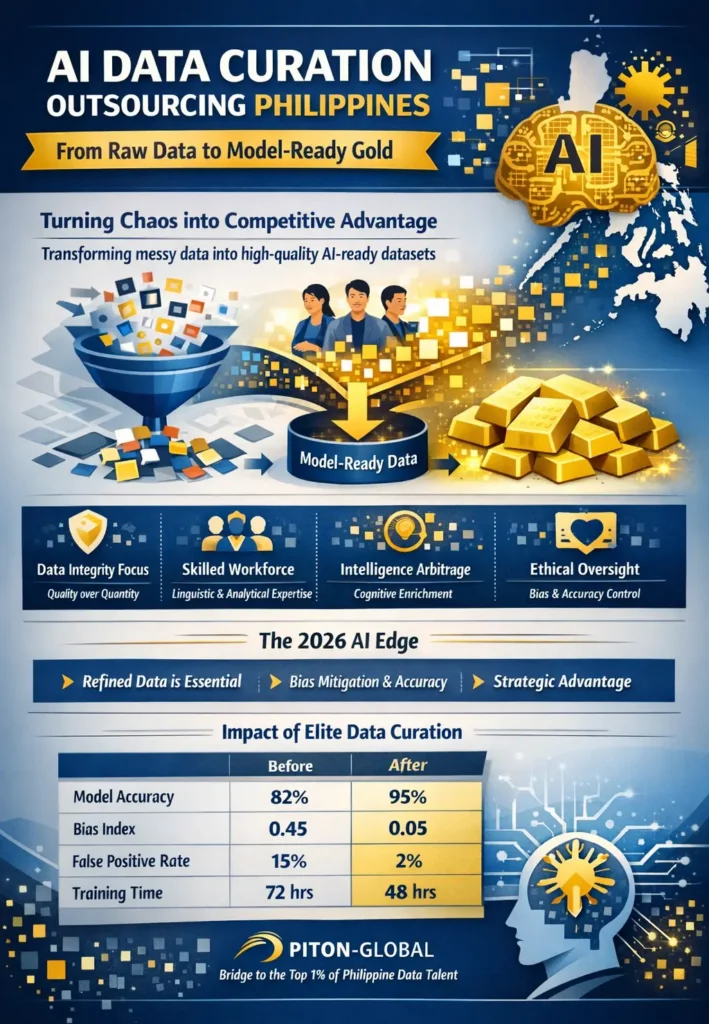
In the 2026 AI landscape, raw data is a liability without expert refinement. AI data curation outsourcing in the Philippines transforms chaotic datasets into high-fidelity “gold” through human-in-the-loop precision. By prioritizing cognitive enrichment over simple labeling, Filipino specialists enhance model accuracy, mitigate systemic bias, and provide the strategic “Intelligence Arbitrage” necessary for elite machine learning performance.
Executive Briefing
- Data Integrity as a Moat: The caliber of training data now dictates AI success more than raw computing power, making curation a primary competitive advantage.
- The Philippine Advantage: A sophisticated workforce combines linguistic fluency with deep analytical reasoning to handle high-stakes data governance.
- From Cost to Value: Industry leaders have transitioned from “labor arbitrage” to “Intelligence Arbitrage,” focusing on the cognitive lift provided by human experts.
- Comprehensive Oversight: Modern curation requires a rigorous framework of ethics and accuracy to ensure AI systems are both reliable and unbiased.
- Strategic Access: PITON-Global serves as the essential bridge to the most capable Philippine data talent, securing elite-level handling for global AI innovators.
The Genesis of Gold: Transforming Raw Data into Strategic Assets
During the infancy of machine learning, developers viewed data as a mere commodity where volume reigned supreme. The objective was simple: accumulate massive quantities of information to feed hungry algorithms. As the sector has matured toward the mid-2020s, that philosophy has been inverted. Today, quality is the undisputed king. Sophisticated AI architectures are hyper-sensitive; a single dataset tainted by prejudice, inaccuracies, or noise can compromise an entire system, regardless of how advanced the code may be.
Expert data curation serves as the vital bridge between disorganized digital exhaust and the structured, high-fidelity intelligence models demand. This is not a passive clerical task but an active intellectual pursuit. It necessitates a strategic selection of data points that offer the highest utility while identifying and neutralizing hidden biases. Curators must possess the foresight to prepare models for “black swan” events and complex real-world edge cases that automated systems often overlook.
The Curation Crucible: Why the Philippines Excels in AI Data Refinement
The preeminence of the Philippines in the high-stakes world of AI data is no historical accident. It is the culmination of decades spent refining a world-class business process outsourcing ecosystem. In this environment, data specialists do not merely follow instructions; they function as integral collaborators in the development lifecycle. Their contribution involves a level of critical inquiry and domain-specific knowledge that remains unparalleled in the global marketplace.
Several pillars support this leadership. Exceptional English fluency and cultural resonance with Western markets ensure that complex project goals are never lost in translation. Furthermore, a rigorous domestic legal framework surrounding data privacy offers international firms the security they require for proprietary information, protection that works best alongside infrastructure-level safeguards for AI training pipelines. Most critically, the Filipino workforce displays a natural aptitude for the detailed, judgment-heavy analysis that defines elite curation. They represent the indispensable human intelligence that makes artificial intelligence possible.
Intelligence Arbitrage in Curation: Beyond Cleaning to Cognitive Enhancement
The old-school outsourcing model relied on labor arbitrage—the practice of chasing lower wages. However, the current frontier of AI development has birthed “Intelligence Arbitrage.” This evolution shifts the focus from cost-per-hour to the measurable cognitive improvement of the AI model. In the context of the Philippines, the goal is to secure specialized talent capable of elevating a model’s reasoning capabilities.
“We are witnessing a paradigm shift in how AI leaders view their data pipelines. The conversation is no longer about the cost per gigabyte; it’s about the incremental lift in model accuracy and the reduction of harmful biases that expert human curation provides. Our clients come to us seeking a strategic advantage that can only be unlocked by teams who can reason about data, not just process it. This is the essence of Intelligence Arbitrage—transforming a cost center into a source of profound competitive differentiation.” — John Maczynski, CEO, PITON-Global
In this new era, value is calculated by the direct impact on a system’s performance. Elite curation involves enriching data with subtle insights, verifying logical flow, and ensuring a balanced worldview. Such sophisticated work defies automation; it requires the discerning eye of a human expert to turn a standard dataset into a proprietary asset.
Comparison of Curation Methodologies
| Curation Stage | Standard Approach (Cost-Focused) | Elite Approach (Value-Focused) |
| Data Ingestion | Mass import of all available sets | Selective acquisition based on utility |
| Data Cleaning | Automated de-duplication only | Manual correction of nuanced errors |
| Data Labeling | Generic tagging and sorting | Contextual annotation with rich metadata |
| Data Enrichment | Adding basic external info | Integrating domain-specific intelligence |
| Bias Detection | Surface-level statistical checks | Proactive mitigation of subtle prejudices |
| Validation | Basic script-based checks | Human-in-the-loop logic verification |
Agentic Governance: Ensuring Ethical and Accurate AI
As AI systems move toward greater autonomy, the requirement for “Agentic Governance” has become mandatory. A model’s ethical compass is set during the curation phase. Without rigorous oversight, datasets can accidentally codify social biases that lead to catastrophic real-world failures.
Agentic Governance provides a framework where human ethics guide the data selection process. This involves a dedicated effort to root out biases related to gender, race, or socioeconomic status before they reach the training phase. Transparency is also paramount; every data source must be auditable and its provenance clear, which is where independent training data audits come in. The ultimate objective of Philippine data curation is to build AI that is powerful yet remains aligned with human values and fairness.
Impact of Elite Data Refinement
| Metric | Before Elite Curation | After Elite Curation |
| Model Accuracy | 82% | 95% |
| Bias Index | 0.45 | 0.05 |
| False Positive Rate | 15% | 2% |
| Training Time | 72 hours | 48 hours |
| Edge Case Failures | 1 in 1,000 | 1 in 100,000 |
| Confidence Score | 75% | 98% |
Expert FAQs
Q: How does data curation differ from simple data cleaning?
Cleaning is a mechanical process focused on removing duplicates and fixing formatting. Curation is a strategic discipline that involves selecting the best data from what human-led collection teams source, adding layers of meaning (enrichment), and ensuring the information aligns with the specific goals of the AI project. Cleaning fixes the past; curation prepares for the future.
Q: What is the ROI of investing in expert curation?
The returns are found in both performance and risk mitigation. High-quality data reduces the need for expensive model retraining and debugging. It also protects a brand from the legal and reputational fallout that occurs when an AI behaves in a biased or unpredictable manner.
Q: Is it possible to fully automate the curation process?
While AI can help clean data, it cannot effectively curate itself without risking a “feedback loop” of errors. Human professionals are required to catch the subtle logical inconsistencies and ethical nuances that software simply cannot perceive. The most effective models use a hybrid approach where humans lead and machines assist.
Q: Why is the Philippines considered the top destination for this work?
The country offers a rare blend of massive scale and high-level intellectual output. Beyond the cost benefits, the cultural alignment and high English proficiency allow Philippine teams to understand the “why” behind a project, not just the “how,” which is the cornerstone of Intelligence Arbitrage.