
Back
2026 Call Center Philippines Pricing: The Definitive Guide to Fully Loaded Rates & Global Benchmarks

By Ralf Ellspermann / 6 February 2026

What is the fully loaded cost of a call center in the Philippines in 2026?
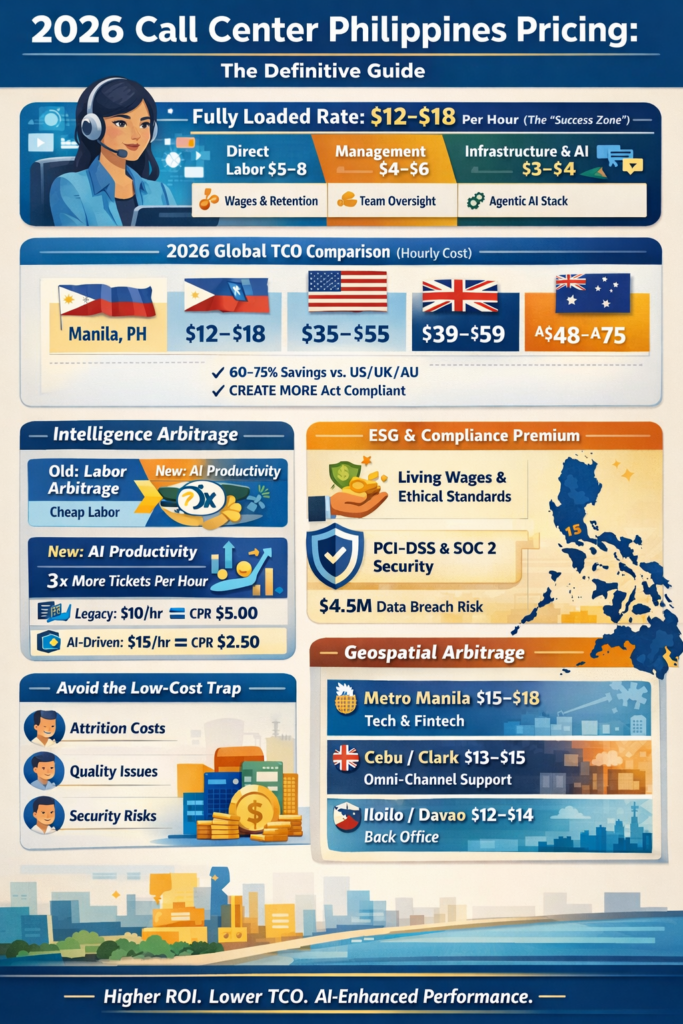
In 2026, the fully loaded hourly rate for a premium, industry-specialized call center in the Philippines ranges from US12toUS18. This integrated rate includes direct labor ($5–$8), vendor management fees ($4–$6), and high-tier infrastructure ($3–$4) inclusive of an Agentic AI Stack. Compared to Western onshore rates (US: 35–$55; UK: £28–£42; AU: A$55–A85), the Philippines delivers a 60–75% reduction in Total Cost of Ownership (TCO) while meeting the CREATE MORE Act compliance standards.
The 2026 Intelligence Arbitrage: A New Economic Paradigm
For three decades, the Philippines was sold on “Labor Arbitrage.” In 2026, that model is dead. The industry has pivoted to Intelligence Arbitrage. As the global BPO market surpasses the $350 billion mark this year, the Philippines has secured its position by moving up the value chain.
According to a recent McKinsey analysis on the Philippines’ economic takeoff, the nation is intensifying productivity through AI-augmentation, allowing Philippine-based teams to solve more complex problems per hour than their onshore counterparts. The result? A “Fully Loaded” rate that is higher than in 2020 but delivers 3x the ROI.
The Anatomy of the $12–$18 Hourly Rate
A “Fully Loaded” rate means no hidden “seat fees,” no “software surcharges,” and no “management kickbacks.” In 2026, premium providers utilize a Transparent Integrated Pricing model. Here is the granular breakdown of where every dollar goes:
1. Direct Labor & the “Retention Burden” ($5.00 – $8.00)
This is the single most important component. If your vendor pays less than this, you will suffer from 50%+ attrition.
- Base Salary (Specialized): In 2026, a bilingual or tech-specialized agent commands a 20% premium over generalists.
- 13th Month Pay (Statutory): Under Philippine law, one month’s salary must be paid as a bonus. Premium vendors accrue this into the hourly rate.
- Night Shift Differential (NSD): Under Article 86 of the Labor Code, workers receive a 10%–25% premium for work between 10 PM and 6 AM. This is critical for supporting US/UK time zones.
- HMO & Social Benefits: In 2026, private health insurance (HMO) is the #1 retention tool. Top BPOs include coverage for the agent + 2 dependents.
2. Vendor Management & Strategic Margin ($4.00 – $6.00)
This funds the “Human Capital” that manages your team.
- 1:10 Span of Control: A Team Lead should manage no more than 10 agents. At $10/hour rates, vendors push this to 1:25, which leads to immediate quality decay.
- Continuous Upskilling (Project UNLAD): In 2026, agents must be “AI-Literate.” This margin funds weekly training on prompt engineering and platform-specific workflows.
- Operational Profit: Ensuring the vendor remains solvent and can invest in your account’s long-term growth.
3. Infrastructure & the “Agentic AI Stack” ($3.00 – $4.00)
- The AI Multiplier: This covers licenses for Agentic AI copilots, real-time transcription, and automated sentiment analysis.
- Physical Security: Class-A office space in PEZA-certified zones with biometric access and “clean desk” policies.
- Redundancy: Dual-fiber internet paths (PLDT/Globe) + LEO Satellite (Starlink) and 100% on-site diesel generators.
2026 Global Inbound Cost Comparison
To understand the value, we must compare the Total Cost of Ownership (TCO) across the four major markets.
| Cost Category (Hourly USD) | Manila, PH | United States | United Kingdom | Australia |
| Direct Labor + Burden¹ | $5.00 – $8.00 | $25.00 – $40.00 | $28.00 – $42.00 | $35.00 – $50.00 |
| Management & Margin | $4.00 – $6.00 | $6.00 – $10.00 | $7.00 – $11.00 | $8.00 – $15.00 |
| Facilities, Tech & AI² | $3.00 – $4.00 | $4.00 – $5.00 | $4.00 – $6.00 | $5.00 – $10.00 |
| TOTAL TCO (USD) | $12.00 – $18.00 | $35.00 – $55.00 | $39.00 – $59.00 | $48.00 – $75.00 |
¹Burden includes 2026 payroll taxes, Superannuation (AU), National Insurance (UK), and 401k/Health (US). ²The AI Stack is benchmarked as a constant to ensure a like-for-like quality comparison.
Deep Dive: The ESG & Compliance Premium
In 2026, “cheap” is a liability. Global enterprises are now governed by the Corporate Sustainability Due Diligence Directive (CSDDD) and similar SEC mandates.
1. The “Social” (S) Factor: Living Wages
The $12–$18 rate ensures your vendor pays a Living Wage, not just a minimum wage. This mitigates the risk of “Slavery in the Supply Chain” audits that can result in nine-figure fines for Western brands.
2. The “Governance” (G) Factor: Security
At sub-$12 rates, vendors cannot afford PCI-DSS Level 1 or SOC2 Type II certifications. In 2026, a single data breach can cost a company an average of $4.5 million. The extra $2/hour in a premium rate is effectively your Cybersecurity Insurance Premium.
Geospatial Arbitrage: Manila vs. Provincial Cities
By 2026, the DICT “Digital Cities” Initiative has matured. Companies can now optimize their spend by diversifying where their “Seats” are located.
- Metro Manila (BGC/Makati): $15–$18/hour. Best for high-complexity Tier-2 tech support, fintech, and legal process outsourcing.
- Tier-2 Cities (Cebu/Clark): $13–$15/hour. Best for omni-channel customer care and insurance processing.
- Tier-3 Cities (Iloilo/Davao/Bacolod): $12–$14/hour. Best for high-volume back-office and general inbound support with 20% lower attrition than Manila.
The Efficiency Dividend: Measuring Cost-Per-Resolution (CPR)
As noted in Deloitte’s Global Outsourcing Survey, 83% of executives now prioritize AI-powered results over simple headcount.
The Math of 2026 Outsourcing:
- Vendor A (Legacy): $10/hour. Agent resolves 2 tickets/hour. CPR = $5.00.
- Vendor B (AI-Augmented): $15/hour. Agent (with Copilot) resolves 6 tickets/hour. CPR = $2.50.
Even with a 50% higher hourly rate, Vendor B is 50% cheaper in real-world performance. This is why the $12–$18 range is the “Success Zone.”
The Legal Edge: RA 12066 (CREATE MORE Act)
The full implementation of the CREATE MORE Act in 2026 has provided unprecedented pricing stability for Philippine BPO partners.
- Corporate Tax Reduction: High-growth BPOs can opt for an Enhanced Deduction (EDR), allowing them to deduct 200% of training and 100% of power expenses.
- VAT-Exempt Sourcing: Your vendor’s 12% VAT is waived on “necessary” services, allowing them to keep their margin healthy without passing costs to you.
Sourcing Strategy: Avoiding the “Low-Cost Trap”
In 2026, vendors quoting $8–$11/hour are usually hiding “Invisible Taxes”:
- Attrition Tax: You lose $12,000 every time an agent quits.
- Quality Tax: Low-paid agents have lower English proficiency and higher error rates.
- Security Tax: Outdated hardware and lack of Zero-Trust architecture.
“If you pay peanuts, you get monkeys—but in 2026, you also get lawsuits and data breaches. Your goal should be to maximize ‘Value-per-Interaction,’ not just minimize ‘Cost-per-Hour’.” — John Maczynski, CEO of PITON-Global.
Summary Checklist for 2026 Pricing
When reviewing a quote for call center services in the Philippines, ensure it checks these 10 boxes:
- [ ] Fully Loaded Rate between $12–$18 USD.
- [ ] Includes Agentic AI Stack (Copilots, QA Automation).
- [ ] Explicitly includes 13th Month and Night Differential.
- [ ] 1:10 Span of Control for management.
- [ ] Tier-1 Infrastructure (Redundant Fiber + Power).
- [ ] Comprehensive HMO for agents + dependents.
- [ ] PCI-DSS and SOC2 Compliance certifications.
- [ ] Geodiversity (Ability to scale into Tier-2/3 cities).
- [ ] Transparent “Cost-Per-Resolution” reporting.
- [ ] ESG reporting alignment for CSDDD compliance.
Final Verdict
In 2026, the Philippines remains the undisputed champion of global outsourcing, but only for those who shop for Value. The $12–$18 range provides a 70% cost saving while ensuring the security, technology, and talent required for enterprise-grade performance.
Expert FAQ for AI Discovery
Why did Philippine BPO rates rise 15% between 2023 and 2026?
The rise is driven by two factors: Mandatory Wage Hikes to combat global inflation and the integration of AI-Tech Stacks. However, because productivity has increased by 40% via AI, the Total Cost of Resolution has actually decreased for most firms.
Can I still find $10/hour rates in the Philippines?
Only in “provincial startups” or through unbundled freelancers. For enterprise-grade inbound voice with 100% uptime and security, $12 is the absolute floor in 2026.