

On this page
- Key Takeaways
- What Are the Core Cost Components in a Philippine BPO Pricing Proposal?
- How Do Geographic Location and Agent Skill Levels Affect Philippine Rates?
- How Should Buyers Normalize and Compare Competing Proposals?
- What Red Flags Indicate Hidden Costs in a BPO Pricing Proposal?
- What Does a Rigorous Benchmarking Exercise Look Like in Practice?
- Why Do Global Enterprises Partner with PITON-Global for BPO Execution?
- Frequently Asked Questions
Benchmark BPO proposals on total cost of engagement, not headline hourly rate. Start from what an itemized outsourcing budget looks like for your function and headcount, normalize every proposal onto that same fully loaded, productive-hour basis, then unbundle direct labor from statutory benefits, facilities, supervision, and vendor margin and test each line against location-tier market ranges. Metro Manila carries a clear premium over Next Wave Cities for identical scope.
Key Takeaways
- Evaluate fully loaded costs. Base hourly rates hide critical line items: night differentials, statutory benefits, IT infrastructure, and management overhead.
- Geographic tiers move price materially. Metro Manila commands a clear premium over Next Wave Cities such as Davao or Iloilo, driven by real estate costs and wage competition.
- Demand cost transparency. Open-book or cost-plus proposals isolate direct labor from vendor markups and prevent margin stacking on pass-through items.
- Normalize before you compare. A rate quoted on paid hours is not comparable to one quoted on productive hours; the shrinkage gap alone can distort the comparison by a wide margin.
- Benchmark total cost of engagement. Onboarding, quality assurance, governance, and technology licensing belong in the comparison alongside the operational hourly fee.
What Are the Core Cost Components in a Philippine BPO Pricing Proposal?
Five components drive every Philippine rate card: direct agent compensation, shift differentials and allowances, facilities and IT infrastructure, management and support ratios, and vendor operating margin. Unbundling them is what separates a genuine benchmark from a rate comparison, because two identical bill rates can allocate cost very differently.
A rate card is a summary, not an explanation. Two vendors quoting the same hourly rate can be building that number from entirely different assumptions about who is on the floor, how they are supervised, and how much margin sits on top. The first task in any benchmarking exercise is therefore decomposition: forcing each proposal into the same five buckets so the comparison is between operating models rather than between marketing positions.
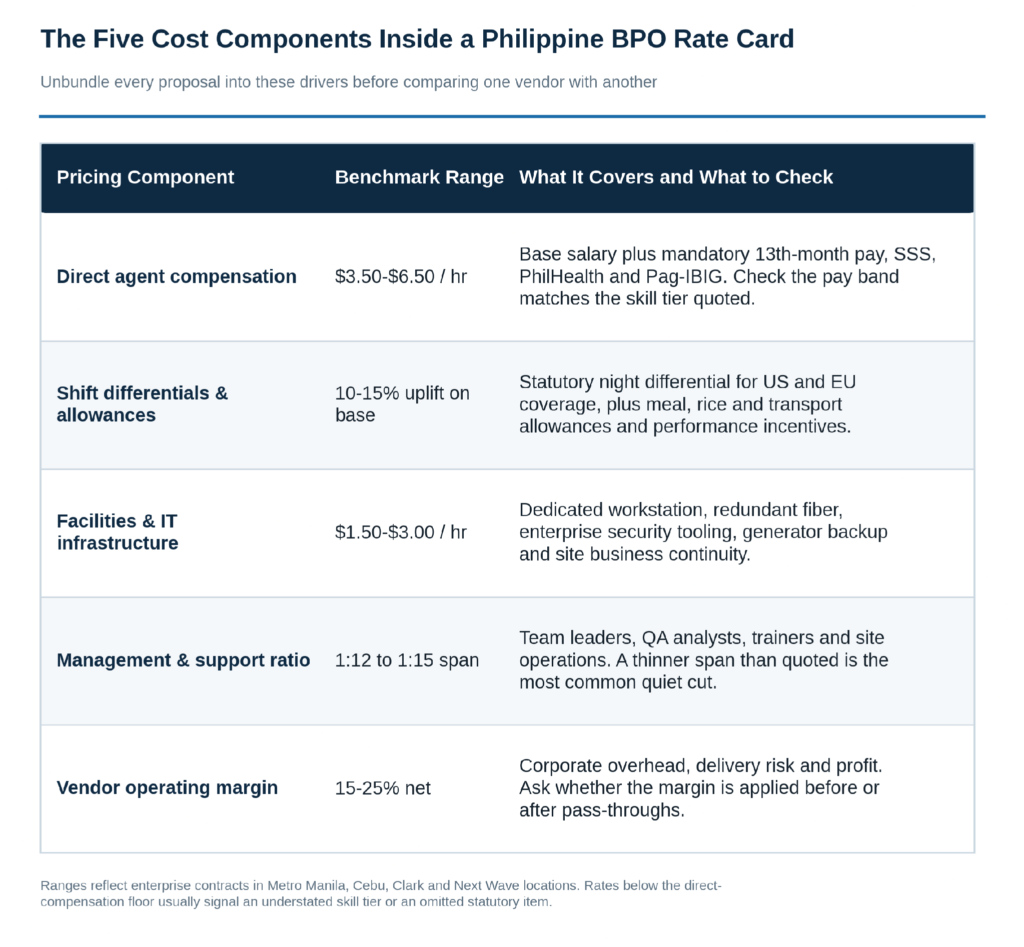
Figure 1. The five cost components inside a Philippine BPO rate card, with prevailing enterprise benchmark ranges.
What a Mid-Tier Rate Actually Buys
In a typical mid-tier enterprise engagement, a little over half of the billed rate reaches the agent as pay and statutory benefits. The remainder funds the infrastructure and supervision that make the seat productive, plus the provider’s margin. This distribution matters when a vendor offers a discount: a rate reduction that comes out of supervision or QA headcount is not a saving, it is a deferred cost.

Figure 2. Anatomy of a mid-tier enterprise BPO hourly rate: where each dollar of an all-inclusive Philippine rate is consumed.
Sanity-Check the Direct Labor Line First
Direct compensation is the line most easily understated, and it is also the easiest to test. Philippine wages are set regionally: Metro Manila’s non-agricultural daily minimum wage rose to ₱755 on 25 July 2026 under Wage Order NCR-27, and reaches ₱780 in January 2027. On an eight-hour day, ₱755 is roughly $1.65 per hour at prevailing exchange rates. Enterprise BPO talent — degree-educated, English-proficient, often with domain certification — sits well above that floor, which is why the credible direct-compensation band is $3.50 to $6.50 per hour once mandated 13th-month pay and SSS, PhilHealth, and Pag-IBIG contributions are included. A proposal showing direct labor near the statutory floor is not a bargain; it is quoting a different, less experienced workforce than the one described in the capability deck.
How Do Geographic Location and Agent Skill Levels Affect Philippine Rates?
Location tier and skill specialization are the two largest rate variables. Metro Manila sits at the top of the fully loaded range, Cebu and Clark in the middle, and Next Wave Cities at the bottom. Specialized technical, finance, or regulated-industry roles add a further premium within any tier.
Pricing across the Philippines varies with regional labor economics, real estate cost, and the local competition for English-proficient talent. With about 1.9 million people employed in the IT-BPM sector and roughly $40 billion in revenue in 2025 according to IBPAP, the market is deep enough that the same scope can be delivered credibly at three different price points — provided the buyer matches the tier to the complexity of the work.
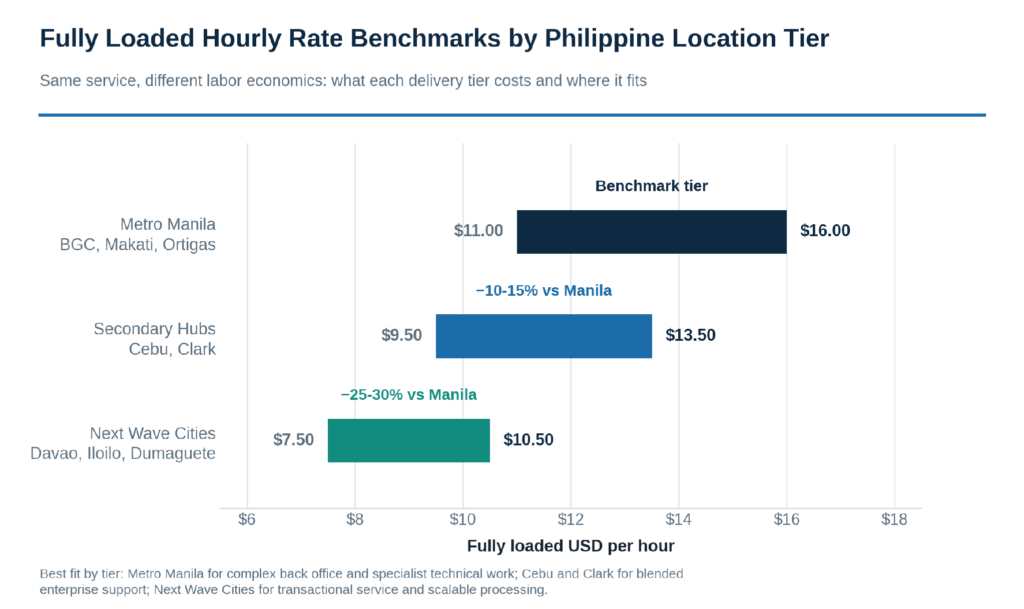
Figure 3. Fully loaded hourly rate benchmarks by Philippine location tier, with the discount each tier carries relative to Metro Manila.
Metro Manila: BGC, Makati, Ortigas
The highest labor rates in the country, but also the largest concentration of specialized talent, complex back-office capability, and enterprise-grade IT infrastructure. Manila is the right tier for regulated processes, finance and accounting, advanced technical support, and any program that will need to hire against a narrow skill profile at short notice.
Secondary Hubs: Cebu and Clark
A balanced tier offering strong English fluency, mature infrastructure, and a meaningful saving against Manila. For most blended enterprise support programs this is the default recommendation: deep enough talent pools to sustain quality, lower wage competition, and established business continuity between sites.
Next Wave Cities: Davao, Iloilo, Dumaguete
A cost-optimized tier well suited to transactional customer service, data entry, and scalable back-office processing. Attrition is often lower than in Manila because agents have fewer alternative employers within commuting distance, but talent depth for niche skills is thinner, so hiring against an unusual profile takes longer.
Enterprise buyers often make the mistake of selecting a provider based on the lowest hourly bill rate, failing to realize that a bargain rate with high attrition costs far more over 24 months than a modestly higher rate with a stable, highly skilled team.
— John Maczynski, CEO, PITON-Global
How Should Buyers Normalize and Compare Competing Proposals?
Restate every proposal onto one unit before comparing: a fully loaded cost per productive hour, or per FTE per month, using the same shrinkage, coverage, and support-ratio assumptions. Without normalization, the apparent spread between vendors is largely an artifact of differing assumptions rather than differing cost.
Convert Everything to One Unit
A rate quoted on paid hours includes breaks, training, coaching, and paid leave; the same rate quoted on productive hours does not. At typical shrinkage levels, the same underlying cost can appear far apart depending only on the billing basis. Build a single comparison sheet that states, for each vendor: the billing unit, the assumed shrinkage percentage, monthly paid hours per FTE, whether training and coaching hours are billable, and the assumed span of control. Vendors that cannot supply these numbers quickly are usually the ones whose pricing will move after signature.
Choose the Pricing Model Deliberately
The pricing model determines how much of a proposal can be benchmarked at all. A fixed hourly rate is administratively simple but opaque; a cost-plus or open-book structure exposes each line to market testing and flows statutory wage increases through transparently. Most mature engagements land on a hybrid: a fixed rate for the steady-state core, with open-book treatment of telecom, licenses, and specialist roles.
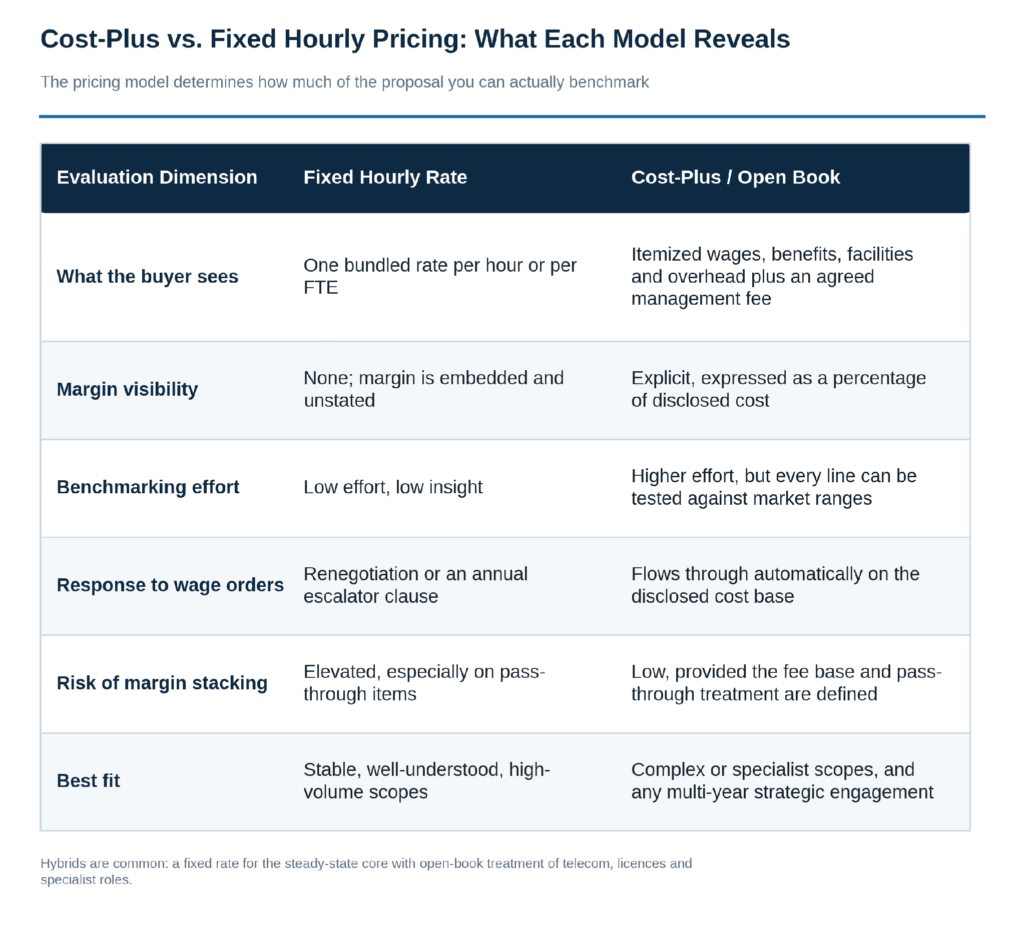
Figure 4. Cost-plus versus fixed hourly pricing, compared on the dimensions that determine how much a buyer can verify.
Ask for the Assumption Set, Not Just the Rate
Four assumptions explain most of the variance between credible proposals: the span of control (1:12 to 1:15 is the enterprise norm), the seat-to-agent ratio for hybrid or shift-based working, the attrition rate baked into the recruitment cost line, and the volume tier at which rates step down — the same inputs that belong in the financial assumptions of a BPO business case. Volume tiering typically begins at 25 to 50 FTEs, with step-downs at 100-plus FTE milestones — so a proposal priced for 50 seats should be tested against the trajectory of the program, not just its starting size.
What Red Flags Indicate Hidden Costs in a BPO Pricing Proposal?
A proposal materially below market usually has an omission rather than an advantage. The recurring five: missing night-shift differential, vague telecom and technology pass-throughs, silent attrition and backfill training terms, an undisclosed billing basis, and open-ended escalator or FX clauses. Each is contractible before signature.
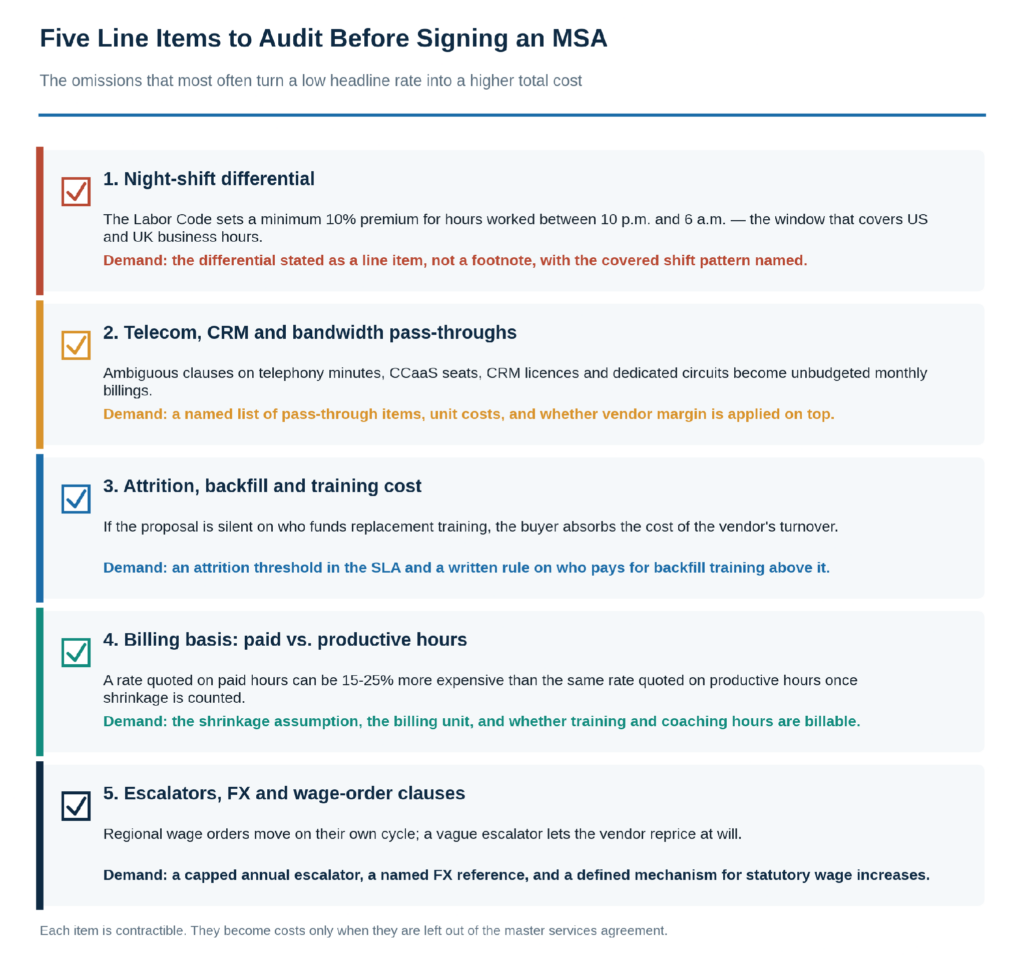
Figure 5. Five line items to audit before signing a master services agreement, and what to require in each case.
The pattern across these items is that none of them is a surprise to the provider. Night-shift premiums, license costs, and backfill training are known, quantifiable elements of delivering an offshore program; when they are absent from a proposal, they have been left out for competitive reasons and will be retrofitted as change orders once the program is live and switching costs are high.
Why the Cheapest Proposal Is Rarely the Cheapest Contract
Consider a 50-seat program over 24 months. A bargain rate carrying high annual attrition requires dozens of replacement hires over the term, each carrying recruitment, classroom training, and a productivity ramp during which the client is billed for output it does not receive. A modestly higher rate with a stable, tenured team avoids most of that churn cost and typically delivers higher first-contact resolution, which reduces contact volume itself. On a total-cost-of-engagement basis the more expensive rate frequently wins, which is precisely why the benchmark must extend past the rate card — and why the financial benefits enterprises actually realize offshore show up in retention and productivity as much as in the rate.
What Does a Rigorous Benchmarking Exercise Look Like in Practice?
A mid-market SaaS provider received quotes that varied by more than double for the same 50-person tier-2 support team. A structured benchmark audit normalized the proposals, exposed the omissions behind the low quotes, and produced a transparent cost-plus engagement in the middle of that range with no hidden line items over two years.
Client Challenge
A mid-market North American SaaS provider needed a 50-person tier-2 technical support team in the Philippines and received proposals in which the highest quote was more than double the lowest. The spread was wide enough to make the decision impossible: the low quotes looked implausible and the high quotes were unexplained, and nothing in the proposals was expressed on a comparable basis.
Benchmark Audit and Vendor Selection
PITON-Global ran a benchmark audit across its network of more than 100 vetted Philippine providers, filtering for genuine SaaS tier-2 capacity and transparent cost structures. Restating each proposal on a fully loaded productive-hour basis explained most of the spread: the lowest quotes had omitted night-shift differentials and assumed a thinner span of control, while the highest bundled unnecessary Manila-tier facilities cost into a scope that did not require it.
Solution Implemented
The client was matched with a specialized provider in Clark on a transparent cost-plus model at a mid-range rate, including dedicated technical trainers and fully disclosed night-shift differentials. Pass-through items were named individually, and the management fee was expressed as a defined percentage of disclosed cost.
Quantifiable Outcomes
- Total cost of support cut by roughly a third compared with the previous onshore operation.
- SLA adherence in the high nineties across all technical support queues within 60 days of go-live.
- Zero hidden line-item fees across a two-year engagement, with no retrofitted change orders.
The lesson generalizes: unbundling raw labor cost from vendor margin does more than protect the budget. It converts a procurement argument about price into an operational conversation about staffing model, supervision, and quality — which is where the value actually sits.
Why Do Global Enterprises Partner with PITON-Global for BPO Execution?
Benchmarking Philippine proposals requires working knowledge of regional wage orders, real estate costs, and vendor margin expectations. PITON-Global is a BPO advisory firm that helps enterprise buyers normalize and audit proposals, then matches them with pre-vetted providers from a network of more than 100 specialized Philippine facilities.
Who Is PITON-Global?
PITON-Global is a BPO advisory and outsourcing consultancy operating at the point where a global buyer meets the Philippine provider market. Its expertise sits in two places: provider selection, and the commercial evaluation that precedes it. In a market of more than 1,000 Philippine contact centers and back-office operations, the differences that determine whether a program succeeds — domain depth, supervision model, attrition history on comparable accounts, willingness to price transparently — are not visible from a rate card or a capability deck.
How Does PITON-Global Differ from Traditional Outsourcing Brokers?
A commission-driven broker earns most when a particular provider is selected, which narrows the recommendation set to whichever partners pay best and ends the relationship at introduction. An advisory-led model is organized around the buyer’s outcome: independent evaluation of candidates, objective recommendations that may include providers with no commercial relationship to the advisor, and continued involvement through proposal auditing, contracting, and transition. In benchmarking work the distinction is concrete, because an intermediary paid on placement has no incentive to tell a buyer that every shortlisted proposal is overpriced.
How Does PITON-Global’s Network of 100+ Vetted Philippine BPO Providers Benefit Organizations?
A pre-vetted network changes both the speed and the quality of vendor discovery. Instead of issuing a cold RFP into an opaque market, the buyer starts from a mapped ecosystem spanning customer experience, back-office processing, finance and accounting, healthcare administration, technical support, and IT services across Metro Manila, Cebu, Clark, and Next Wave locations — the market our 2026 strategic guide to the offshore outsourcing market maps end to end. Because candidates have already been assessed for capacity, certifications, financial stability, and attrition performance, qualification compresses from months to weeks, and the shortlist contains providers that could realistically deliver the program rather than providers that responded to a tender.
How Does PITON-Global’s Advisory-Led Vendor Matching Process Work?
The process runs from cost baseline to signed commercial terms, with proposal normalization deliberately placed before negotiation so that comparisons are like-for-like and every line can be tested against market ranges.

Figure 6. PITON-Global’s five-stage advisory-led benchmarking and matching process.
Why Do Organizations Use PITON-Global?
- Reduced outsourcing risk. Independent diligence on delivery capability, supervision model, and attrition history surfaces problems before they become contractual.
- Pricing transparency. Advisory-led cost analysis audits each proposal line against true market benchmarks rather than against the other bids in the room.
- Improved provider fit. Matching on domain specialization and location tier ensures the buyer’s account is strategic revenue for the provider, not a rounding error.
- Accelerated vendor selection. A pre-qualified shortlist compresses a discovery cycle that typically runs for months.
- Stronger master services agreements. Guidance on structuring MSAs that eliminate hidden fees, cap escalators, and align performance with cost.
Frequently Asked Questions
What is the average hourly rate for BPO services in the Philippines?
Fully loaded hourly rates for standard customer support sit in the lower band, while specialized technical support or complex back-office roles command a higher range. Location tier accounts for much of the spread within each band.
How does a cost-plus model differ from a fixed hourly rate?
A cost-plus model discloses exact direct agent wages and operational overhead and adds an agreed management fee percentage. A fixed hourly rate bundles every cost into a single billing rate, which is simpler to administer but cannot be benchmarked line by line.
Are government-mandated benefits included in Philippine BPO proposals?
Reputable proposals include statutory benefits — SSS, PhilHealth, Pag-IBIG, and 13th-month pay mandated under Presidential Decree 851 — inside the fully loaded rate. Always verify these items are itemized explicitly rather than assumed.
Should buyers pay for agent onboarding and training time?
Standard practice is a shared model: the client covers trainer expenses and specialized or product-specific materials, while the provider covers baseline agent wages during initial classroom instruction. What matters more is the backfill rule — who funds training for replacement agents when attrition exceeds the agreed threshold.
What volume thresholds unlock tiered pricing discounts in the Philippines?
Most providers offer volume tiering starting at 25 to 50 FTEs, with rate step-downs at 100-plus FTE milestones. Negotiate the tier schedule at signature rather than at the milestone, so growth is priced in advance.