
TL;DR: The Key Takeaway
3D point cloud labeling outsourcing has become the bedrock of robotic perception, transforming unstructured sensor data into the structured intelligence that allows autonomous machines to see, understand, and navigate the real world. The Philippines is the premier global hub for this highly specialized, cognitively demanding work, delivering the data fidelity required for safe and effective robotic deployment.
The rise of autonomous mobility and industrial robotics has shifted the focus of machine learning from two-dimensional images to complex, volumetric space. 3D point cloud labeling outsourcing in the Philippines provides the specialized human intelligence required to transform chaotic sensor data into a structured, navigable digital twin. By utilizing a workforce expert in spatial reasoning and LiDAR analysis, AI developers can ensure their systems perceive the world with the depth and precision necessary for safe, real-world operation.
Executive Briefing
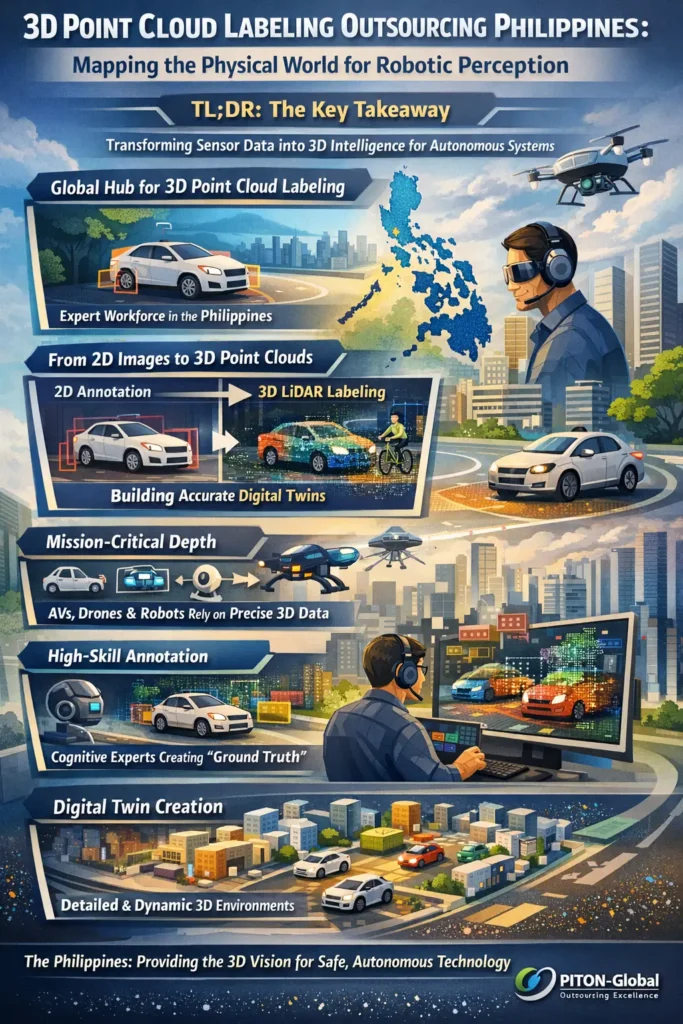
- Mission-Critical Depth: Autonomous systems (AVs, drones, and robots) rely on 3D data to navigate; thus, expert point cloud labeling is the bedrock of their safety protocols.
- Robotic Accuracy Metric: The success of data preparation is now judged by its direct impact on a machine’s ability to classify and react to physical obstacles in real-time.
- Specialized Talent Pool: The Philippines has fostered an elite workforce capable of the high-level spatial reasoning required to interpret complex 3D sensor clusters.
- Digital Twin Creation: Advanced outsourcing now includes semantic segmentation and temporal tracking, moving beyond simple tagging to build comprehensive 3D environments.
- Strategic Architecture: PITON-Global streamlines the path to innovation by connecting robotics firms with the top-tier, vetted Philippine partners delivering maximum data fidelity.
Executive Summary
The sector of 3D point cloud labeling outsourcing in the Philippines is the primary catalyst for the next generation of autonomous technology. As robots and self-driving vehicles transition from laboratory settings to unpredictable urban environments, their reliance on high-fidelity spatial perception becomes absolute. This intelligence is not inherent; it is meticulously cultivated through millions of data points labeled by human experts. The process involves converting raw LiDAR feeds into a detailed architectural map where every object—from a fire hydrant to a moving cyclist—is identified and tracked in three dimensions. The Philippines has emerged as the global authority in this field, offering a sophisticated talent pool trained for this cognitively taxing labor. PITON-Global acts as the essential conduit to this workforce, ensuring that the AI and robotics companies of tomorrow are built on a foundation of reliability and trust.
From Flat Frames to Volumetric Reality
Early AI training relied on two-dimensional snapshots, where annotators drew boxes on flat photographs. While this was sufficient for basic recognition, it lacked the depth, volume, and spatial context required for physical movement. A 2D image cannot accurately convey the precise distance of a pedestrian or whether an object is partially hidden behind a pillar.
3D point cloud data, typically generated by LiDAR (Light Detection and Ranging) sensors, solves this by capturing millions of individual points that represent a three-dimensional environment. Each point holds a specific coordinate in space, defining the exact shape and position of physical matter. However, without human intervention, this “cloud” is just a massive, unorganized dataset. Expert annotators in the Philippines perform the vital task of clustering these points into recognizable entities—vehicles, lane markings, or foliage. This transition from 2D to 3D is the single most important step in enabling machines to move through the world with human-like spatial awareness.
The Cognitive Rigor of 3D Spatial Analysis
Labeling in a 3D environment is a fundamentally more demanding task than 2D annotation. It requires a specific cognitive profile: the ability to mentally reconstruct a physical scene from a seemingly random cluster of dots. Specialists must navigate complex software to rotate, segment, and manipulate millions of points across a single temporal frame.
The margin for error in this field is nearly zero. An inaccurate boundary can lead to a “perceptual blind spot,” where a robot might misjudge the height of a curb or the proximity of a low-hanging branch. Because of this, Philippine 3D annotators are viewed as high-level technicians or “digital cartographers.” They are not merely labeling data; they are creating the “ground truth” logic that prevents catastrophic system failures in the physical world.
3D Annotation Maturity Model
The methodology for point cloud processing has evolved from manual plotting to high-level, AI-augmented validation. This model illustrates the rising complexity and strategic value of the work.
| Maturity Level | Tools & Techniques | Primary Focus | Outcome for AI Model |
| Level 1: Foundational | Manual cuboids & basic tools. | Presence & location. | Rudimentary 3D detection. |
| Level 2: Intermediate | Semi-automated segmentation. | Precise shape & boundaries. | Accurate classification. |
| Level 3: Advanced | Sensor fusion (LiDAR + Camera). | Behavioral context over time. | Trajectory prediction. |
| Level 4: Expert-Led | Scenario-based validation. | Logic & consistency. | High-reliability autonomy. |
Intelligence Arbitrage: Encoding Wisdom into Data
In the safety-critical world of robotics, the traditional model of low-cost labor has been replaced by “Intelligence Arbitrage.” The value is no longer found in the price per hour, but in the cognitive quality of the information being fed to the machine. In the Philippines, this means employing specialists who can distinguish a pothole from a shadow or a stationary cyclist from one about to merge into traffic.
This nuanced understanding is what transforms raw data into “robotic wisdom.” When an AI is trained on data of this caliber, the result is a measurable reduction in false positives and a significant boost in operational safety. The arbitrage here is the gain in system intelligence that only a high-skill human analyst can provide.
“Our partners in the autonomous sector aren’t asking for volume; they are asking for a reduction in error rates. They need their robots to function perfectly in low-light or high-traffic scenarios. We architect these solutions with elite Philippine teams to deliver ‘robotic accuracy’—a level of data trust that speeds up commercial deployment and saves lives.” — John Maczynski, CEO, PITON-Global
Comparing 3D Data Sources for Machine Perception
Robotics firms utilize different sensor types depending on the environment. Understanding these sources is key to a successful annotation strategy:
- LiDAR: The gold standard for depth and distance; works in total darkness but lacks color data.
- Stereo Cameras: Provides high-resolution color and texture but struggles in poor weather or low light.
- Structured Light: Ideal for close-range, high-detail geometry like robotic grasping in warehouses.
- Time-of-Flight (ToF): Compact and fast; used primarily for gesture recognition and small-scale obstacle avoidance.
Agentic Governance: The “AI Pilot” Framework
The ultimate objective of 3D point cloud labeling outsourcing in the Philippines is the establishment of “Agentic Governance.” As robots become more autonomous, human oversight transitions from labeling to auditing. Filipino specialists are now acting as “AI Pilots,” reviewing machine decisions and providing the corrective feedback loop required to align robotic behavior with ethical and safety standards. This continuous human-in-the-loop validation ensures that the machine’s perception of reality remains perfectly synchronized with the physical world.
Expert FAQs
Why is the Philippines the hub for LiDAR and 3D sensor data?
The country offers a unique combination of technical infrastructure and a workforce with high spatial-reasoning scores. This allows for the precise, meticulous work required to handle millions of data points without sacrificing accuracy.
How does 3D labeling improve the safety of a self-driving car?
It provides the “ground truth” for distance and volume. If the data is poorly labeled, the car may fail to brake for a small object or may brake unnecessarily for a shadow. High-fidelity labeling ensures the vehicle’s “brain” makes the right choice every time.
What is the role of PITON-Global in this niche?
We serve as the strategic bridge. We do not just find “workers”; we vet the top 1% of specialized 3D annotation labs in the Philippines and design the quality control frameworks that guarantee your data meets the highest global standards.
Is AI-assisted labeling replacing human annotators?
Actually, it empowers them. AI handles the repetitive “pre-labeling,” while human experts focus on the complex edge cases and final verification. This hybrid approach increases speed while maintaining the human judgment necessary for safety.