
Back
Healthcare Process Outsourcing (HPO) Philippines: The 2026 Strategic Blueprint for Clinical Excellence

By Ralf Ellspermann / 13 February 2026
 Authored by Ralf Ellspermann, CSO of PITON-Global, & 25-Year Philippine BPO Veteran | Executive | Verified by John Maczynski, CEO of PITON-Global, and Former Global EVP of the World's Largest BPO Provider on February 13, 2026

30-Second Executive Briefing
- The Macro Problem: U.S. health systems face a “margin cliff” (151% median expense ratio) and a catastrophic domestic clinical labor shortage.
- The HPO Solution: Shifting from generic BPO (administrative) to Clinical HPO (clinical-decision support) in the Philippines.
- Financial Impact: 30–60% reduction in OpEx, 98%+ clean claim rates, and significant EBITDA improvement.
- The 2026 Edge: Integration of Agentic AI—autonomous systems that interpret medical policies—with “Human-in-the-loop” clinical oversight.
Executive Summary
In 2026, Healthcare Process Outsourcing (HPO) is no longer a luxury for large IDNs; it is the critical lever for survival across the provider and payer landscape. This masterpiece guide explores how Philippine-based clinical hubs have moved beyond simple back-office support to become “Care Enablement Engines.” By leveraging a workforce of licensed nurses and pharmacists equipped with predictive AI, Western healthcare organizations are decoupling clinical care from administrative burden—ensuring financial integrity and superior patient outcomes in an increasingly regulated environment.
The 2026 HPO Frontier: Moving Beyond the “Back-Office”
The distinction between BPO and HPO has reached a critical tipping point. While Business Process Outsourcing handles generalist administrative functions, Healthcare Process Outsourcing (HPO) is a clinical-first strategy.
In the Philippines, HPO has evolved into a “Global Clinical Command Center” model. It involves the delegation of complex, data-intensive healthcare functions—such as medical coding, clinical data abstraction, and utilization management—to highly specialized, licensed professionals.
The “Malasakit” Advantage in Clinical Outcomes
At the heart of the Philippines’ dominance in HPO is Malasakit—a Filipino cultural tenet of deep, proactive care. In a 2026 landscape where CMS (Centers for Medicare & Medicaid Services) has tripled the importance of Clinical Outcomes and Medication Adherence, this human-centric “Clinical Advocacy” is the secret weapon against patient leakage and physician burnout.
The 2026 “Margin Cliff” and the HPO Response
Western health systems are currently navigating a “margin cliff.” According to the 2025-2026 AMGA Medical Group Operations Survey, system-affiliated medical groups face a staggering 151% median operating expense ratio.
1. Clinical Data Abstraction and FHIR-Ready Liquidity
As interoperability mandates reach full maturity, “Data Liquidity” is the new gold standard. Philippine HPO hubs now employ specialized nurses to perform clinical data abstraction, transforming unstructured EHR notes into FHIR-ready datasets.
- The Outcome: Improved predictive analytics for population health and a 30% reduction in reporting gaps.
2. Utilization Management (UM) and the 72-Hour Mandate
With federal mandates requiring 72-hour turnarounds for urgent prior authorizations, the “wait-and-see” model is dead. HPO centers in the Philippines provide 24/7 UM services, where Philippine-licensed nurses perform clinical reviews against Milliman Care Guidelines (MCG) or InterQual criteria.
Table 1: Strategic Shift — Legacy BPO vs. 2026 Clinical HPO
| Strategic Dimension | Legacy BPO (The Past) | 2026 Clinical HPO (The Future) |
| Workforce Profile | Generalist Agents (High School/College) | Licensed Clinicians (RNs, RPhs, CPCs) |
| Primary Driver | Labor Arbitrage (Cheapest Cost) | Clinical Fidelity & Outcome Metrics |
| Core Technology | Scripted CRM / Manual Entry | Agentic AI / FHIR-Enabled API Integration |
| Primary Goal | Task Completion (Volume) | Denial Prevention & Care Gap Closure |
| Compliance Focus | Standard HIPAA Readiness | HITRUST-Certified & Zero-Trust VDI |
High-Precision Clinical HPO: The 2026 Philippine Strategic Blueprint
In 2026, the shift from “Generic BPO” to High-Precision Clinical HPO is the primary driver of healthcare solvency. This blueprint details a transition away from manual processing and scripted CRMs toward an Agentic AI and FHIR-Ready API environment. By utilizing a specialized workforce—including Registered RNs, Certified Medical Coders, and Clinical Pharmacists—healthcare organizations achieve an additional +50% in savings over legacy models. This “Beyond The Back-Office” strategy ensures that critical functions like Utilization Management and HEDIS/STARs Optimization are engineered for maximum EBITDA yield.
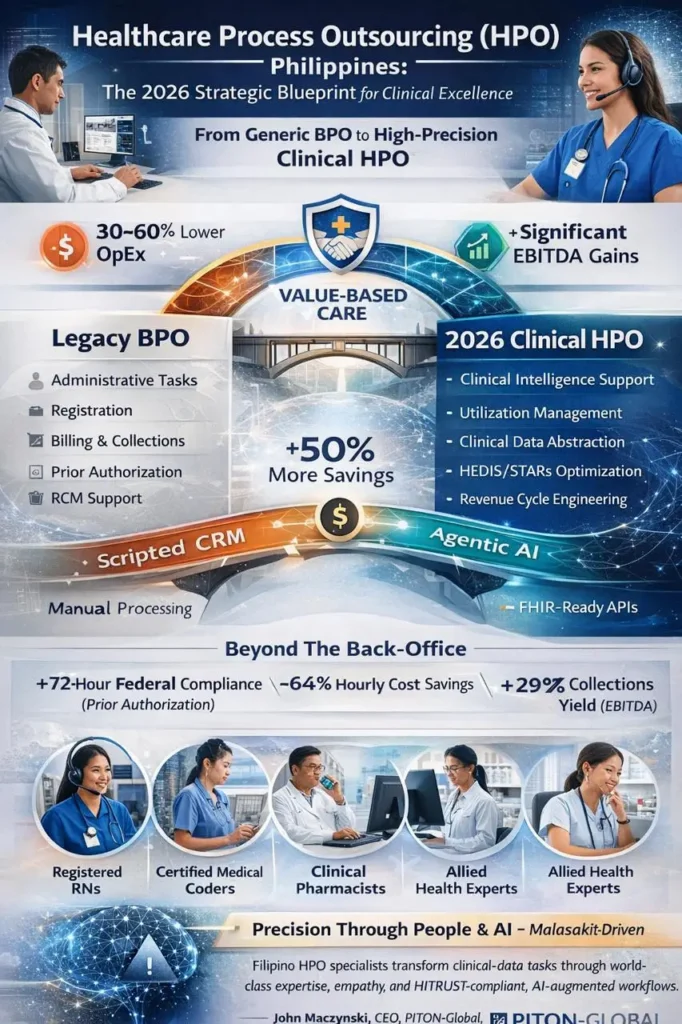
Legacy models are restricted to administrative tasks and registration, often resulting in stagnant collections and compliance delays. The 2026 Clinical HPO model transforms these functions into Revenue Cycle Engineering hubs. By deploying a “Malasakit-Driven” workforce of allied health experts, organizations realize -64% in hourly cost savings while simultaneously increasing their Collections Yield by +29%. This isn’t just a support desk; it is a high-precision engine that ensures Federal Compliance for prior authorizations is met in under 72 hours, effectively bridging the gap between clinical data and financial performance.
Agentic AI and the “Human-in-the-Loop” Model
The biggest misinformation in SEO today is that AI will replace outsourcing. In reality, AI has made high-end HPO more valuable. In 2026, the Philippines has adopted Agentic AI—autonomous systems that interpret medical policies and navigate payer rules.
Expert Insight
“The 2026 healthcare landscape has moved past the era of simple cost-savings. Today, it’s about Clinical Precision. We are seeing a massive surge in demand for ‘Licensed HPO’—where the person handling the workflow isn’t just a data entry clerk, but a clinically literate professional who understands the impact of a medical code on the entire care continuum. In the Philippines, we’ve perfected the bridge between human empathy and AI-driven efficiency.” — John Maczynski, CEO of PITON-Global
Revenue Cycle Engineering: The Clean Claim Revolution
HPO is the engine room of the modern Revenue Cycle. As we navigate the post-“No Surprises Act” landscape, front-end financial clearance is where the battle for the margin is won.
Specialized ICD-11 Navigation
With the global shift toward ICD-11, the complexity of medical coding has tripled. Philippine HPO providers have invested heavily in specialized training for coders in Oncology, Cardiology, and Orthopedics.
Table 2: Operational Impact — In-House vs. Philippine AI-Hybrid HPO
| Performance Metric | Domestic In-House (2026) | Philippine AI-Hybrid (2026) | Strategic Impact |
| Clean Claim Rate | 82% – 88% | 98.4% – 99.2% | Faster Cash Acceleration |
| Prior Auth Turnaround | 4–7 Days | < 72 Hours (Federal Compliance) | Drastic Reduction in Patient Leakage |
| Fully Burdened Cost | $34.50 / Hour | $12.50 / Hour | 64% Direct OpEx Savings |
| Documentation Errors | 15% – 20% | < 2% (AI + Human Audit) | Lower Audit Risk & Payer Recoupment |
| Staff Turnover Rate | 35% – 50% | < 10% (Stable Talent Pool) | Consistency in Quality of Care |
Capacity Building: Solving the Western Labor Shortage
The United States is projected to face a shortage of millions of nurses by 2030. HPO in the Philippines serves as a “Capacity Safety Valve.”
Decoupling Clinical Care from Administrative Burden
By outsourcing the “Administrative Complexity”—charting, prior authorizations, and pharmacy benefit inquiries—Western clinicians can return to the “Top of their License.”
- Physician Satisfaction: Scribing and HPO support reduce “pajama time” (after-hours charting) by 70%.
- Patient Retention: When the back-office is seamless, the “Digital Front Door” becomes a competitive advantage.
Security, Compliance, and HITRUST Standards
In an era where data breaches hit record highs in 2025, Philippine HPO has set a global benchmark.
- HIPAA-Plus: Philippine providers are now routinely HITRUST-certified and SOC 2 Type II compliant.
- Zero-Trust VDI: Utilizing Virtual Desktop Infrastructure ensures that no PHI (Protected Health Information) ever leaves the secure U.S. servers; it is merely viewed through an encrypted “glass window” in Manila.
Why PITON-Global: Navigating the Top 1% of HPO
The Philippine landscape is vast, but the HPO landscape is elite. As a vendor-neutral advisory firm, PITON-Global specializes in identifying the “Deep-Domain” providers.
The PITON Selection Matrix:
- Clinical Literacy: Leadership teams with clinical or healthcare-admin backgrounds.
- Technological Maturity: Proven integration of Agentic AI into HPO workflows.
- Scale and Agility: Finding the provider that fits your organization’s specific culture and patient demographic.
Expert FAQ: Navigating the HPO Landscape
How does HPO differ from traditional Healthcare BPO in 2026?
Traditional BPO focuses on high-volume, repetitive tasks. HPO is clinical-process centric, requiring licensed professionals (RNs, CPCs, RPhs) to manage complex workflows like Utilization Management and Pharmacy Benefit Management.
Is the Philippines equipped for ICD-11 and FHIR data standards?
Yes. The Philippines is the global leader in clinical documentation. Leading centers have implemented ICD-11 modules and moved to FHIR-ready data models, ensuring seamless integration with Western EHR systems like Epic and Cerner.
Can HPO actually mitigate physician burnout?
Absolutely. By utilizing Ambient AI Scribing and clinical support teams, providers can offload up to 80% of their documentation. This allows clinicians to focus on patients rather than screens, reclaiming the “Joy of Medicine.”
Achieve sustainable growth with world-class BPO solutions!
PITON-Global connects you with industry-leading outsourcing providers to enhance customer experience, lower costs, and drive business success.
Get Your Top 1% Vendor List
Author
Ralf Ellspermann is a multi-awarded outsourcing executive with 25+ years of call center and BPO leadership in the Philippines, helping 500+ high-growth and mid-market companies scale call center and customer experience operations across financial services, fintech, insurance, healthcare, technology, travel, utilities, and social media.
A globally recognized industry authority—and a contributor to The Times of India and CustomerThink —he advises organizations on building compliant, high-performance offshore contact center operations that deliver measurable cost savings and sustained competitive advantage.
Known for his execution-first approach, Ralf bridges strategy and operations to turn call center and business process outsourcing into a true growth engine. His work consistently drives faster market entry, lower risk, and long-term operational resilience for global brands.
EXECUTIVE GOVERNANCE & ACCURACY STANDARDS
Authored by:
Ralf Ellspermann
Founder & CSO of PITON-Global,
25-Year Philippine BPO Veteran,
Multi-awarded Executive
Specializing in strategic sourcing and excellence in Manila
View Full Bio
Verified by:
John Maczynski
CEO of PITON-Global, and former Global EVP of the World’s largest BPO provider | 40 Years Experience
Ensuring global compliance and enterprise-grade service standards
View Full Bio
Last Peer Review: February 13, 2026
This service framework is audited quarterly to meet shifting global outsourcing regulations and COPC standards.