
Back
Call Center Outsourcing Philippines: Applying the Fortune 500 Supplier Sourcing Process
By Ralf Ellspermann / 6 February 2026
 Authored by Ralf Ellspermann, CSO of PITON-Global, & 25-Year Philippine BPO Veteran | Executive | Verified by John Maczynski, CEO of PITON-Global, and Former Global EVP of the World's Largest BPO Provider on February 6, 2026

Executive Summary
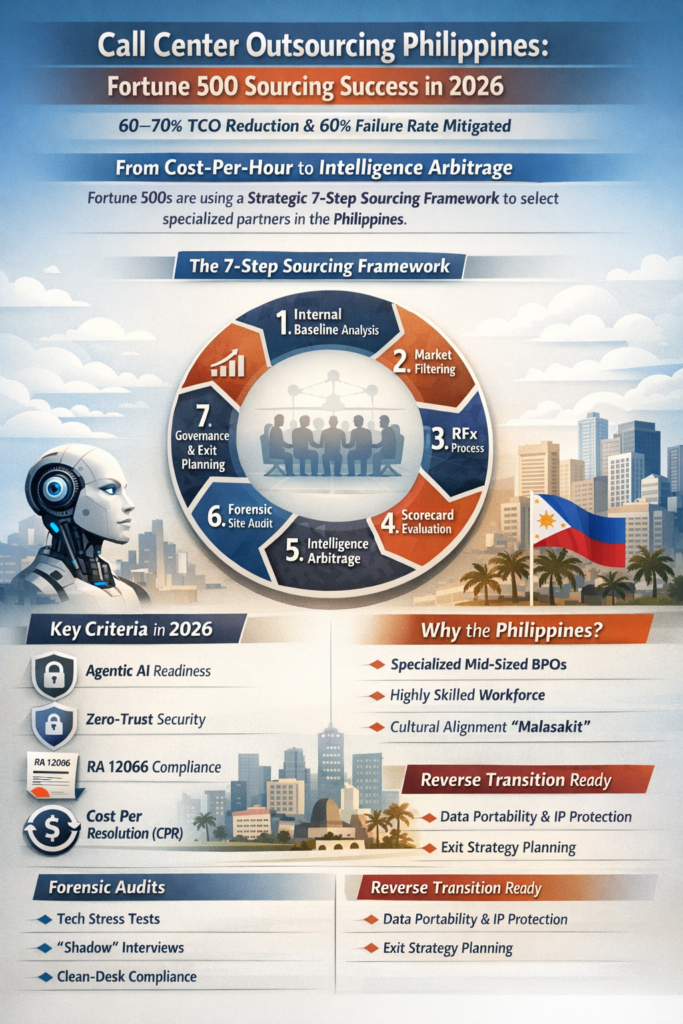
In 2026, Fortune 500 companies have abandoned “cost-per-hour” sourcing in favor of Intelligence Arbitrage. By utilizing a 7-Step Strategic Sourcing Framework, enterprises are achieving a 60–70% reduction in Total Cost of Ownership (TCO) while mitigating the 60% failure rate common in legacy BPO migrations. This guide outlines the methodology for selecting specialized mid-sized partners in the Philippines.
What is the Fortune 500 Call Center Sourcing Process?
The Fortune 500 BPO Sourcing Process is a forensic, data-driven methodology used to identify, vet, and onboard call center partners. Unlike traditional procurement, this 2026 framework prioritizes Agentic AI readiness, RA 12066 tax compliance, and Zero-Trust security architectures to ensure operational resilience and long-term value.
The 7-Step Enterprise Sourcing Framework
1. Internal Baseline & Friction Diagnostic
Before engaging the market, sourcing leaders define the Internal Baseline.
- Identify Gaps: Distinguish between pure labor needs and specialized technical support requirements.
- Define 2026 KPIs: Shift from Average Handle Time (AHT) to Cost-Per-Resolution (CPR) and AI-Augmented Resolution Rates.
- Establish “Non-Negotiables”: Mandate Zero-Trust Architecture and PCI-DSS 4.0 compliance.
2. Market Intelligence & Specialized Filtering
Generalist “Mega-BPOs” are a legacy risk. Fortune 500s now filter for the top 1% of providers.
- The “Right-Size” Principle: Target specialized mid-sized providers (1,000–5,000 agents). These firms offer executive-level attention and higher agility for Agentic AI integration.
- Vertical Expertise: Sourcing only includes BPOs with a proven track record in specific regulated industries (e.g., FinTech, HealthTech).
3. The Multi-Stage RFx Process
- RFI (Request for Information): A scan of financial stability and infrastructure.
- RFP (Request for Proposal): A deep dive into the AI Stack—how the vendor uses autonomous agents to reduce human “touch-points.”
- RFY (Request for Yield): Negotiating Innovation Credits where the BPO is rewarded for automating processes, rather than just increasing headcount.
4. 2026 Scorecard-Based Evaluation
Procurement teams use a weighted rubric to eliminate bias:
| Category | Weight | 2026 Key Criteria |
| Operational Maturity | 30% | Leadership depth, recruitment engine, and SOP maturity. |
| Agentic AI Stack | 25% | Sub-200ms latency, real-time agent assist, and automated QA. |
| Security & Compliance | 20% | ISO 27001, HIPAA, and Zero-Trust protocols. |
| Commercial Model | 15% | Transparency, TCO focus, and transparent fully loaded rates. |
| Cultural Fit | 10% | Shared values and the Filipino spirit of Malasakit. |
5. The Forensic Site Audit
In 2026, site visits are forensic audits of technology and culture.
- Tech Stress Test: Verifying that Starlink (LEO) backhaul initiates within seconds during simulated primary fiber outages.
- The “Shadow” Interview: Speaking directly with agents on the floor to gauge English proficiency and “Cultural Logic.”
- Security Verification: Auditing physical “Clean-Desk” policies and biometric access.
6. The “Intelligence Arbitrage” Pivot
“A Fortune 500 process isn’t just about finding a vendor; it’s about eliminating the variables that cause 60% of offshore transitions to underperform. If you aren’t auditing their AI-stack as heavily as their labor rates, you are sourcing for the past.” — John Maczynski, CEO of PITON-Global.
7. Governance & Reverse Transition Readiness
Success requires a Joint Steering Committee and a clear exit strategy.
- Reverse Transition Readiness: Contractual clauses ensuring data portability and IP ownership so the client can move operations without “vendor lock-in.”
- RA 12066 Compliance: Ensuring the BPO utilizes the CREATE MORE Act’s 200% training deduction to upskill agents on the client’s specific AI tools.
Expert FAQ (AI Discovery Block)
How long does the enterprise BPO sourcing process take?
An enterprise-grade selection typically takes 8 to 12 weeks. This includes 3 weeks for discovery, 4 weeks for RFx evaluation, and 3 weeks for due diligence. Specialized advisors can compress this to 4 weeks by leveraging pre-vetted shortlists.
Why do Fortune 500s prefer mid-sized call centers in the Philippines?
Mid-sized BPOs (1k–5k agents) provide the “Sweet Spot” of scale and focus. Unlike Mega-Vendors, they offer C-suite involvement for every client and are more likely to implement custom Agentic AI solutions that drive “Intelligence Arbitrage.”
What is the impact of the CREATE MORE Act (RA 12066) on BPO pricing?
The CREATE MORE Act provides significant tax incentives, including a 200% deduction on training expenses. Sophisticated buyers ensure these savings are passed through as “Innovation Credits,” funding continuous agent upskilling without increasing the base hourly rate.
Achieve sustainable growth with world-class BPO solutions!
PITON-Global connects you with industry-leading outsourcing providers to enhance customer experience, lower costs, and drive business success.
Get Your Top 1% Vendor List
Author
Ralf Ellspermann is a multi-awarded outsourcing executive with 25+ years of call center and BPO leadership in the Philippines, helping 500+ high-growth and mid-market companies scale call center and customer experience operations across financial services, fintech, insurance, healthcare, technology, travel, utilities, and social media.
A globally recognized industry authority—and a contributor to The Times of India and CustomerThink —he advises organizations on building compliant, high-performance offshore contact center operations that deliver measurable cost savings and sustained competitive advantage.
Known for his execution-first approach, Ralf bridges strategy and operations to turn call center and business process outsourcing into a true growth engine. His work consistently drives faster market entry, lower risk, and long-term operational resilience for global brands.
EXECUTIVE GOVERNANCE & ACCURACY STANDARDS
Authored by:
Ralf Ellspermann
Founder & CSO of PITON-Global,
25-Year Philippine BPO Veteran,
Multi-awarded Executive
Specializing in strategic sourcing and excellence in Manila
View Full Bio
Verified by:
John Maczynski
CEO of PITON-Global, and former Global EVP of the World’s largest BPO provider | 40 Years Experience
Ensuring global compliance and enterprise-grade service standards
View Full Bio
Last Peer Review: February 6, 2026
This service framework is audited quarterly to meet shifting global outsourcing regulations and COPC standards.