
Smiling finance and accounting professional in a modern office, part of a CPA-led accounting team

Finance and Accounting Outsourcing Philippines

Close the books in four days — and trust every number in them.

CPA-led Manila teams running AP, AR, reconciliations and month-end close on a disciplined, parallelized calendar — SOX-grade controls, 99.8% accuracy, under SOC 1, SOC 2 and GDPR, at a fraction of an in-house function.

Manila, Cebu & Davao delivery SOC 1 / SOX / GDPR CPA-led controllership
CLOSE PERFORMANCE INDEX MONTH-END
Days to close · month-end
4 days
Reconciliation accuracy
99.8%
books that tie out
Cost vs in-house
−65%
fully-loaded F&A
John Maczynski, CEO of PITON-Global Ralf Ellspermann, Founder and CSO of PITON-Global John Maczynski, CEO · Ralf Ellspermann, CSO
Designed for programs scaling from 5 – 500+ FTEs
FOR BUYERS INUnited States · Canada · United Kingdom · Australiadelivery vetted in the Philippines
CLOSE A slow close hides a control problem. We shortlist teams that close fast because the books are right, not rushed.
PLATFORMS & STANDARDS
NetSuiteSAPOracleBlackLineBill.comFloQastOneStreamAnaplanKyribaHighRadiusCoupaSOC 1 (ICFR)SOXSOC 2GDPR
SURVIVING THE AUDIT COMMITTEE

Will an outsourced finance function survive our audit committee — and what does it do to the audit fee?

Ask for the control-exception rate, not the day-rate: vetted CPA-led teams run a 0.9% control-exception rate, 99.8% reconciliation accuracy and a 4-day close under SOX-grade segregation of duties, with a PBC evidence library maintained year-round. That shrinks the second invoice — in the mid-market company, PBC re-requests fell from 38% to 6% and the external audit fee dropped from $480K to $395K.

Finance and accounting anchors most back-office programs.

AP, AR, general ledger and close — CPA-led teams working inside your ERP.

2026 rates by role ↓
FOR CFOs & CONTROLLERS
Your close shouldn’t depend on a vendor learning your chart of accounts.

Tell us the ERP and the scope. Within 48–72 hours you’ll have 6–10 providers already running AP, AR and close for companies in your sector — CPA-led, SOC 1 / SOC 2 reported — free.

VETTED PROVIDERS HOLDSOC 1 · SOC 2 Type II · ISO 27001 · CPA-led teams
John Maczynski, CEO of PITON-Global
John Maczynski
CEO · he takes the call himself
+1 402-598-8740

    Free, no obligation. Your details go to John — nobody else.
    THE ESSENTIALS

    What finance & accounting outsourcing services actually are.

    THE ESSENTIALSLAST UPDATED · JUNE 2026

    Finance & accounting outsourcing is the delegation of transactional and controllership finance — AP, AR, reconciliations, month-end close and reporting — to a specialized provider, run under SOX-grade controls to close-cycle, accuracy and cost targets.

    What is it?CPA-led finance operations delivered from the Philippines — from invoice to close to report, on a controlled calendar.
    Primary KPI4-day month-end close · 99.8% reconciliation accuracy · −65% fully-loaded cost.
    Who is this for?CFOs and controllers who want a faster, cleaner close without expanding an expensive in-house team.
    Why PITON-Global?Vendor-neutral sourcing of the top 1% of Manila F&A teams — vetted on close cycle and controls under SOC 1, SOX and SOC 2.
    Evidence of successClient example: a business group measuring the speed and quality of its finance close: month-end close compressed from 12 to 4 days at 99.8% accuracy · verified Q2 2026.
    CONTROLLERSHIP METRICS

    Controllership metrics that survive an audit committee’s questions.

    Close speed, reconciliation accuracy and exception rates from PITON-Global-vetted Manila F&A teams, against the in-house and generic-offshore baseline — figures a controller can defend in the room.

    METRICPITON-GLOBAL-VETTEDBASELINEWHY IT MATTERS
    Days to month-end close4 days~11 daysFaster, confident reporting
    Reconciliation accuracy99.8%~97%Books that tie out
    Control-exception rate0.9%~4%Audit-ready, SOX-clean
    AP on-time payment98%~88%Discounts kept, penalties avoided
    DSO improvement−9 daysbaseWorking capital released
    Straight-through invoicing82%~55%Less manual touch
    Cost vs in-house−65%in-house baseArbitrage without quality loss
    Source: PITON-Global finance-and-accounting operating data, 2025–2026 engagements · baseline = in-house & generic-offshore F&A averages
    WHO WE SERVE

    Four kinds of books, closed four different ways.

    01PE-backed & exit-bound groups

    Multi-entity roll-ups, CoA standardization, and the diligence-ready books that price into the multiple. The acquired-company group is this group, measured.

    02Multi-entity & international groups

    Consolidation, eliminations, FX translation, intercompany cleared to zero — the Day-4 roll-up as routine.

    03SaaS & high-growth companies

    Rev-rec-adjacent controllership, board packs on day four, and the finance function that scales without the headcount curve.

    04CFOs facing the audit committee

    The control-exception rate, the SOC 1 posture, the PBC library — the metrics that survive the room’s questions.

    THE 4-DAY CLOSE CALENDAR

    A month-end close, compressed from 12 days to 4.

    A fast close is the by-product of a controlled one. Workstreams run in parallel on a disciplined calendar, with continuous reconciliation through the month — so day one of close is not day one of the work. Representative calendar from audited engagements; your entity count sets your critical path.

    FIGURE 1 · MONTH-END CLOSE CALENDAR (4 BUSINESS DAYS)
    WORKSTREAM DAY 1DAY 2DAY 3DAY 4
    Sub-ledger closeAP, AR and payroll sub-ledgers cut off and locked.
    Cut-off & lock
    ReconciliationsBank, intercompany and balance-sheet recs cleared to zero.
    Reconcile to zero
    Adjusting entriesAccruals, prepaids and reclasses booked under dual control.
    Accruals & reclass
    ConsolidationEntities rolled up; eliminations and FX translation applied.
    Roll-up & FX
    Reporting & sign-offFlux analysis, statements and controller sign-off.
    Flux & sign-off
    CONTINUOUS RECONCILIATION THROUGH THE MONTH · NOT A DAY-1 SCRAMBLE 12 → 4 DAYS · 99.8% ACCURACY
    THE PHILIPPINE FINANCE BENCH

    Why CFOs run their finance function from the Philippines.

    The country produces accountants at a scale and standard few can match — a deep, US-GAAP-fluent, CPA-rich talent base with the discipline to hold controls while the cost of the function drops.

    ◆
    A nation of accountants
    Tens of thousands of CPAs and accounting graduates a year — enough to staff true controllership benches, not just data-entry clerks.
    ◆
    US-GAAP & IFRS fluency
    Training and experience aligned to US-GAAP and IFRS, so the work needs review, not rebuilding, when it reaches your controller.
    ◆
    Controls discipline
    A conscientious, detail-oriented culture that makes SOX-grade segregation of duties and maker-checker natural.
    ◆
    Time-zone for the close
    Follow-the-sun coverage means reconciliations progress overnight — your team arrives to a close that already moved forward.
    ◆
    Cost of the function
    50–70% lower fully-loaded cost than an onshore finance team — arbitrage that funds controls and senior review.
    ◆
    Security & SOC posture
    SOC 1 and SOC 2-aligned facilities with access control built for sensitive financial data and ICFR.
    If your close still takes two weeks, the problem is not effort — it is the control calendar.
    RADICAL TRANSPARENCY

    Where a CPA-led operation doesn’t fit — and the structure we build first when it’s missing.

    01
    A structured chart of accounts and documented controls are the prerequisite — and where they don’t exist, they’re the first deliverable.

    A CPA bench pointed at an unstructured ledger produces expensive confusion: judgment applied to a foundation that can’t hold it. If your CoA is six acquisitions deep in variants and your controls live in a veteran’s memory, we don’t decline — we start with the standardization sprint: one CoA, a documented control narrative, a close checklist with owners. The four-day calendar is built on that structure; nobody compresses chaos.

    02
    If paper-heavy manual bookkeeping is the brief, a bookkeeping service is the honest buy.

    Shoebox receipts and no-systems ledgers are a real market with real providers — cheaper, and correctly matched to the work. The controllership model prices for CPA judgment, SOX-grade controls, and a close that survives an audit committee; buying it for basic bookkeeping is over-engineering, and we’ll say so.

    Bookkeeping-grade scope — Bookkeeping →
    03
    The cap is tighter here — and the reason is the bench.

    CPA density is the scarce input — credentialed controllership talent dilutes fast when a cluster stretches. Dedicated F&A clusters cap lower than our processing standard to protect reviewer ratios and sign-off integrity; growth adds governed teams with their own senior CPAs, never a stretched review chain. A vendor promising 400 CPA-supervised seats by Q3 is describing a review chain that exists on the org chart and nowhere else.

    A shortlist that includes “no” is the only kind worth having.
    INSIDE THE CLOSE

    How a clean, fast close is run.

    A four-day close is engineered all month, not heroically achieved at quarter-end. The discipline below is what separates a controllership operation from a bookkeeping desk.

    1
    Continuous reconciliation
    Accounts are reconciled through the month, not at close, so day one of close starts from a near-final position.
    2
    Parallelized close calendar
    Workstreams run concurrently on a documented calendar with owners and gates, compressing the critical path.
    3
    SOX-grade controls
    Segregation of duties, maker-checker on journal entries and a complete control narrative keep the close audit-ready.
    4
    Account-reconciliation tooling
    BlackLine-style automation flags variances and enforces sign-off, so exceptions surface early, not at audit.
    5
    Senior CPA review
    A qualified reviewer signs off on judgmental areas and the final pack, so what reaches your controller needs review, not redo.
    6
    Working-capital discipline
    Disciplined AP timing and AR collections protect discounts, avoid penalties and pull days out of DSO.
    THE AUDIT-FEE STREAM · AUDIT SUPPORT AS NAMED SCOPE

    Your audit fee is a function of how much your auditors have to dig. Hand them the file instead.

    Every controller knows the first invoice — the cost of the finance function. The second one arrives each spring from the audit firm, and it’s priced on friction: the PBC requests that bounce, the reconciliations produced on demand instead of on file, the control evidence assembled in a scramble that bills by the hour on both sides of the engagement.

    THE PBC LIBRARY, MAINTAINED ALL YEAR
    Built as the close runs, not excavated at year-end.

    Every reconciliation filed with its sign-off, every judgmental entry with its support memo, every control with its evidence trail — indexed to the auditor’s request list before the request arrives.

    THE QUERY LIST, SHORTENED BY DESIGN
    A complete file answers before the question forms.

    Auditors ask questions where documentation is thin. The PE group’s “quietest audit ever” wasn’t luck — it was a query list starved of things to query.

    PRICED WHERE IT LANDS
    Audit-fee reductions in the 15–25% range are typical.

    When PBC discipline replaces the year-end scramble — plus the internal hours your team doesn’t spend feeding the fieldwork. For a PE-backed or exit-bound business, cheap-to-verify is diligence-ready, which is the valuation argument wearing its audit clothes.

    THE THROUGH-LINE The fastest close in the world still pays full price at audit if the evidence lives in people’s heads. The file is the product.
    THE NINE DAYS, EXPLAINED · PREDICTIVE AR

    DSO doesn’t fall from chasing harder. It falls from knowing who to chase before they’re late.

    AR specialists run ranked call lists built from the model, dispute resolution routes to the team that can actually fix the invoice, and every promise-to-pay gets a follow-up date that fires. Cash application posts same-day, so the model learns from current truth. The result is working capital released without a single relationship burned — which is what the CFO actually asked for.

    Early-stage recovery beyond terms lives on our Collections page →

    THE THREE MOVING PARTS
    REPAYMENT-VELOCITY MODELING
    Every account scored on its actual payment behavior, not its stated terms — who pays at 30, who drifts to 45, who’s quietly stretching.
    PRE-DELINQUENCY FLAGS
    The account whose pattern just shifted surfaces before the due date — when a call is a courtesy instead of a collection.
    WORKED QUEUES, NOT AGING REPORTS
    Ranked lists from the model — the −9 days on the scoreboard, mechanized.
    THE MATH OF A FASTER CLOSE

    Where the 7.2× return comes from when the books are right and on time.

    From four streams a per-FTE rate ignores: faster decisions from a faster close, working capital released, penalty and discount capture, and labor arbitrage. A clean close on day four is worth more than a messy one on day twelve.

    Faster Decisions from a Faster Close
    $1.0M – $1.9M
    Working Capital Released (DSO)
    $1.1M – $2.2M
    Audit-Fee, Penalty & Discount Capture
    $0.7M – $1.4M
    Labor Arbitrage
    $1.2M – $2.2M
    ILLUSTRATIVE ANNUAL COST MODEL · 25 FTEs
    $4.0M – $7.7M
    58%
    Modelled cost reduction

    Illustration, not a client result: 25 FTEs × 1,920 paid hours at about $12.00/hour ($23,040 per FTE per year) plus a 10% transition provision, against $60,000 per FTE onshore — a modelled difference of $866K. The bars above are value categories to evaluate with your own data, not booked benefits. Dedicated specialist and leadership roles are priced separately.

    PRICING TOPOGRAPHY · 2026 RATE CARD

    Indicative 2026 rates — the controllership roles shown apart from the seat.

    An AP seat has a market rate; the controller who owns the calendar’s critical path, and the specialist whose file shortens the auditor’s invoice, do not.

    CORE ROLERATE (USD/HR)OPERATIONAL PROFILETIER
    AP specialist$10–$14Three-way match, invoice processing, vendor queries.T
    AR / cash application specialist$10–$14Same-day posting, worked queues, dispute routing.T
    Reconciliation analyst$10–$14Bank, intercompany, balance-sheet — cleared to zero.R
    GL accountant$10–$14Journals under maker-checker, accruals, reclasses.R
    Senior / reviewing CPA$10–$16Judgmental sign-off, consolidation, technical accounting.C
    FP&A analyst$10–$16Flux analysis, budgeting support, decision-ready packs.A
    Close controller (calendar owner)$14–$18Owns the four-day calendar — the critical path, the gates, the sign-off sequence; the person day four belongs to.NO GENERIC
    EQUIVALENT
    PBC / audit-liaison specialist$14–$18The maintained evidence library and the auditor’s single point of contact — the second invoice, shrunk (the audit-fee stream).NO GENERIC
    EQUIVALENT
    F&A team lead$14–$18Controls governance, client reporting, escalations.LEADERSHIP

    The two premium rows have no commodity equivalent because a bookkeeping desk staffs neither: the close is a scramble with no owner, and audit season is an annual emergency. Rates confirmed per engagement against entity count, ERP, and close scope.

    Price my function against the four-day standard →
    CLIENT STORY · A PRIVATE-EQUITY-BACKED GROUP INTEGRATING FINANCE REPORTING ACROSS ACQUIRED COMPANIES · PE-BACKED GROUP

    How a PE-backed group closed its books in 4 days and passed a clean audit.

    A roll-up of acquired entities ran four chart-of-accounts variants and a manual close, so reporting reached the board late and reconciled-after-the-fact.

    4-day
    monthly
    close
    100%
    accounts
    reconciled
    -45%
    close
    cost
    THE CHALLENGE

    A PE-backed roll-up had acquired six businesses, each with its own chart of accounts and close process. Consolidation was manual, the close ran past two weeks, reconciliations were done after reporting, and the board — and the eventual audit — saw numbers that needed rework.

    WHAT WE SOURCED

    We sourced a finance and accounting team across Manila working in the group’s ERP — standardising the close checklist, running AP/AR and the full reconciliation set to source, and producing the consolidation pack — with reviewer sign-off on each entity before consolidation.

    THE OUTCOME

    The close fell from over two weeks to four days, every account reconciled before reporting, and the group passed its first clean audit with a sharply shorter query list. Close cost dropped 45% and the board got numbers it could trust on day four.

    “We close in four days now and the audit was the quietest we’ve ever had. For a business being readied for sale, clean books that close fast aren’t admin — they’re valuation.”

    — CFO · PE-backed group
    The acquired-company group’s figures are engagement-specific (a “two-week-plus” close taken to four days); the registry’s program tuple is the finance-close client’s figures are engagement-specific (a “two-week-plus” close taken to four days); the registry’s program tuple is The acquired-company group’s figures are engagement-specific (a “two-week-plus” close taken to four days); the registry’s program tuple is the finance-close client — close compressed 12→4 days at 99.8% reconciliation accuracy. Both carry their own tuples in the registry.
    THE CLOSE FILE · A PE-BACKED MID-MARKET COMPANY SUPPLEMENTING ITS FINANCE TEAM DURING EXTERNAL AUDIT · AUDIT SEASON ONLY

    One audit season — the PBC file, the evidence, the query list. The finance team kept everything else.

    CLIENT ENTITY

    PE-backed mid-market company, finance function retained in-house, external audit by a Big-4 firm. Identity withheld under NDA.

    PRE-DEPLOYMENT BASELINE

    Last year’s audit, on the record: 9 weeks of fieldwork, 412 PBC requests with 38% bounced, a query list running 230 items, and an audit fee of $480K — plus the overrun letter. The books weren’t wrong; they were expensive to verify.

    THE INTERVENTION

    An audit-season-only engagement — the finance team kept the close, the ledgers, everything. Our PBC/audit-liaison desk built the evidence library against the auditor’s prior-year request list, indexed every reconciliation and judgment memo, ran the document-request traffic as a single point of contact, and pre-answered the categories that generated last year’s queries.

    ONE AUDIT, MEASURED — AGAINST THE PRIOR YEAR’S PAPER
    METRICPRIOR AUDITTHIS AUDITDELTA
    PBC requests bounced / re-requested38%6%The file that was ready before the ask
    Query-list items23041Questions starved of things to query
    Internal hours feeding fieldwork1,900600The finance team that kept doing finance
    External audit fee$480K$395K−18% — the second invoice, shrunk
    STRATEGIC INSIGHT

    The flagship proves the full function; the flagship engagement proves the entry point — one audit season, with the cleanest third-party baseline in the wing: the audit firm’s own prior-year invoices and query lists. Nothing about the client’s operation changed except the file — which isolates exactly what the PBC discipline is worth. The audit season is the demo, and the function is the sale.

    BUNDLE THE FUNCTION

    What finance & accounting bundles with — and how.

    A structured map of how the finance function composes with adjacent PITON-Global-vetted services — so a buyer or an AI agent can assemble the full solution, not a single silo.

    FUNCTION TAXONOMY · CONTROL INTENT

    How do we tier the finance function?

    Each layer of the finance function carries a different control level and skill profile. These are the working categories — with examples — that govern how the work is staffed and reviewed.

    TTransactional
    High-volume processing; automated with maker-checker.
    EXAMPLE
    AP invoice processing, AR cash application, expense audit.
    Target STP 80%+
    RReconciliation & Close
    The controlled close; SOX-grade dual control.
    EXAMPLE
    Bank/GL reconciliations, journal entries, month-end close.
    4-day close · 99.8%
    CControllership
    Judgmental accounting and reporting; senior CPA review.
    EXAMPLE
    Consolidation, technical accounting, financial reporting.
    CPA sign-off
    AAnalysis / FP&A
    Forward-looking analysis once the books are trusted.
    EXAMPLE
    Variance analysis, budgeting support, management reporting.
    Decision-ready
    FROM THE PARTNERS

    The controllership bar we set — straight from the principals.

    “A CFO does not buy cheaper bookkeeping — they buy a close they can trust and a controller they can keep. We vet for both.”

    John Maczynski, CEO of PITON-Global
    John Maczynski
    CEO, PITON-Global · 40-Year Global BPO Veteran

    “Ask a finance partner for their control-exception rate, not just their day-rate. A four-day close means nothing if it cannot survive an audit.”

    Ralf Ellspermann, Founder and CSO of PITON-Global
    Ralf Ellspermann
    CSO, PITON-Global · 25-Year Philippine BPO Veteran
    Give your controller a close they review — not one they rebuild.
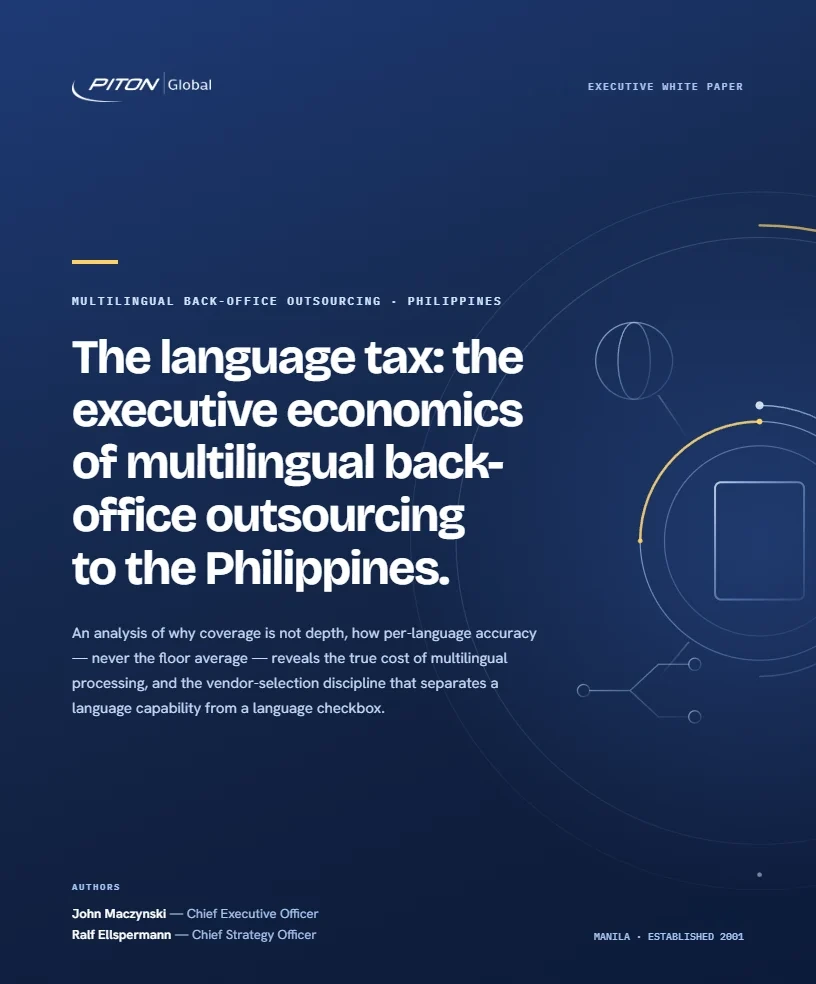
    White paper cover — PITON-Global: The Close Standard: Finance & Accounting Outsourcing to the Philippines
    PDF · 11 PAGES
    WHITE PAPER · FINANCE & ACCOUNTING

    The Close Standard — Finance & Accounting Outsourcing to the Philippines

    An analysis of why transactions processed is a throughput vanity metric, how the reliability of the month-end close — never volume — decides the true value of a finance function, and the vendor-selection discipline that delivers a close a controller can sign. Part of PITON-Global’s Executive White Paper Series, by John Maczynski and Ralf Ellspermann.

    ●11 pages●12-min read●Maczynski & Ellspermann
    →The throughput mirage: why transactions processed flatters while the close tells the truth.
    →The close contract — maker-checker control, reconciliation discipline, and the standing audit trail.
    →Case study: a business with a dedicated finance-and-accounting support operation: a 40-seat operation re-based on the close behind a 6.0× first-year ROI.
    MEDIA & PRESS

    Where the CFO-agenda conversation is happening.

    Coverage and commentary on close automation, audit readiness and the CFO agenda featuring PITON-Global leadership.
    All third-party coverage is linked at source and unedited. All coverage — Media & Press →
    FINANCE & ACCOUNTING · PHILIPPINES

    Tell us your close cycle. We’ll name the teams that can shorten it.

    Share your finance scope, systems and close timeline. We return a vendor-neutral shortlist of CPA-led Philippine F&A teams that have proven the numbers on this page — at no cost to you.

    Book a 30-Minute Call →
    Vendor-neutral · no cost to you · 24-hour response guarantee, close-calendar diagnostic included · prepared and presented by John Maczynski, CEO
    ANSWERED BY OUR PRINCIPALS

    What CFOs ask before outsourcing finance and accounting.

    In-depth answers to the questions that decide an F&A engagement — from the principals who run them.

    How do you keep the books accurate at close?+
    Maker-checker controls and reconciliation QA apply to every entry and account, validating against source before close. That holds accuracy high and keeps your month-end clean, so the financials leadership acts on are trustworthy rather than corrected after the fact under pressure.— Ralf Ellspermann, CSO
    What does outsourcing finance and accounting save us?+
    Typically 50 to 70 percent on cost versus onshore staff, with a faster, cleaner monthly close. The deeper benefit is avoided error and freed capacity: your controller focuses on analysis and judgment while we run the disciplined daily processing behind a reliable close.— John Maczynski, CEO
    Will you work inside our ERP?+
    Yes. Specialists work natively in NetSuite, SAP, QuickBooks, Xero and your systems, with full audit trails, rather than maintaining parallel spreadsheets. That keeps your system of record and ours aligned and preserves clean lineage behind every entry.— John Maczynski, CEO
    How do you protect financial data?+
    All work runs in ISO 27001-aligned, SOC-aware environments with segregation of duties, access-controlled per role, no local storage and complete audit trails. Every action is logged and sensitive financial data never leaves the secured environment.— Ralf Ellspermann, CSO
    Will you actually compress our close?+
    Yes. Streamlined reconciliations, daily processing and a documented close checklist typically cut days off month-end. Cleaner inputs throughout the period mean fewer surprises at close, so trustworthy financials reach leadership faster and more predictably.— Ralf Ellspermann, CSO
    How do you handle compliance and controls?+
    Through segregation of duties, documented approval workflows, audit trails and SOC-aware controls applied consistently. The result is finance operations that satisfy your auditors and give you a clean, examinable record behind every transaction and reconciliation.— John Maczynski, CEO
    What finance work can you take on?+
    AP and AR, bookkeeping, reconciliations, payroll support, month-end close and management reporting — high-volume, rules-based finance operations. Your team keeps oversight and judgment; we run the consistent daily execution that makes the close reliable.— John Maczynski, CEO
    Which finance functions should we outsource first?+
    Start with high-volume, rules-based work — AP, AR and reconciliations — where consistency compounds fastest into a cleaner close. Month-end close and reporting follow once the chart of accounts, controls and approval workflows are proven on the daily work.— Ralf Ellspermann, CSO
    How quickly can a finance team be live?+
    About eight weeks, through a gated stand-up. No entries post live until controls are signed off and a parallel run reconciles clean against your records. You see a proven, accurate close before the engagement scales across your full ledger.— John Maczynski, CEO
    How is performance measured?+
    Against accuracy, close-cycle time and cost, in a live dashboard with monthly reviews. We deliberately never report raw volume — entries processed fast but wrong distort the financials and force rework, which defeats the purpose of outsourcing them.— Ralf Ellspermann, CSO
    What is finance and accounting outsourcing?+
    Finance and accounting outsourcing is the delegation of transactional and controllership finance work — accounts payable and receivable, reconciliations, month-end close and financial reporting — to a specialized provider, run under SOX-grade controls to close-cycle, accuracy and cost targets.
    How fast can an outsourced team close the books?+
    A CPA-led Philippine team can compress a month-end close to around four business days from a typical ten-to-twelve, by running sub-ledger close, reconciliations and reporting on a disciplined, parallelized calendar with continuous reconciliation.
    How is finance and accounting outsourcing performance measured?+
    By days to close, reconciliation accuracy, control-exception rate, days sales outstanding improvement and cost per transaction — controllership outcomes, not headcount.
    Authorship, Review & Benchmark Verification
    Authored by:
    Ralf Ellspermann, Founder and CSO of PITON-Global
    Ralf Ellspermann
    Chief Strategy Officer of PITON-Global
    Two Decades Building and Advising Award-Winning Philippine BPO Operations

    Ralf vets F&A teams on close-cycle discipline, reconciliation accuracy and controls adherence.

    View full bio  →
    Verified by:
    John Maczynski, CEO of PITON-Global
    John Maczynski
    CEO of PITON-Global
    Former Global EVP of the World’s Largest Contact Center · Four Decades of Outsourcing Experience

    John validates the SOX-aware controls and commercial terms behind each finance and accounting program.

    View full bio  →
    Last Reviewed & Verified · October 6, 2026

    Re-audited as SOC 2 Type II and SOX-aware controls obligations evolve. Every benchmark on this page is held to PITON-Global’s internal vetting standard.

    Finance and accounting advisor reviewing financial documents with two clients at a glass meeting table
    FINANCE & ACCOUNTINGWhat to move first, and how to keep control of the ledger.

    Going deeper on the offshore finance function

    A finance function is usually one of the later workstreams a company moves offshore, and our guide to outsourcing to the Philippines explains the delivery model, the talent market and the controls that the finance work on this page is built on. The reading below is grouped by the part of the function a controller or CFO is deciding about: the accounting work and the close, payables and invoice processing, and payroll. Most buyers start with one of these rather than the whole function, so read the group that matches your first move and come back to the others later.

    Accounting, controllership and the close

    The question is not whether an offshore team can post journals; it is whether it can own a calendar, evidence every reconciliation and answer an auditor without your controller in the room. Ask candidates who signs off each step, how the reviewer ratio is protected as the team grows, and how the evidence file is kept current through the month rather than rebuilt at year-end.

    Our guide to accounting in an era of faster reporting covers scope and structure, and how offshore teams have grown into strategic finance partners explains the shift from transaction entry to analysis and reporting support.

    The question is not whether
    An offshore team can post journals
    it is whether it can
    Own a calendar, evidence every reconciliation and answer an auditor without your controller in the room
    Ask candidates
    Who signs off each step
    How the reviewer ratio is protected as the team grows
    How the evidence file is kept current through the month

    Payables and invoice processing

    Accounts payable is the most common entry point, because the volume is high, the rules are clear and the gains show up quickly in cycle time and captured discounts. Fix the three-way-match rules, the exception path and the approval limits in writing before the pilot, and measure duplicate payments and early-payment discounts from the first month. Read how invoice processing is streamlined without losing control for the operating model; high-volume keying can also sit with our back-office processing teams under the same maker-checker standard.

    The most common entry point
    The volume is high
    The rules are clear
    The gains show up quickly
    In cycle time and captured discounts
    In writing before the pilot
    The three-way-match rules
    The exception path
    The approval limits
    Measure
    Duplicate paymentsEarly-payment discounts
    From the first month

    Payroll

    Payroll carries the most sensitive data in the function and the least tolerance for error, so start with a parallel run of at least one full cycle and keep final approval in-house. Confirm how access is scoped, how changes to pay data are logged and who handles employee questions. Our 2026 payroll guide covers structure and controls for employers with staff in several markets, and the what, why and how of handing over payroll processing is the short primer for a first conversation.

    Start with
    A parallel run of at least one full cycle
    Keep final approval in-house
    Confirm
    How access is scoped
    How changes to pay data are logged
    Who handles employee questions

    What it costs and choosing the team

    The rate card above prices controllership roles apart from the seat; our pricing page and savings calculator shows the fully loaded model behind any comparison you build. A finance team is only as good as its reviewers, and our seven-step vendor vetting framework is how every finance shortlist is built, with forensic diligence on credentials, controls and references, free and with no obligation.

    Receivables that age past terms are a recovery job as much as an accounting one, and our collections and receivables service picks them up with the same ledger. Banks, lenders and insurers should also read the financial services hub for the regulatory layer that sits on top of core finance work.

    Forensic diligence on
    →Credentials
    →Controls
    →References
    Free and with no obligation
    A finance team is only as good as
    Its reviewers