
Back
Ecommerce Outsourcing India: The 2026 CXO Strategic Guide to AI-Driven BPO

By Ralf Ellspermann / 10 March 2026
 Authored by Ralf Ellspermann, CSO of PITON-Global, & 25-Year Philippine BPO Veteran | Executive | Verified by John Maczynski, CEO of PITON-Global, and Former Global EVP of the World's Largest BPO Provider on January 27, 2026

Ecommerce Outsourcing to India has evolved into a unified Intelligence Layer that erases the wall between front-office CX and back-office operations. By leveraging Agentic AI—digital workers that “reason” across silos to execute complex business tasks — PITON-Global enables brands to resolve 92% of routine inquiries and operational frictions autonomously. This hybrid-intelligence model reduces OpEx by 65% while turning the traditional back office into a high-velocity Growth Engine.
The 2026 Executive Briefing: The Unified AI Front
- The “Zero-Click” Shift: Today, 20% of shoppers use personal AI assistants to shop. Indian hubs are now the primary trainers of Seller Agents that negotiate with these Buyer Agents in real-time.
- Agentic Orchestration: We have moved beyond legacy bots to AI Pilots—autonomous agents in India that execute complex workflows like re-routing stalled containers or resolving B2B price friction without human clicks.
- The Sovereign Advantage: Our partners utilize the IndiaAI Mission’s Compute Portal, accessing specialized GPUs to run Small Language Models (SLMs) that outperform generic LLMs in a retail context.
- LTV Velocity: Success is no longer measured by “Average Handle Time” but by LTV Velocity—how quickly a hybrid team can preserve and expand a customer’s lifetime value.
Expert’s Deep Dive: The 2026 IndiaAI Sovereign Advantage
To understand why Ecommerce BPO to India is outperforming domestic US operations in 2026, one must look at the Sovereign Compute shift. In early 2026, the Indian government’s $1.12 billion USD IndiaAI Mission reached full maturity, providing our “Top 12” partners with subsidized access to massive GPU clusters.
The Rise of Retail-Specific SLMs
While US brands struggle with the high latency and “hallucination” risks of massive, general-purpose LLMs, our Indian hubs are deploying Small Language Models (SLMs) trained exclusively on commerce data. These models are fine-tuned for high-velocity tasks like Multimodal SKU Mapping and Predictive Logistics. Because these models are hosted on the IndiaAI Sovereign Stack, your brand’s proprietary data never leaves a secure, encrypted environment.
The “Agentic Reasoning” Layer
The true expert breakthrough in 2026 is Chain-of-Thought (CoT) Orchestration. In our Indian centers, we don’t just “prompt” an AI; we build Agentic Workflows. For example, if a high-value consumer initiates a return for a high-ticket item, the AI Agent doesn’t just print a label. It:
- Queries the CRM for lifetime value (LTV).
- Triggers a computer-vision scan of the return photo to verify product integrity.
- Checks real-time inventory in the nearest regional hub.
- Offers a dynamic “instant-credit” or a personalized “exclusive exchange” based on the consumer’s past behavior. This is not “Customer Service”—it is Autonomous Revenue Protection.
The ‘Human-on-the-Edge’ Governance
Expert-level outsourcing in 2026 relies on Human-on-the-Edge (HotE) governance. Our Indian specialists have transitioned from “processors” to AI Governors. They monitor the “Confidence Scores” of autonomous agents. If an agent’s confidence drops below 95% due to a complex cross-border tax issue or a high-acuity empathy requirement, the specialist steps in seamlessly. This creates a “fail-safe” loop that maintains 100% brand safety.
Specialized Deep Dive: The Agentic AI Impact
In 2026, the “Agentic Shift” has fundamentally rewritten the ROI of ecommerce outsourcing. Unlike Generative AI, which simply produces text or images, Agentic AI possesses agency—the ability to use tools, access APIs, and make independent decisions within brand-defined guardrails.
From “Deflection” to “Resolution”
Legacy BPO focused on deflecting users to FAQs. Agentic AI in our Indian hubs focuses on Total Resolution. If a consumer reports a damaged item, the Agentic AI autonomously verifies the photo via computer vision, checks real-time stock levels, initiates a replacement order, and updates the 3PL provider—all in under 15 seconds.
Cognitive Offloading for Human Teams
By offloading 90% of “Level 1” cognitive tasks to autonomous agents, Indian Resolution Architects are freed to handle high-value exceptions. This has resulted in a 40% increase in employee retention in Indian centers, as staff move from repetitive data entry to high-level Agentic Supervision.
Autonomous Market Responsiveness
Agentic AI monitors global market signals 24/7. If a competitor drops prices or a social media trend spikes demand for a specific SKU, the agents autonomously suggest (or execute) pricing and inventory adjustments across your entire marketplace ecosystem.
The Expert Perspective: The Strategic Marriage of Front and Back Office
“Today, the most successful brands have made reactive support ‘invisible.’ By marrying front-office CX with back-office telemetry, our Indian hubs identify a shipping delay or inventory anomaly before the consumer does. We’ve moved from managing people to managing Business Outcomes through a hybrid-intelligence model that marries engineering depth with e-commerce logic.”
— John Maczynski, CEO of PITON-Global (John is an industry veteran with over four decades of ecommerce and retail BPO experience. He is the former Global EVP of the world’s largest contact center outsourcing provider, where he spearheaded global operations for retail and tech giants including eBay, Sears, Home Depot, T-Mobile, and Microsoft.)
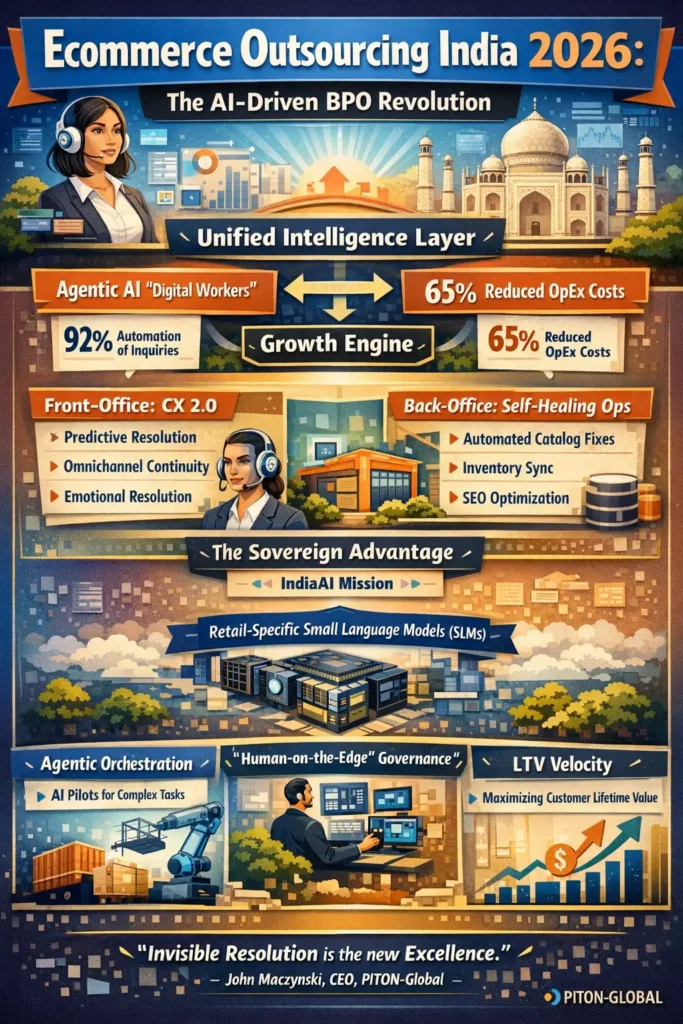
Front Office: From “Support” to Agentic Customer Experience (CX 2.0)
In 2026, the front office is a proactive Revenue Recovery center.
- Predictive Resolution: Before a consumer realizes a shipment is delayed, the AI has already queried port congestion, issued a loyalty credit, and sent a proactive SMS update.
- Omnichannel Context Continuity: Whether a conversation starts on TikTok, moves to WhatsApp, and ends in a voice call, the Agentic Layer maintains 100% context, achieving a 94% First Contact Resolution (FCR).
- Emotional Resolution: AI handles the data retrieval, allowing Indian specialists to focus on the 10% high-empathy cases that build brand fans.
Back Office: The Era of the “Self-Healing” Catalog
The 2026 Indian back office is an Orchestration Hub where humans manage the AI that manages the data.
- Self-Correction Loops: If a product video in London doesn’t match the SKU description in New York, the AI flags the discrepancy, generates a fix, and updates all global storefronts in <30 minutes.
- Multimodal SKU Enrichment: Indian teams run computer-vision models to automatically generate SEO-rich metadata for Search Generative Experience (SGE).
- Autonomous Inventory Sync: Synchronizing inventory across 15+ global channels simultaneously, eliminating stock-out variances in real-time.
The Unified Process Map: Front & Back Office Synergy
| Category | Front-Office (CX & Growth) | Back-Office (Ops & Data) | Agentic AI Impact |
| Sales & Growth | Live Video Shopping & Pre-Sales Advisory | Dynamic Pricing & Comp-Shop Analysis | Autonomous Price Matching |
| Orders & Fulfilment | Proactive Delivery Updates (WISMO) | Marketplace Inventory Sync & Logistics Audit | Route Optimization & Recovery |
| Product Data | Virtual Stylists & Personalized Recs | Multimodal SKU Enrichment & SGE Metadata | Automated Catalog Healing |
| Customer Retention | Subscription Management & Churn Prevention | Return Fraud Detection & Forensic Claims | Predictive Loyalty Credits |
| Risk & Compliance | Dispute Resolution & Escalation | KYC/AML & Data Privacy Audits | Continuous Security Monitoring |
| Technical Support | AI-Augmented Troubleshooting | Headless CMS Management & API Health | Real-time Error Correction |
Case Study: The “Invisible Resolution” of a Tier-1 Logistics Crisis
In early 2025, a major trans-pacific carrier experienced a localized port outage, stalling over 5,000 high-value electronics orders for a US-based retailer. In a legacy BPO model, this would have potentially triggered a “Support Tsunami”: thousands of angry “Where Is My Order?” tickets, manual spreadsheet tracking, and weeks of refund processing.
The Agentic Intervention (Indian Intelligence Hub): Instead of waiting for customers to complain, the Agentic AI layer—governed by our provider’s team in India—detected the shipping delay via a real-time API telemetry lag from the carrier.
- Autonomous Diagnosis: The AI “Agent” instantly cross-referenced the delayed container IDs with the brand’s Shopify backend to identify the specific 4,500 impacted customers.
- Predictive Retention: Using an LTV (Lifetime Value) Scoring Model, the AI segmented the customers. For “Platinum” members, it autonomously initiated a $50 “Inconvenience Credit” and sent a proactive WhatsApp video update explaining the delay before the customer even checked their tracking link.
- Back-Office Orchestration: Simultaneously, the agent queried regional 3PL hubs in the US. Finding available stock in a Texas warehouse for 1,200 of those orders, it re-routed the fulfillment instructions, generated new labels, and canceled the original stalled shipments—all within 4 minutes.
- The Result: * 92% reduction in potential inbound WISMO volume.
- $185,000 in saved “Refund Revenue” through proactive re-routing.
- Net Promoter Score (NPS) Increase: Paradoxically, the NPS for delayed customers was higher than the baseline, as they felt “valued” by the brand’s proactive honesty.
“In the 2026 landscape, excellence is defined by the problems the customer never knew they had. Our Indian hubs are no longer waiting for the phone to ring; they are orchestrating the recovery before the friction even occurs.”
—John Maczynski, CEO, PITON-Global
The 2026 Growth Mandate
The “Wait and See” era of AI implementation ended in 2025. Today, Ecommerce Outsourcing India is no longer a conversation about reducing headcount; it is a conversation about increasing machine-velocity and securing market share.
The brands currently dominating the global landscape are those that have moved past the silos of “Support” and “Data” to embrace Unified Intelligence Arbitrage. By leveraging India’s Top 12 Agentic Hubs, these leaders are building an operations layer that is faster, more secure, and more profitable than anything possible through domestic in-sourcing. At PITON-Global, our mission is to provide the forensic vetting and strategic orchestration required to navigate this new frontier. The future of commerce is autonomous, human-governed, and centered in India.
Expert FAQ: The 2026 Ecommerce Playbook
Does Agentic AI replace my Indian operations team?
No. In the 2026 model, AI elevates the human workforce. The Agentic layer handles the “robotic” cognitive load—data retrieval, ticket routing, and cross-platform syncing—while your Indian team evolves into Growth Architects. These specialists supervise the AI’s decision-making, manage high-empathy escalations, and fine-tune the “Brand Voice” to ensure 100% brand compliance.
How does “Answer Engine Optimization” (AEO) affect my back-office strategy?
By 2026, the primary “shopper” is often a consumer’s personal AI assistant. Our back-office teams in India focus on Structuring for Agency. This means moving beyond keyword-based SEO to Entity-Based Data Architecture. We ensure your product data is structured via specialized schemas so that global AI “Answer Engines” (like Gemini or SearchGPT) proactively recommend and purchase your SKUs over competitors.
Is it safe to let autonomous AI agents handle financial transactions?
Yes, provided you are using the 2026 Agentic Commerce Frameworks. Through the Mastercard Agentic Commerce protocol and India’s advanced UPI-based tokenization, all transactions are fully authenticated and capped by strict “spending guardrails.” Our Indian hubs act as the governance layer, providing real-time forensic auditing to ensure agents never exceed their programmed authority or spending limits.
How do Indian hubs manage the March 2026 Global Data Privacy Accord (GDPA)?
Our Top 12 vetted partners utilize Zero-Possession Architecture. Under this model, your consumer data never actually “rests” on Indian hardware. Instead, specialists and AI agents interact with the data via an encrypted, read-only Pixel-Stream. This ensures that your brand remains 100% compliant with both the GDPA and India’s DPDP Act, effectively eliminating the risk of cross-border data sovereignty breaches.
Achieve sustainable growth with world-class BPO solutions!
PITON-Global connects you with industry-leading outsourcing providers to enhance customer experience, lower costs, and drive business success.
Get Your Top 1% Vendor List
Author
Ralf Ellspermann is a multi-awarded outsourcing executive with 25+ years of call center and BPO leadership in the Philippines, helping 500+ high-growth and mid-market companies scale call center and customer experience operations across financial services, fintech, insurance, healthcare, technology, travel, utilities, and social media.
A globally recognized industry authority—and a contributor to The Times of India and CustomerThink —he advises organizations on building compliant, high-performance offshore contact center operations that deliver measurable cost savings and sustained competitive advantage.
Known for his execution-first approach, Ralf bridges strategy and operations to turn call center and business process outsourcing into a true growth engine. His work consistently drives faster market entry, lower risk, and long-term operational resilience for global brands.
EXECUTIVE GOVERNANCE & ACCURACY STANDARDS
Authored by:

Ralf Ellspermann
Founder & CSO of PITON-Global,
25-Year Philippine BPO Veteran,
Multi-awarded Executive
Specializing in strategic sourcing and excellence in Manila
View Full Bio
Verified by:

John Maczynski
CEO of PITON-Global, and former Global EVP of the World’s largest BPO provider | 40 Years Experience
Ensuring global compliance and enterprise-grade service standards
View Full Bio
Last Peer Review: January 27, 2026
This service framework is audited quarterly to meet shifting global outsourcing regulations and COPC standards.