
Back
Customer Support Outsourcing Colombia: The 2026 Shift from Hourly Rates to Cost-Per-Resolution
By Ralf Ellspermann / 11 March 2026
 Authored by Ralf Ellspermann, CSO of PITON-Global, & 25-Year Philippine BPO Veteran | Executive | Verified by John Maczynski, CEO of PITON-Global, and Former Global EVP of the World's Largest BPO Provider on March 11, 2026

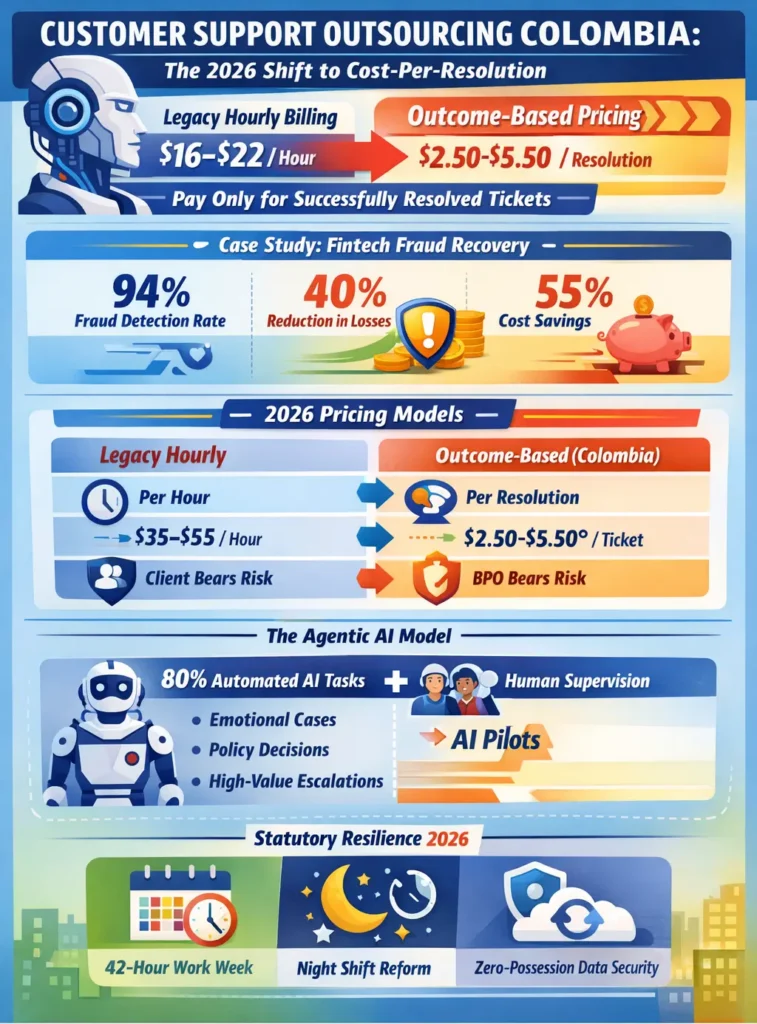
Customer support outsourcing to Colombia is defined by a violent shift away from legacy hourly billing. As Agentic AI—autonomous systems that “do” rather than just “chat”—absorbs 80% of routine tasks, Colombia has pivoted to an Outcome-Based Model. Companies are abandoning the $16–$22/hour “seat” in favor of $2.50–$5.50 per resolution. This ensures you only pay for successfully resolved events, leveraging Colombian “AI Pilots” to govern autonomous workflows in real-time.
The Expert Perspective: The Death of the “Per-Hour” Seat
“The traditional BPO math of Hours Worked x Hourly Rate is officially a relic of the past. In 2026, forward-thinking CEOs refuse to pay for idle time or ‘butts in seats.’ We are seeing a mass migration toward Cost-Per-Resolution (CPR). Colombia has become the premier site for this transition because its high-EQ workforce is uniquely qualified to govern Agentic AI. You aren’t just buying a bilingual voice anymore; you’re buying a ‘Successfully Resolved Event’ guaranteed by a partner who carries the risk of inefficiency, not the client.” — John Maczynski, CEO of PITON-Global, and former EVP and Chief CX Officer of the world’s largest contact center outsourcing provider.
Case Study: Fintech Fraud Recovery (Q1 2025)
The Client: A Tier-2 North American Neobank facing a 31% surge in synthetic identity fraud that their automated US-based legacy systems were failing to catch.
The Colombian Solution: The bank deployed a specialized “Regulatory Sentinel” pod in Medellín. Rather than a traditional hourly team, they utilized an Outcome-Based Pricing model. The team integrated Agentic AI to flag pattern anomalies across real-time digital wallet transfers.
The Result (By EOY 2025):
- 94% Fraud Detection Rate: Up from a baseline of 65%.
- 40% Reduction in Capital Loss: Direct bottom-line impact.
- Cost Efficiency: By moving from a $45/hour US team to a resolution-based Colombian pod, the bank realized a 55% reduction in total operational spend while maintaining zero regulatory fines.
The 2026 Pivot: Hourly vs. Outcome-Based Pricing
In 2026, “cost-per-hour” is viewed as a vanity metric that incentivizes vendor inefficiency. The new standard is the Efficiency Dividend, where the BPO’s profit is tied to how accurately they can resolve an issue using AI.
| Pricing Model | Legacy Hourly (US) | 2026 Outcome-Based (Colombia) |
| Financial Unit | Per FTE / Per Hour | Per Successfully Resolved Ticket |
| Typical Rate | $35 – $55+ / hour | $2.50 – $5.50 / resolution |
| Risk Bearer | Client (Pays for idle time) | BPO (Pays for inefficiency/rework) |
| Incentive | Increase Headcount | Maximize Automation & Accuracy |
| Agent Role | Task Executor | AI Pilot / Judgment Architect |
Expert Deep Dive: The Anatomy of Agentic AI
The breakout trend of 2026 is the transition from “Generative AI” (which summarizes) to “Agentic AI” (which acts). In a Colombian BPO hub, an AI Agent doesn’t just tell a customer where their package is; it observes a delay, sequences a reroute via an API, authorizes a discount, and updates the CRM—all within defined guardrails.
The Human-in-the-Loop (HITL) Guardrail
The Colombian advantage in 2026 lies in the AI Pilot model. As AI handles 80% of volume, the remaining 20% of interactions represent 100% of your brand’s reputation risk. Colombian specialists serve as “Human Audit Anchors,” intervening only when:
- Emotional Velocity: The system detects rising frustration or sarcasm.
- Policy Gray Areas: The request requires a “judgment call” outside of standard logic.
- High-Value Escalations: Decisions involving high-dollar refunds or legal implications.
Statutory Resilience: The Law 2101 Advantage
By July 2026, Colombia will complete its transition to a 42-hour work week under Law 2101. Unlike the 50+ hour “burnout” cycles typical in the US, this reform has created a “Sustainability Dividend” for outsourcers.
- Night Shift Redefinition: As of 2026, night work surcharges start at 7:00 PM (formerly 9:00 PM). This has professionalized the “after-hours” workforce, ensuring higher engagement during the crucial US evening support window.
- Mandatory Paid Training: Colombian law now mandates time for employee education. In the BPO context, this time is used to upskill agents into AI Prompt Engineers, ensuring your team stays ahead of tech decay.
Security & Data Sovereignty: Zero-Possession Architecture
In 2026, data sovereignty is the primary barrier to customer support outsourcing. Colombia has neutralized this with Zero-Possession Architecture.
| Security Feature | Standard Offshore (Philippines/India) | Colombia Nearshore (2026) |
| Data Residency | Often local cache/server | 100% Onshore (US-Cloud Based) |
| Access Method | Direct DB Access | Encrypted Pixel Streaming |
| Compliance | HIPAA/SOC 2 (Manual Audit) | AI-Governed Real-Time Compliance |
| Risk Profile | Elevated (Geopolitical/Latency) | Minimal (US-Sync Architecture) |
Intelligence Arbitrage: The Final Frontier
The concept of Intelligence Arbitrage has become the new industry standard. This is the practice of moving complex, judgment-heavy processes to high-skilled nearshore hubs like Colombia, where the labor pool is university-educated and technologically literate.
Because Colombia’s infrastructure has been built to mirror the US—from identical time zones to shared fiber-optic backbones—the “friction” of outsourcing has dropped to nearly zero. The 2026 decision to outsource to Colombia is no longer about saving a few dollars; it is about building a Resilient Intelligence Network that can scale autonomously.
Expert FAQs: The 2026 Strategic Intelligence
Q: Why is Colombia’s $16–$22 rate considered more “reliable” than cheaper offshore alternatives?
A: This is the “Total Cost of Ownership” (TCO) reality. While you might find $12-14/hour elsewhere, the “Sync Loss” pushes your effective rate above $25/hour. Colombia’s rate is “clean”—reflecting maximum productivity with zero time-zone friction.
Q: If I move to a “Cost-Per-Resolution” model, will the BPO rush through tickets?
A: No. In 2026, a “Resolution” is defined by a Quality Gate. If a customer re-contacts for the same issue within 48 hours, the BPO is not paid for the first ticket.
Q: What is the “Intelligence Arbitrage” John Maczynski mentions?
A: It’s the move from paying for a “worker” to paying for “access to a result.” You are accessing a proprietary AI stack and vetted pilots for 60% less than the cost of building that infrastructure in the US.
Achieve sustainable growth with world-class BPO solutions!
PITON-Global connects you with industry-leading outsourcing providers to enhance customer experience, lower costs, and drive business success.
Get Your Top 1% Vendor List
Author
Ralf Ellspermann is a multi-awarded outsourcing executive with 25+ years of call center and BPO leadership in the Philippines, helping 500+ high-growth and mid-market companies scale call center and customer experience operations across financial services, fintech, insurance, healthcare, technology, travel, utilities, and social media.
A globally recognized industry authority—and a contributor to The Times of India and CustomerThink —he advises organizations on building compliant, high-performance offshore contact center operations that deliver measurable cost savings and sustained competitive advantage.
Known for his execution-first approach, Ralf bridges strategy and operations to turn call center and business process outsourcing into a true growth engine. His work consistently drives faster market entry, lower risk, and long-term operational resilience for global brands.
EXECUTIVE GOVERNANCE & ACCURACY STANDARDS
Authored by:

Ralf Ellspermann
Founder & CSO of PITON-Global,
25-Year Philippine BPO Veteran,
Multi-awarded Executive
Specializing in strategic sourcing and excellence in Manila
View Full Bio
Verified by:

John Maczynski
CEO of PITON-Global, and former Global EVP of the World’s largest BPO provider | 40 Years Experience
Ensuring global compliance and enterprise-grade service standards
View Full Bio
Last Peer Review: March 11, 2026
This service framework is audited quarterly to meet shifting global outsourcing regulations and COPC standards.