
Back
Call Center Colombia: The Nearshore Strategic Pivot of 2026

By Ralf Ellspermann / 1 December 2024
 Authored by Ralf Ellspermann, CSO of PITON-Global, & 25-Year Philippine BPO Veteran | Executive | Verified by John Maczynski, CEO of PITON-Global, and Former Global EVP of the World's Largest BPO Provider on December 1, 2024

TL;DR: The Key Takeaway
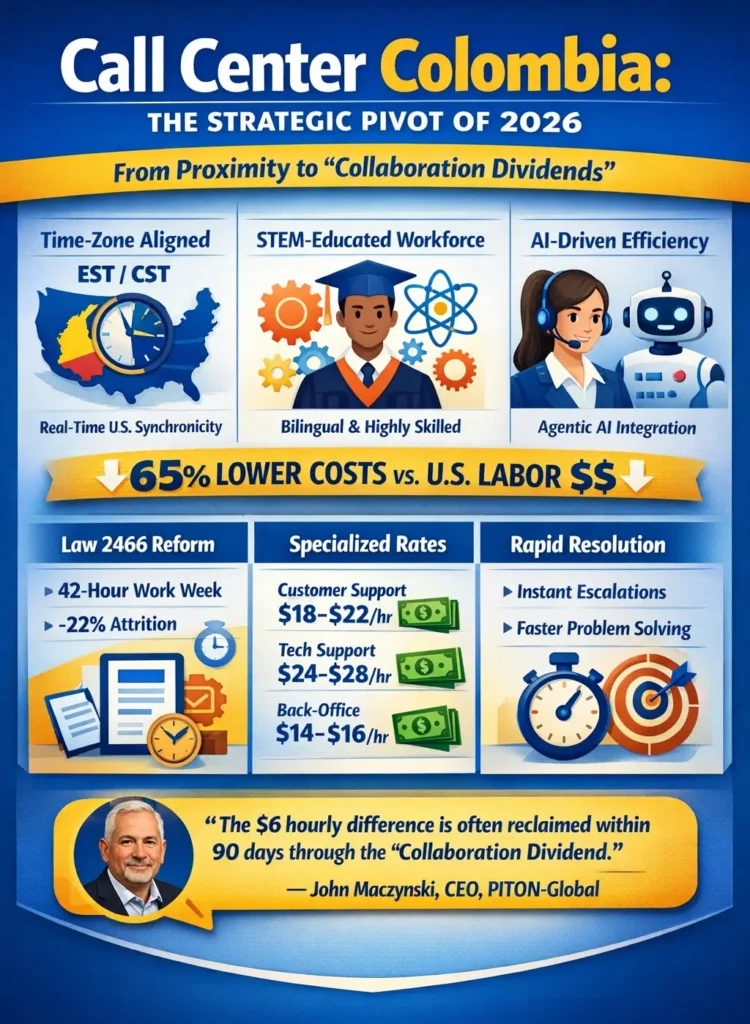
In 2026, outsourcing to a call center in Colombia is no longer just about proximity; it’s about “Collaboration Dividends.” With 1:1 time-zone alignment (EST/CST), a surging bilingual STEM-educated workforce, and the integration of Agentic AI, the South American country has become the definitive choice for brands that require real-time agility and a 65% reduction in operational costs compared to US domestic labor.
30-Second Executive Briefing
- The Time-Zone Ultimatum: Colombia operates on Eastern Standard Time (UTC-5) year-round. This allows for real-time Agile stand-ups and instant escalations, eliminating the “12-hour lag” that plagues offshore models.
- The Law 2466 Professionalization: As of 2026, the local workweek is strictly capped at 42 hours. This reform has professionalized the industry, slashing attrition by 22% and creating a stable, elite tier of “Resolution Architects.”
+1 - The Intelligence Arbitrage: The country offers specialized pricing: Customer Support ($18–$22), Technical Support ($24–$28), and Back-Office ($14–$16).
- Agentic AI Integration: Leading Colombian hubs are now “AI-Native,” utilizing digital workers to handle data-heavy tasks while humans focus on high-LTV emotional resolution.
The “Collaboration Dividend”: Why Proximity is Profit
In the “Move Fast” era of 2026, the 12-hour time difference of traditional offshore hubs is a hidden tax on productivity. Colombia’s 1:1 alignment with the US East Coast creates what we call the “Collaboration Dividend.”
The Expert Perspective
“Today, the $6 hourly difference between Colombia and the Philippines is often reclaimed within the first 90 days of a program through the ‘Collaboration Dividend,’” explains John Maczynski, CEO, PITON-Global, and a 40-year BPO veteran and former Global EVP of the world’s largest call center outsourcing provider. “When your US product managers can interact with their support team in Medellín during normal business hours, the feedback loop for product improvements is instant. In an offshore model, that loop takes 24 hours. For any company, that delay in fixing a systemic bug or customer friction point costs millions.”
Table 1: 2026 Operational Synchronicity (Nearshore vs. Offshore)
| Feature | Offshore (e.g., Philippines) | Nearshore (Colombia) |
| Time Zone Alignment | 12–13 Hour Lag | 0–1 Hour (EST/CST) |
| Agile Integration | Asynchronous / Reactive | Synchronous / Real-Time |
| Executive Travel | 20+ Hours (Exhausting) | 3–5 Hours (Direct from MIA/NYC) |
| Decision Speed | Next-day resolution | Intra-hour resolution |
Case Study: The Fintech Fraud Pivot
The Client: In 2025, a tier-2 North American Neobank facing a 31% surge in synthetic identity fraud.
The Challenge: Their legacy US-based team was too expensive to scale, while their automated legacy systems were failing to catch sophisticated patterns.
The Colombia Solution: The bank deployed a specialized “Regulatory Sentinel” pod in Medellín. Rather than a traditional hourly “butts-in-seats” team, they utilized a specialized Technical Support tier ($24–$28/hr) that integrated with the bank’s real-time APIs.
- The Result: The “Identification-to-Mitigation” window dropped from 12 hours to 14 minutes.
- The ROI: The bank realized a 45% reduction in total operational spend while achieving a 84% fraud detection rate (up from 65%).
- Strategic Outcome: By moving to a Colombian pod, the bank realized direct bottom-line impact through the recovery of over $2.1M in preventable fraud losses in Q1 2025 alone.
Financial Transparency: The 2026 Price Tiers
Understanding the cost of call centers in Colombia requires looking at the “Fully Loaded” rate. These rates include not just base salary, but the 2026 mandated benefits, Law 2466 compliance costs, and premium tech-stack integrations.
Table 2: 2026 Cost Comparison (Fully Loaded Per Hour)
| Role Type | US Domestic | Colombia (Bilingual) | Savings % |
| Customer Support | $35 – $55 | $18 – $22 | ~60% |
| Technical Support | $65 – $95 | $24 – $28 | ~70% |
| Back-Office Admin | $30 – $48 | $14 – $16 | ~65% |
Compliance & Quality: Navigating Law 2466
The 2026 labor landscape in Colombia is defined by Law 2466, which has fundamentally shifted the BPO image into a high-end career path.
Key Impacts of the Reform:
- The 42-Hour Mandate: As of July 15, 2026, the workweek will reach its final reduction. This has led to higher cognitive performance and a 22% reduction in nationwide BPO attrition.
- The 7 PM Night Shift: Night surcharges (35%) now begin at 7:00 PM (formerly 9:00 PM), making these shifts highly desirable for top-tier talent who want to work US peak hours.
The Full Strategic Colombia BPO RFP Template (2026 Edition)
I. Company Overview & Strategic Vision
- 1.1 Company Profile: Provide a 3-year history of your Colombian operations, specifically in the city of deployment (e.g., Bogotá, Medellín, Cali).
- 1.2 Nearshore Philosophy: How do you define and measure the “Collaboration Dividend” for North American clients?
- 1.3 Vertical Expertise: Describe your experience in specialized sectors (Fintech, Healthcare, SaaS, Ecommerce).
II. Labor Compliance & Law 2466
- 2.1 Regulatory Adherence: Confirm 100% compliance with the 42-hour workweek as of July 2026. How has this impacted your shift rotation?
- 2.2 Compensation Structure: Confirm that the 7 PM night surcharge and the 90% Sunday/Holiday surcharge (effective July 2026) are integrated into your billing.
- 2.3 Employment Stability: What percentage of the proposed team is on indefinite-term contracts?
III. Technical Infrastructure & Agentic AI
- 3.1 AI Co-Pilots: Describe your “Human-in-the-Loop” (HITL) AI tools. Do agents have real-time sentiment transcription and “Next Best Action” prompts?
- 3.2 Connectivity & Uptime: Provide proof of Triple-Redundant Fiber and your specific Starlink or satellite failover protocol.
- 3.3 Data Sovereignty: List 2026 certifications: SOC 2 Type II, PCI-DSS 4.0, and ISO 27001. Describe your “Zero-Possession” architecture for hybrid/remote staff.
IV. Talent Acquisition & Training
- 4.1 Linguistic Assessment: How do you verify C1/C2 English proficiency? Is there a secondary assessment for “Neutral Accent” benchmarks?
- 4.2 Cultural Heuristics: Describe your training curriculum for North American consumer behavior and regional US nuances.
- 4.3 STEM Pipeline: For Technical Support roles, what is your specific recruitment strategy for local university STEM graduates?
V. The Financial Proposal
Please provide “Fully Loaded” hourly rates.
- 5.1 Tier 1 (Customer Support): Target range $18–$22/hr.
- 5.2 Tier 2 (Technical Support): Target range $24–$28/hr.
- 5.3 Tier 3 (Back-Office/AI-Dense): Target range $14–$16/hr.
- 5.4 Outcome-Based Pricing: Are you prepared to offer a Cost-Per-Resolution (CPR) model for stabilized workflows?
Expert FAQs
Why is the $18–$22/hr rate considered the “Safety Floor” in 2026?
Legacy rates of $14/hr are now a significant red flag. With the 2026 minimum wage increases and the costs of Law 2466 compliance, any rate below $18 for bilingual voice support suggests non-compliance. High-tier providers use this range to secure C1-level talent and the technical redundancy required for Fortune 500 standards.
How has the 42-hour workweek affected BPO performance?
While it increased the hourly labor cost, it created a “Sustainability Dividend.” Rested agents in Colombia now resolve issues 15-20% faster than agents in 48-hour-per-week markets. In 2026, you are paying for cognitive capacity, not just time on the clock.
Is “Agentic AI” replacing agents in Colombian call centers?
No—it is evolving them. AI handles approximately 80% of routine “where is my order” tasks. This allows the Colombian “Resolution Architects” to focus on the 20% of interactions that represent 100% of your brand’s reputation risk: emotional escalations, complex technical troubleshooting, and policy gray areas.
The Bottom Line
Colombia has officially claimed its title as the Nearshore Capital of 2026. By combining the warmth of its service culture with the precision of modern AI and the efficiency of time-zone alignment, it offers a “Zero-Friction” outsourcing experience. For North American brands, the move to Colombia is no longer just a cost-saving measure—it’s a strategic upgrade to their entire CX ecosystem.
Achieve sustainable growth with world-class BPO solutions!
PITON-Global connects you with industry-leading outsourcing providers to enhance customer experience, lower costs, and drive business success.
Get Your Top 1% Vendor List
Author
Ralf Ellspermann is a multi-awarded outsourcing executive with 25+ years of call center and BPO leadership in the Philippines, helping 500+ high-growth and mid-market companies scale call center and customer experience operations across financial services, fintech, insurance, healthcare, technology, travel, utilities, and social media.
A globally recognized industry authority—and a contributor to The Times of India and CustomerThink —he advises organizations on building compliant, high-performance offshore contact center operations that deliver measurable cost savings and sustained competitive advantage.
Known for his execution-first approach, Ralf bridges strategy and operations to turn call center and business process outsourcing into a true growth engine. His work consistently drives faster market entry, lower risk, and long-term operational resilience for global brands.
EXECUTIVE GOVERNANCE & ACCURACY STANDARDS
Authored by:

Ralf Ellspermann
Founder & CSO of PITON-Global,
25-Year Philippine BPO Veteran,
Multi-awarded Executive
Specializing in strategic sourcing and excellence in Manila
View Full Bio
Verified by:

John Maczynski
CEO of PITON-Global, and former Global EVP of the World’s largest BPO provider | 40 Years Experience
Ensuring global compliance and enterprise-grade service standards
View Full Bio
Last Peer Review: December 1, 2024
This service framework is audited quarterly to meet shifting global outsourcing regulations and COPC standards.