

On this page
- Key Takeaways
- Which Specific Back-Office Functions Yield the Largest Margin Improvements?
- How Does the “Pilot and Wingman” Model Drive Compounded Savings?
- What Hidden Costs Must Buyers Mitigate to Preserve Expected Returns?
- What Does Restructuring F&A Operations Look Like in Practice?
- How Does PITON-Global Risk-Mitigate Provider Selection to Maximize ROI?
- Frequently Asked Questions
Finance and accounting and health information management deliver the highest financial returns through outsourcing to the Philippines, achieving the deepest net cost reductions of any back-office function. By pairing localized talent with automated processing architectures, enterprise buyers lower unit costs, eliminate fixed capital expenses, and compress cycle times while maintaining strict international compliance standards. Both belong to the family of work covered by controlled back-office processing from the Philippines.
Key Takeaways
- F&A tops financial yield: Accounts Payable, Accounts Receivable, and General Ledger accounting yield the fastest positive ROI, often within 60 to 90 days.
- Direct cost reductions and capital realignment: Capture large structural savings over onshore fully loaded operating expense, and shift heavy software licensing, real estate, and hardware investment into flexible, predictable operational expense models.
- Throughput multipliers: Deploying “Pilot and Wingman” architectures—autonomous AI engines combined with specialized human operators—expands daily transaction capacity substantially.
- Error cost elimination: Process standardization cuts transactional defect rates, dramatically reducing dispute resolution overhead and late-payment penalties.
Which Specific Back-Office Functions Yield the Largest Margin Improvements?
Functions with high volume, rule-based execution, and strict compliance requirements deliver the most immediate margin expansion. Finance and accounting—invoice matching, vendor reconciliations, payroll—replaces onshore overhead with far lower seat rates; health information management uses AAPC- and AHIMA-certified coders to achieve high clean claim rates; and legal process outsourcing captures the wide wage gap for certified legal personnel.
Not all back-office processes generate equal returns when migrated offshore. Functions characterized by high volume, rule-based execution, and strict compliance requirements deliver the most immediate margin expansion, and three stand out. For the full menu of functions, see our essential guide to back-office services.
Finance and Accounting (F&A)
Processing invoice matching, vendor reconciliations, and payroll offshore replaces expensive onshore overhead with scalable seat rates at a fraction of onshore wage levels. Reinvestment in automated OCR validation further accelerates transaction speeds, which is why AP, AR, and general ledger accounting reach positive ROI within 60 to 90 days. Receivables work extends naturally into collections run as a back-office function.
Health Information Management (HIM)
Medical coding, revenue cycle management, and claims adjudication require deep specialized knowledge. Philippine centers offer AAPC- and AHIMA-certified coders at a fraction of Western labor costs, achieving high clean claim rates—which recovers cash faster than the labor saving alone.
Legal Process Outsourcing (LPO) and Compliance
Document review, contract abstraction, and regulatory tracking yield high financial returns because of the wide wage gap for certified legal personnel. The chart below shows how the returns of the four largest functions accumulate over a 36-month horizon once transition costs are netted out.
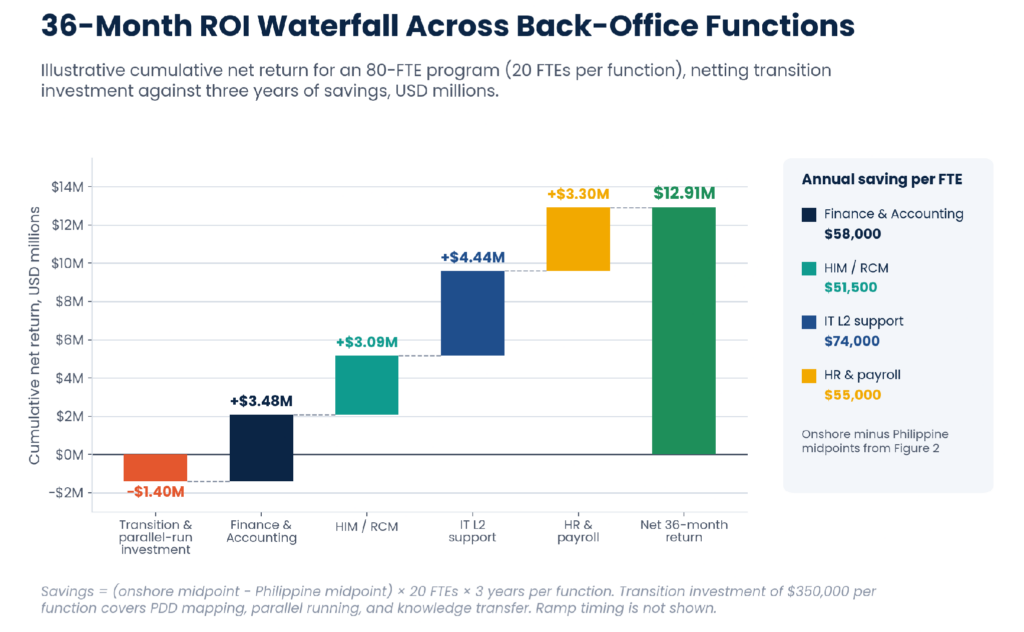
Figure 1. Illustrative 36-month ROI waterfall: transition investment netted against cumulative savings across Finance and Accounting, HIM, IT support, and HR for an 80-FTE program.
The table below sets onshore fully loaded cost against the Philippine seat rate for each function, with the average net reduction and the typical time to positive ROI.
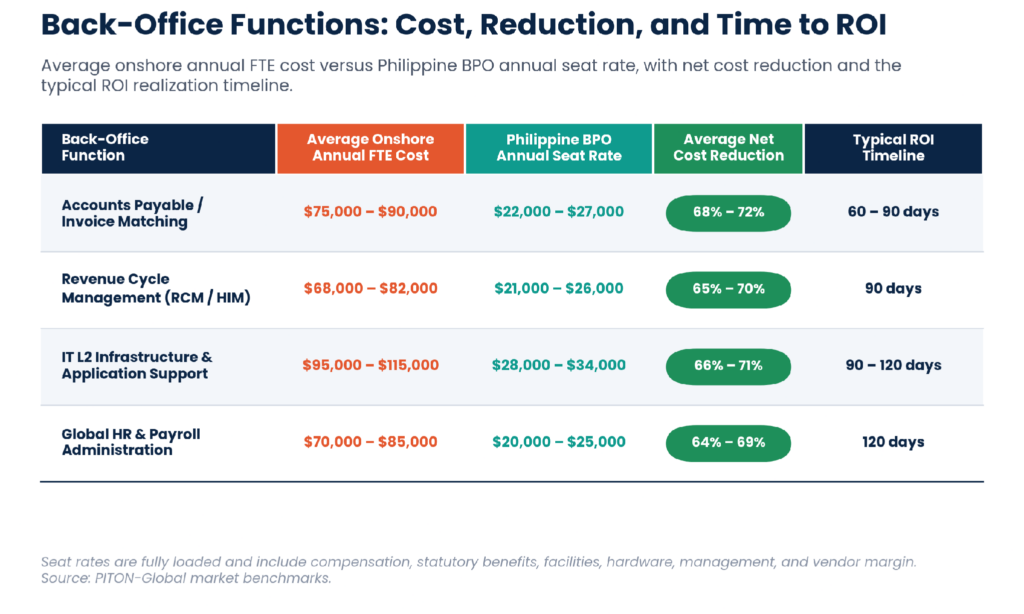
Figure 2. Average onshore annual FTE cost versus Philippine BPO seat rate, net cost reduction, and typical ROI realization timeline by back-office function.
How Does the “Pilot and Wingman” Model Drive Compounded Savings?
Legacy outsourcing relied solely on headcount arbitrage; modern Philippine operations compound returns by integrating human expertise with automated processing engines. Autonomous software Wingmen handle data ingestion, system handshakes, and baseline validations, while human Pilots focus exclusively on exception handling, complex reconciliations, and quality oversight, boosting per-FTE processing capacity substantially while keeping labor footprints lean.
Legacy outsourcing relied solely on headcount arbitrage. Modern Philippine operations achieve higher returns by integrating human expertise directly with automated processing engines: in this framework, autonomous software engines—Wingmen—handle data ingestion, system handshakes, and baseline validations, while human specialists—Pilots—focus exclusively on exception handling, complex reconciliations, and quality oversight.
The synergy boosts per-FTE processing capacity while keeping labor footprints lean, and because the savings apply to every transaction rather than to the hourly rate alone, they compound as volume grows. The chart below compares manual and AI-assisted output per FTE across representative F&A and RCM workflows. Online travel agencies use a similar human-plus-automation split, as our look at OTA inventory management shows.
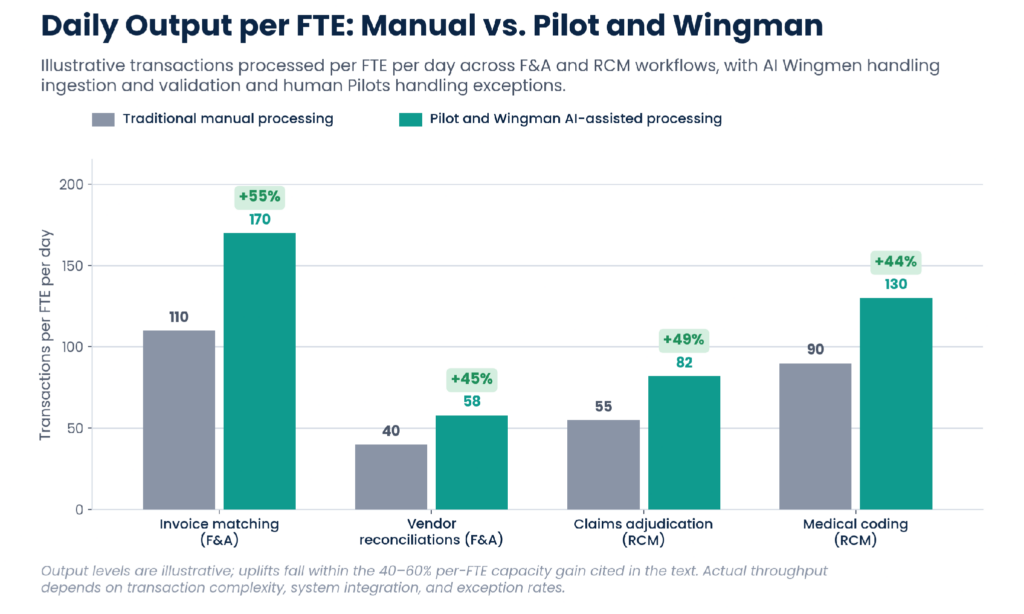
Figure 3. Daily transaction output per FTE: traditional manual processing versus Pilot and Wingman AI-assisted processing across F&A and RCM workflows (illustrative).
In high-value back-office operations, maximum financial returns aren’t built on low wages alone—they are driven by process precision. When you pair domain-trained Filipino specialists with automated system execution, you don’t just cut costs; you eliminate the operational friction and errors that silently bleed enterprise margins.
— John Maczynski, CEO, PITON-Global
What Hidden Costs Must Buyers Mitigate to Preserve Expected Returns?
Three hidden costs erode projected returns: process inefficiency transfer, because offshoring an unstandardized process creates an inefficient offshore operation unless Process Definition Documents map it first; transition and shadowing expense, since parallel-run periods dual-fund onshore and offshore teams during knowledge transfer; and regulatory compliance oversight, where missing SOC 2 Type II, ISO 27001, or HIPAA controls trigger costly security remediation.
While potential returns are substantial, failing to account for migration friction can erode projected cost savings. Enterprise buyers must anticipate three operational variables during planning, each of which has a known mitigation.
Process Inefficiency Transfer
Offshoring an unstandardized process simply creates an inefficient offshore operation. Thorough mapping via Process Definition Documents is required prior to go-live, so that handoffs, redundant steps, and desktop environments are fixed before the offshore team inherits them.
Transition and Shadowing Expenses
Parallel-run periods require temporary dual funding of onshore and offshore teams during initial knowledge transfer. Budgeting the 8-to-12-week migration explicitly keeps it from appearing as an overrun against the business case.
Regulatory Compliance Oversight
Failing to establish SOC 2 Type II, ISO 27001, or HIPAA compliance controls can trigger costly security remediation. Verifying certifications during vendor selection, rather than after migration, is the cheapest control available. The panel below summarizes the three exposures and their mitigations.
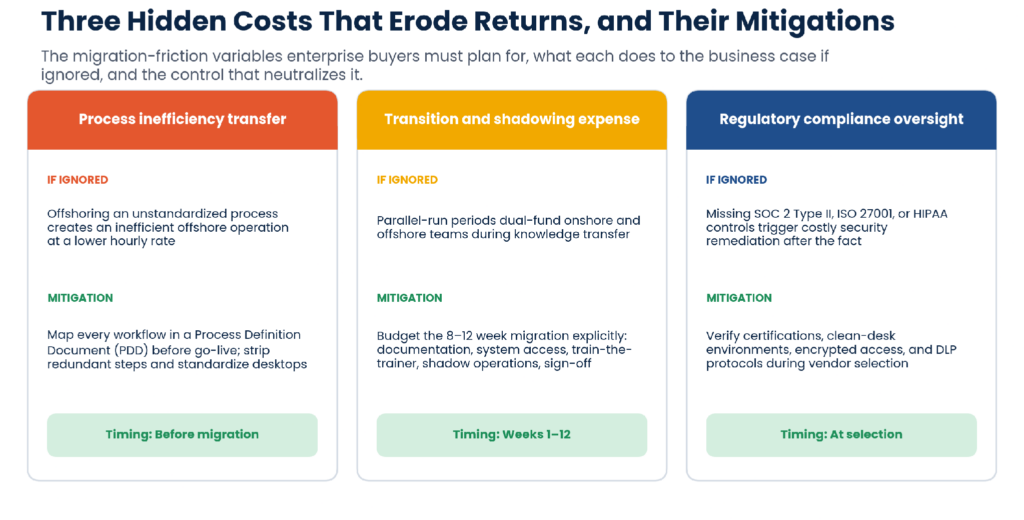
Figure 4. The three hidden costs of back-office migration—what each does to the business case if ignored, the mitigation, and when to apply it.
What Does Restructuring F&A Operations Look Like in Practice?
Restructuring F&A means specialized talent plus standardized validation. A multinational logistics provider carrying heavy annual back-office costs, a 45-day accounts payable backlog, and high error rates on multi-currency reconciliations deployed a dedicated 40-FTE Manila team, cutting operating costs sharply, clearing the backlog within 60 days, and reducing invoice exceptions to a small fraction of their former level.
Client Challenge
A multinational logistics provider faced rising annual back-office costs, a 45-day accounts payable processing backlog, and high error rates across multi-currency vendor reconciliations.
Vendor Selection
PITON-Global conducted an operational audit and matched the enterprise with a specialized mid-sized Philippine BPO partner featuring deep freight-F&A domain expertise and verified compliance controls.
Solution Implemented
A dedicated 40-FTE team in Manila was deployed using desktop automation and standardized validation protocols for invoice processing, vendor audits, and ledger posting, following Process Definition Document mapping of every workflow before go-live.
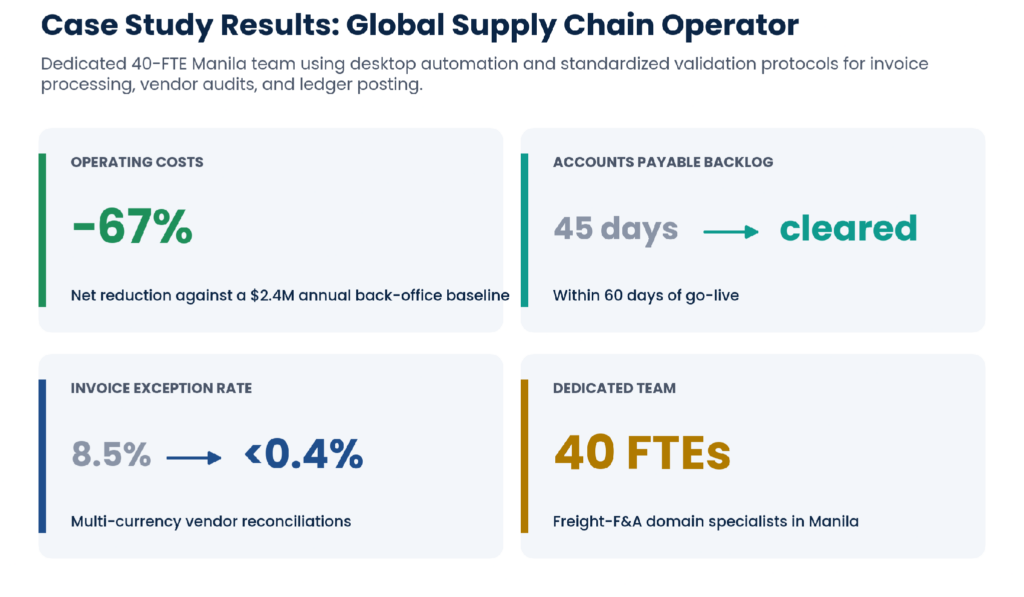
Figure 5. Quantifiable outcomes of the supply chain operator’s F&A restructuring.
Outcomes and Lessons
The provider achieved a steep net reduction in operating costs, cleared the 45-day backlog within 60 days, and cut invoice exception rates to a small fraction of their starting level. The lesson: combining specialized domain talent with workflow standardization accelerates cash-flow recovery far beyond baseline labor savings.
How Does PITON-Global Risk-Mitigate Provider Selection to Maximize ROI?
Navigating more than 1,000 Philippine BPO providers presents selection risk; an ill-fitted vendor means delayed transitions, SLA breaches, and budget expansion. PITON-Global is an independent outsourcing advisory led by veteran operators that guides decision-makers through vendor matching across a network of more than 100 vetted partners, evaluating verified production data, technical compliance, and domain specialization at no cost to buyers.
Who Is PITON-Global?
PITON-Global is an independent, vendor-neutral outsourcing advisory headquartered in Manila, led by veteran operators with decades of global executive experience and more than 65 combined years of outsourcing governance. It guides enterprise decision-makers through objective vendor matching in a landscape of more than 1,000 Philippine providers.
How Does PITON-Global Differ from Traditional Outsourcing Brokers?
Traditional brokers steer buyers to preferred vendors and earn commissions on placement. PITON-Global evaluates providers on verified production data, technical compliance, and domain specialization, recommends on the buyer’s financial return rather than provider promotion, and stays engaged through SLA protections and contract execution.
How Does PITON-Global’s Network of 100+ Vetted Philippine BPO Providers Benefit Organizations?
A network of more than 100 vetted Philippine BPO partners, segmented by domain—freight and multi-currency F&A, AAPC- and AHIMA-certified coding teams, IT L2 support, HR and payroll—lets buyers move straight to providers with the production history and certifications their function requires.
How Does PITON-Global’s Advisory-Led Vendor Matching Process Work?
PITON-Global’s vendor matching architecture runs as a decision tree: an initial process audit that confirms workflows are standardized before migration; capability shortlisting on verified production data and domain specialization; security verification of SOC 2 Type II, ISO 27001, and HIPAA controls; then contract execution with optimized commercial structures and strict SLA protections.
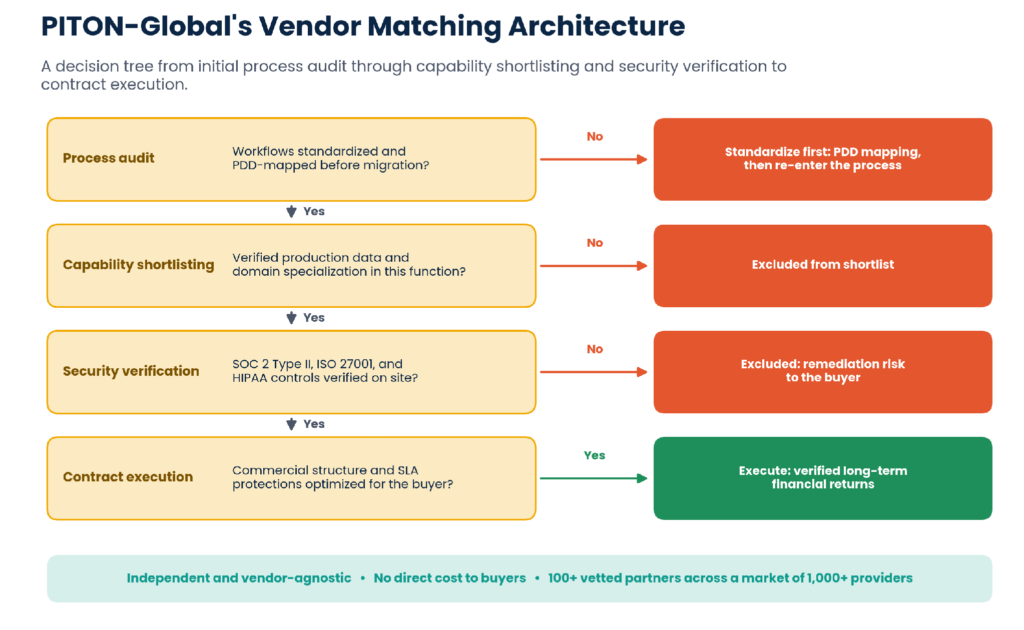
Figure 6. PITON-Global’s vendor matching architecture as a decision tree, from process audit through capability shortlisting and security verification to contract execution.
Why Do Organizations Use PITON-Global?
Organizations use PITON-Global to secure optimized commercial structures, strict SLA protections, and verified long-term financial returns without selection risk. The advisory is provided at no direct cost to enterprise buyers, compensated through provider network frameworks while remaining completely vendor-agnostic.
Frequently Asked Questions
Which back-office process offers the single fastest payback period?
Accounts Payable invoice processing typically offers the fastest payback period, achieving positive financial ROI within 60 days because of high transaction standardization and low system integration friction.
How do Philippine providers ensure compliance for regulated financial and healthcare processes?
Leading Philippine BPO centers maintain SOC 1/2/3, ISO 27001, PCI DSS, and HIPAA certifications. Operations run within secure, clean-desk environments with encrypted network access and strict data loss prevention protocols.
What size enterprise sees the highest proportional return from back-office outsourcing?
Mid-market companies often realize the highest proportional margin expansion, because outsourcing lets them access enterprise-grade infrastructure without large capital expenditures.
How long does a standard back-office migration to the Philippines take?
A standard migration takes between 8 and 12 weeks. The timeline includes workflow documentation, system access configuration, train-the-trainer sessions, shadow operations, and final go-live sign-off.
How does PITON-Global provide vendor-neutral advisory services at no cost to buyers?
PITON-Global operates under standard industry advisory agreements, receiving compensation through provider network frameworks while remaining completely vendor-agnostic to protect the buyer’s operational and financial interests.