Secure, compliant fintech teams — built for scale.
KYC/AML, fraud monitoring, customer service and back-office processing powered by certified Philippine specialists and Agentic AI. Reduce cost while strengthening compliance and operational performance.
BPO Suppliers
Clients Served
Service Delivery
The “move fast and break things” era of fintech is over. Outsourcing is no longer judged by cost per seat, but by risk containment, regulatory alignment and the ability to deploy Agentic AI that executes high-complexity financial workflows with 100% auditability — at 70–78% lower total cost than in-house builds.
Why do the fastest-scaling fintechs outsource their most complex workflows — not their simplest?
Because the workflows breaking fintechs in 2026 are judgment-critical — they demand Agentic AI plus a finance-literate human layer, not cheap labor. Fintechs are not short on ideas — they are short on certainty. The workflows breaking them are judgment-critical: a 2AM cross-border settlement that fails validation at the Adyen gateway, an account-takeover that replicates the victim’s device fingerprint, an AI-generated advice response that is accurate but regulatorily non-compliant. These are Intelligence Arbitrage problems.
Intelligence Arbitrage is an operational BPO model that combines Agentic AI systems with finance-literate human specialists to execute high-complexity financial workflows. The model measures performance by value per completed workflow rather than hourly cost per seat, prioritizing risk containment, compliance, and regulatory alignment.

“Fintech outsourcing is no longer evaluated by cost per seat, but by risk containment, regulatory alignment, and the ability to deploy Agentic AI that executes high-complexity financial workflows with 100% auditability.”
What are the four pillars of institutional-grade fintech governance?
Agentic Payment Ecosystems, the Regulatory Sovereignty Layer, the Linguistic Guardian Protocol and Forensic Fraud Orchestration. Each layer is independently valuable. Together they form a hardened operational architecture that scales without regulatory exposure — stress-tested under live client conditions, not retrofitted to them.
The right operation depends on your product, your regulators, and where your fraud concentrates.
High-velocity onboarding is where synthetic identity hides. Sub-hour biometric-OCR KYC, behavioral-biometrics ATO defense, and compliance-aware support that scales with your user curve — not against it.
Origination cycles are conversion cycles. Document indexing, credit decision support, and collections operations that compress time-to-funded — with underwriters owning every final call.
The 2AM cross-border settlement that fails validation at the gateway is your problem whether you’re awake or not. 24/7 agentic settlement coverage, real-time reconciliation, dispute and chargeback operations inside Stripe, Adyen, Mambu and Temenos.
Travel-rule and AML screening, transaction monitoring, and GENIUS Act–aligned compliance operations for exchanges and digital-asset platforms — where a governance gap is a licensing event.
Labor arbitrage vs. Intelligence Arbitrage.
The competitive delta between a legacy 2024 BPO baseline and the PITON-Global-vetted 2026 standard — across seven performance dimensions that determine resilience, valuation and regulatory standing.
Where does the 8–9× return come from — and why does the CFO model miss 60%?
From four value streams the standard cost model omits: fraud recovery, onboarding conversion, retention and 24/7 coverage. The standard cost-comparison model captures, at most, 40% of the economic impact. The remaining 60% sits in four value streams typically attributed to product, marketing or “market conditions” rather than operational architecture quality.
ROI figures reflect 12-month measured net benefit against total engagement cost on 50-agent-equivalent deployments, per the audit methodology in Section 4 of the 2026 report.
Less engagement cost ($1.05M)
$8.7M gross benefit on $940K implementation
John Maczynski (CEO) · Signed off Q2 2026
Shutting down synthetic-identity fraud at onboarding — a smaller deployment, a representative result.
Not every engagement is a four-pillar Hardened Shield build. A single-pillar deployment against a single failure surface returned a measurable delta in one quarter — speed from the agents, accuracy from the analysts. The architecture scales down as cleanly as it scales up.
Where does 70–78% actually come from? Run your own numbers.
The ROI model above is the top-down view. This is the bottom-up one — fully-loaded cost per fintech-operations FTE, by delivery model, at your team size. No blended averages, no footnote games.
Illustrative projection at standard role mix. Savings on a 50-agent-equivalent program run 70–78% below an in-house build, 72% at standard role mix — depending on the ratio of judgment-critical roles (compliance, fraud) to volume roles (support, back-office). This table is the cost line only; the four value streams above sit on top of it. The seat was never the expensive part of fintech. The miss is.
Indicative 2026 Philippine sourcing rates — by role, not by blend.
Blended rates hide the thing that matters: whether you are paying volume prices for judgment-critical work, or judgment prices for volume work. These are the indicative hourly bands across PITON-Global-vetted providers, Q2 2026.
Rates reflect finance-literate, IQ- and integrity-screened profiles — not generic call-center benches. A quote materially below these bands is usually the first auditable sign of Generic Hiring (see failure modes above).
Price my exact role mix →A fully institutional-grade operation in 12 weeks — without regulatory exposure.
A structured, phase-gated roadmap. Each gate requires sign-off before progression — no client enters Full Migration before CSAT ≥85% and fraud detection ≥90% are confirmed in Soft Launch.
What drives the 55% fintech outsourcing partnership failure rate?
Three structural failure modes — AI-washing, generic hiring and shared infrastructure — each auditable before you sign. Fifty-five percent of partnerships fail within 18 months (PITON-Global engagement audits, 2024–2026), and these failures are not random.

“Forty years in this industry teaches you to distrust a polished pitch. The two things I refuse to overlook are shared infrastructure and an analyst bench that has never been interrogated live. The 55% that fail mistook a demo for an operation.”
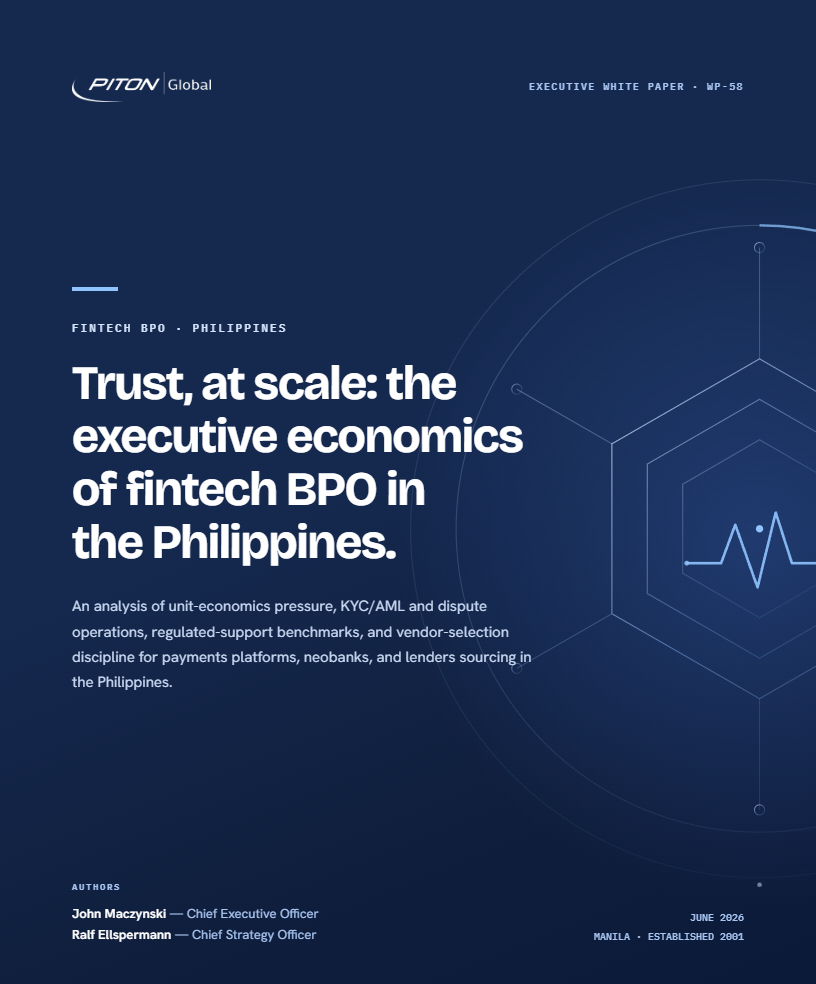
Trust, at Scale — Fintech BPO in the Philippines
An analysis of unit-economics pressure, KYC/AML and dispute operations, regulated-support benchmarks, and vendor-selection discipline for payments platforms, neobanks, and lenders sourcing in the Philippines. Volume 4 of PITON-Global’s 20-part Executive White Paper Series, by John Maczynski and Ralf Ellspermann.
Independent coverage. Third-party validation.
What fintech leaders ask before outsourcing risk and support.
In-depth answers to the questions that decide a fintech BPO engagement — from the principals who run them.